
10 Main Reasons Why Slab Cracks Occur - Explained in Detail

Concrete slabs are foundational elements in residential, commercial, and industrial construction. While concrete is known for its strength and durability, it is not immune to cracking. Cracks in slabs can lead to structural issues, aesthetic concerns, and even safety hazards.
1. Poor Subgrade Preparation
One of the most common reasons for slab cracking is inadequate subgrade preparation. The subgrade acts as the foundation for the concrete slab. If it's not compacted properly or has inconsistent moisture levels, it can cause the slab to settle unevenly after pouring.
- Uneven compaction leads to weak spots.
- Organic material or debris in the subgrade can decompose, creating voids.
- Differential settlement exerts uneven stress on the concrete.
Proper soil testing, compaction, and moisture control are critical steps that must be taken before pouring the concrete.
2. Excess Water in the Mix
A high water-to-cement ratio is a major contributor to slab cracks. While more water makes the mix easier to pour and finish, it compromises strength and durability.
- Excess water weakens the concrete paste, leading to shrinkage.
- As water evaporates, it leaves behind tiny voids, increasing the risk of cracking.
- Plastic shrinkage cracks often appear within hours after pouring due to water evaporation.
Contractors should always follow the recommended mix design, avoiding overwatering at all costs.
3. Rapid Drying of Concrete
Rapid moisture loss during curing can result in cracks known as shrinkage cracks. This typically occurs in hot, windy, or low-humidity environments.
- When surface moisture evaporates faster than the concrete can hydrate, tensile stress builds up.
- This results in surface cracks that can weaken the slab over time.
Using curing compounds, water-retaining blankets, or continuous water spray during the curing process is essential to maintain adequate moisture levels.
4. Inadequate Control Joints
Control joints are deliberately placed lines or cuts that allow concrete to crack in a controlled manner. Without them, the slab will crack randomly as it shrinks.
- Improper spacing or shallow cuts lead to ineffective crack control.
- Joints should be placed at intervals of 24-36 times the slab thickness.
- Timing is critical - joints must be cut before the concrete hardens completely.
Neglecting proper joint planning is a recipe for random slab cracking.
5. Overloading the Slab
Slabs are designed for specific load capacities. When these are exceeded - such as by placing heavy machinery or storage racks - cracks can develop.
- Point loads and distributed loads both contribute to stress.
- Without reinforcement, overloaded slabs are prone to failure.
- Structural engineers must assess the expected usage of the slab during the design phase.
Always ensure slabs are engineered to meet or exceed the intended load to prevent structural cracking.
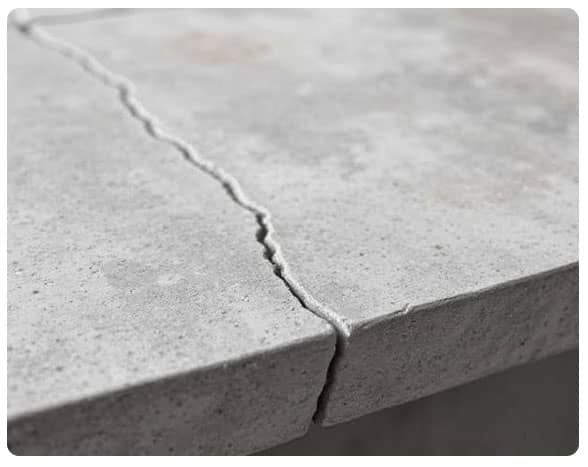
6. Thermal Expansion and Contraction
Concrete naturally expands and contracts with temperature changes. If these movements are restrained by walls, columns, or other structures, stress builds up and leads to cracks.
- Cracks from thermal movement are often diagonal or random.
- Expansion joints are essential to accommodate this movement.
- These joints should be strategically placed to relieve stress.
Ignoring thermal dynamics can compromise both the integrity and lifespan of a concrete slab.
7. Corrosion of Reinforcement
If moisture penetrates the concrete and reaches the steel reinforcement, corrosion begins, leading to rust expansion and cracking.
- Rust occupies more volume than steel, exerting internal pressure.
- This causes spalling, where pieces of concrete break off.
- Chloride-rich environments, such as near roads or coastlines, accelerate corrosion.
Using epoxy-coated rebar, corrosion inhibitors, and quality sealants can help mitigate this issue.
8. Freeze-Thaw Cycles
In colder climates, freeze-thaw cycles are a significant cause of slab cracking. Water entering the pores of concrete freezes and expands, exerting internal pressure.
- Repeated cycles weaken the matrix and cause scaling or cracking.
- Proper air-entrained concrete allows space for expanding ice.
- Sealing the concrete can prevent water ingress.
Ignoring freeze-thaw resistance leads to premature surface degradation and structural cracks.
9. Tree Roots and Vegetation
Slabs built near large trees or aggressive vegetation are at risk of cracking from root growth.
- Roots exert upward pressure, causing the slab to lift and crack.
- Fine root systems can infiltrate cracks or joints, worsening the problem.
- Removing or managing root growth before construction is critical.
Invasive plant species must be kept at bay to preserve the slab's stability over time.
10. Poor Workmanship and Construction Practices
Ultimately, poor execution on the construction site can undermine even the best designs. Common workmanship errors include:
- Inconsistent slab thickness
- Poor finishing techniques that seal the surface too early
- Lack of reinforcement placement accuracy
These issues often lead to premature failure and unnecessary cracking. Hiring qualified professionals and following best practices is essential to avoid these costly errors.
Conclusion: Prevention Is Better Than Repair
Understanding the underlying causes of slab cracking empowers property owners, engineers, and builders to take proactive steps in preventing structural issues. Whether it's ensuring proper subgrade preparation, maintaining moisture during curing, or planning for thermal expansion, attention to detail is the key to long-lasting concrete slabs.
Please watch the following short video for Main Reasons Why Slab Cracks Occur