
Flexural Strength of Concrete: Comprehensive Guide to Its Importance, Testing, and Factors Influencing It
What is Flexural Strength of Concrete?
Flexural strength of concrete, also known as modulus of rupture, refers to the ability of a concrete beam or slab to resist failure in bending. It is a critical property in structural design, particularly for pavements, beams, and slabs where tensile stresses from bending are significant. Typically expressed in megapascals (MPa) or pounds per square inch (psi), flexural strength is an indirect measure of the tensile strength of concrete.
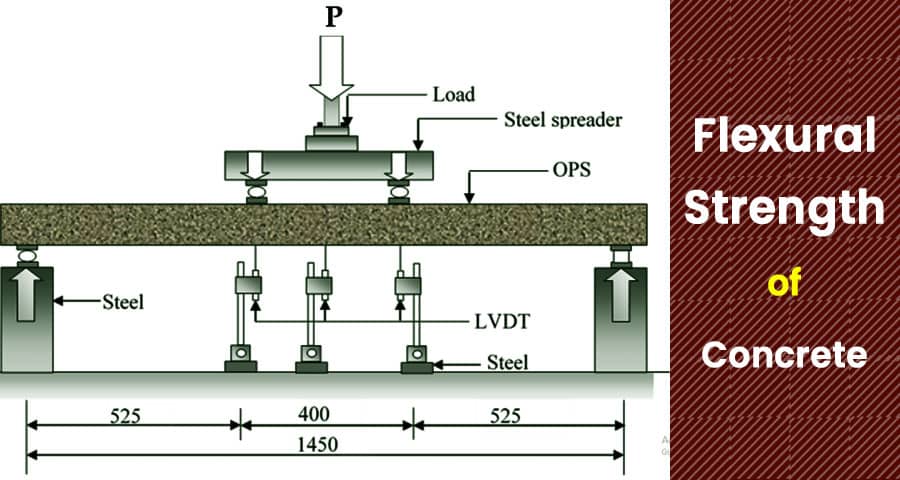
Unlike compressive strength, which is tested using cylindrical or cube specimens, flexural strength evaluates how much load a concrete member can carry before breaking under bending forces. The standard test methods include the third-point loading test and the center-point loading test as per ASTM and IS standards.
Why Flexural Strength Matters in Concrete Structures
In many real-world applications, such as roadways, airport runways, bridges, industrial floors, and tunnel linings, concrete is subjected to bending and tensile forces. Relying solely on compressive strength can lead to an underestimation of actual stress behavior, potentially resulting in premature cracking or failure.
Key reasons flexural strength is vital:
- Prevents crack propagation in concrete slabs and beams.
- Enhances durability under dynamic and fatigue loading.
- Determines slab thickness for pavements and industrial floors.
- Supports load distribution across reinforcements.
- Ensures safety in earthquake-resistant and pre-stressed structures.
Standard Testing Methods for Flexural Strength of Concrete
1. ASTM C78 - Third-Point Loading Test
This is the most common test method used for determining the modulus of rupture.
- Specimen Size: 150 mm x 150 mm x 500 mm (6" x 6" x 20")
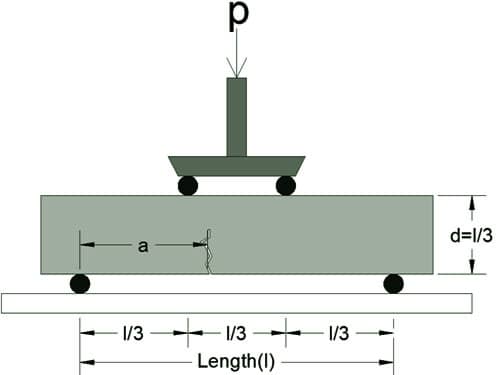
- Procedure: The beam is placed on two supports and loaded at two points that divide the span into three equal parts.
- Formula:
R = P . L / b . d2
Where:
- R = Flexural strength in MPa
- P = Applied load in N
- L = Length of the span in mm
- b = Width of the beam in mm
- d = Depth of the beam in mm
2. ASTM C293 - Center-Point Loading Test
Used for comparative studies where stress concentration is to be analyzed.
- Procedure: Similar beam dimensions are used, but load is applied at the center.
- Results are generally higher than third-point test due to lower stress distribution.
3. IS 516:1959 - Indian Standard Flexural Test
The Indian standard test follows procedures close to ASTM C78 but emphasizes local aggregate and cement properties. The beam size is 100 mm x 100 mm x 500 mm, and loading is done over a 400 mm span.
Typical Values of Flexural Strength
Flexural strength is approximately 10% to 20% of compressive strength, depending on the mix.
| Concrete Grade | Compressive Strength (MPa) | Flexural Strength (MPa) |
|---|---|---|
| M20 | 20 | 3.0 - 3.5 |
| M25 | 25 | 3.5 - 4.0 |
| M30 | 30 | 4.5 - 5.0 |
| M40 | 40 | 5.0 - 6.0 |
Factors Influencing Flexural Strength of Concrete
1. Water-Cement Ratio
A lower water-cement ratio results in higher flexural strength due to reduced porosity and better paste quality.
2. Aggregate Type and Size
- Angular aggregates provide better interlock, improving strength.
- Maximum aggregate size should be optimized. Larger aggregates reduce cement requirement but may create stress concentrations.
3. Cement Content and Type
High-quality cement and supplementary cementitious materials like fly ash, silica fume, or slag cement enhance flexural strength.
4. Curing Conditions
Proper curing maintains moisture and temperature, which is essential for hydration. Improper curing leads to micro-cracking and reduced strength.
5. Concrete Age
Flexural strength increases with age, typically gaining up to 90% of its final strength by 28 days and more thereafter.
6. Admixtures
Superplasticizers improve workability without increasing water content, while retarders, accelerators, and air entrainers modify strength characteristics.
7. Fiber Reinforcement
Inclusion of steel fibers, glass fibers, or polypropylene fibers significantly improves flexural performance, especially post-crack behavior.
Design Considerations Based on Flexural Strength
In pavement design, the flexural strength is directly used in fatigue and stress ratio analysis. Slab thickness, reinforcement spacing, and subgrade modulus are all influenced by it.
In structural design, the modulus of rupture helps determine moment capacity, cracking behavior, and deflection limitations.
Key design formulas:
- Modulus of Rupture (MR):
MR = fr / γ
Where fr is the flexural strength and γ is the safety factor.
- Allowable Stress Design:
Mallowable = fr . S
Where S is the section modulus.
Enhancing Flexural Strength in Practice
To achieve superior flexural strength, several strategies can be implemented:
- Use high-performance concrete (HPC) mixes.
- Apply surface treatments to reduce crack initiation.
- Incorporate fiber reinforcement for crack-bridging capability.
- Perform post-tensioning or pre-stressing to introduce compressive stresses countering tensile forces.
- Ensure quality control during mixing, placing, and curing.
Comparison Between Flexural and Compressive Strength
| Property | Flexural Strength | Compressive Strength |
|---|---|---|
| Resistance to | Bending (Tensile stress) | Crushing (Compressive stress) |
| Typical Test | Beam test (third-point) | Cube or cylinder test |
| Common Values | 3 - 6 MPa | 20 - 60 MPa |
| Importance in Design | Pavements, slabs, beams | Columns, footings, walls |
Common Failures in Flexural Testing
Understanding failure modes is crucial:
- Shear failure due to inadequate depth.
- Compression zone crushing when the top fibers reach compressive limits.
- Sudden cracking in the tension zone indicating brittle behavior.
- Load misalignment or improper curing leading to premature failure.
Conclusion
The flexural strength of concrete is a cornerstone parameter in modern structural and pavement engineering. It ensures that concrete structures can withstand tensile and bending stresses effectively, preventing catastrophic failures and long-term damage. With proper testing, material selection, and design approaches, flexural performance can be optimized to meet the demands of today's infrastructure.
Please watch the following short video for Flexural Strength of Concrete