
Rate Analysis for Concrete: A Comprehensive Guide
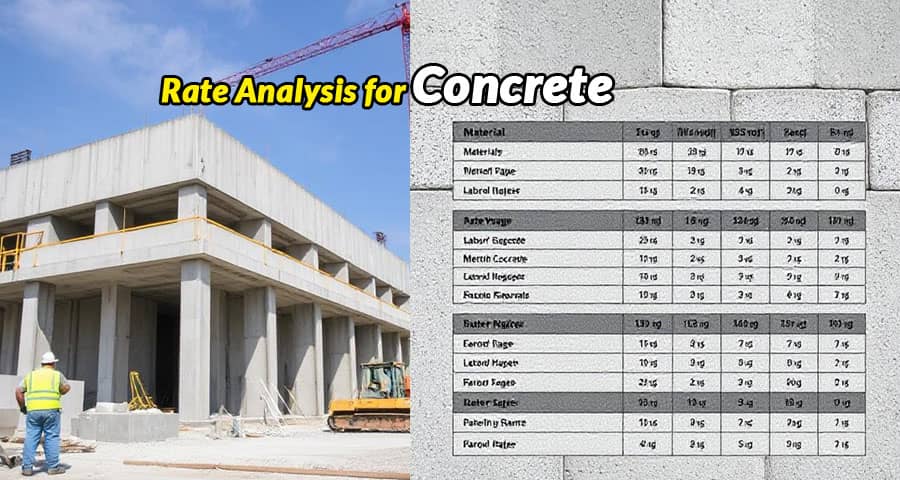
Concrete is the backbone of modern construction, and understanding its rate analysis is crucial for accurate cost estimation, budgeting, and project execution. In construction, rate analysis not only helps determine the unit cost of concrete but also ensures efficient resource allocation for labor, material, equipment, and overheads.
What is Rate Analysis of Concrete?
Rate analysis of concrete is the method of calculating the per cubic meter cost of concrete by considering all resources involved in its production and placement. This includes:
- Materials (cement, sand, aggregates, water, admixtures)
- Labor charges (mixing, placing, compacting, curing)
- Equipment and machinery (mixers, vibrators, pumps)
- Overheads and contractor's profit
The analysis helps engineers, contractors, and project managers to determine the most economical approach while ensuring quality and safety standards.
Key Materials Required for Concrete Rate Analysis
1. Cement
Cement is the primary binding material in concrete. Its consumption depends on the grade of concrete (M20, M25, M30, etc.). For instance:
- M20 concrete (1:1.5:3 mix) requires approx. 8 bags of cement per cubic meter.
- Each bag of cement = 50 kg = 0.0347 cubic meter.
2. Fine Aggregate (Sand)
Sand fills the voids between coarse aggregates and ensures workability. Generally, 0.44 m3 of sand is required per m3 of M20 concrete.
3. Coarse Aggregate
Coarse aggregates provide strength and durability. Around 0.88 m3 of stone chips are needed for one cubic meter of M20 grade concrete.
4. Water
Water ensures proper hydration and workability. The water-cement ratio generally ranges from 0.45 to 0.55, depending on the mix design.
5. Admixtures (Optional)
Superplasticizers or retarders may be added to enhance workability and durability. Their cost is typically considered at 1 - 2% of cement cost.
Labor Requirement in Concrete Work
Labor plays a vital role in mixing, placing, vibrating, and curing concrete. For 1 m3 of concrete, the approximate labor requirement is:
- Mason - 1 Nos.
- Helper/Labour - 2 Nos.
- Coolie/Unskilled labor - 2 Nos.
- Water carrier - 1 Nos.
Labor cost varies depending on region, but it typically constitutes 15 - 20% of total concrete cost.
Equipment and Machinery Costs
For medium to large projects, equipment cost is included in the analysis. Common equipment includes:
- Concrete Mixer (0.25 - 0.3 m3 capacity)
- Needle Vibrator (40mm or 60mm)
- Transit Mixer (for RMC supply)
The equipment charge is usually calculated as a rental cost per m3 of concrete, averaging around ₹200 - ₹300 per m3.
Step-by-Step Rate Analysis of M20 Concrete (1:1.5:3 Mix)
Let us calculate the rate analysis of 1 m3 of M20 grade concrete:
1. Material Calculation
- Cement = 1 Part
- 1 / (1+1.5+3) = 1/5.5 = 0.182
- Cement = 0.182 x 1.54 m3 x 1440 = 405 kg = 8.1 bags
- Sand = 1.5 Parts
- 1.5/5.5 x 1.54 = 0.42 m3
- Aggregate = 3 Parts
- 3/5.5 x 1.54 = 0.84 m3
2. Material Cost Estimation (Assuming market rates)
- Cement: 8.1 bags x ₹380 = ₹3078
- Sand: 0.42 m3 x ₹1200 = ₹504
- Aggregate: 0.84 m3 x ₹1000 = ₹840
- Water + Admixture: ₹100
Total Material Cost = ₹4522
3. Labor Charges
- Mason: ₹600
- Helpers & Laborers: ₹1200
- Water Carrier: ₹300
Total Labor Cost = ₹2100
4. Equipment Cost
- Mixer + Vibrator charges = ₹250
5. Overheads & Contractor's Profit (15%)
(₹4522 + ₹2100 + ₹250) x 15% = ₹1030
6. Grand Total Cost of 1 m3 Concrete (M20)
= ₹4522 + ₹2100 + ₹250 + ₹1030 = ₹7902 / m3
Rate Analysis for Different Grades of Concrete
The cost of concrete varies with grade:
- M15 (1:2:4) → Lower cement consumption → ~₹6500/m3
- M20 (1:1.5:3) → Medium strength → ~₹7900/m3
- M25 (1:1:2) → Higher cement requirement → ~₹8800/m3
- M30 and above (Design Mix) → Requires mix design → ₹9500 - ₹11,000/m3
Factors Affecting Rate Analysis of Concrete
Several factors influence the final rate of concrete:
- Location and material availability - Transport cost of aggregates and sand can vary widely.
- Labor wages - Different states have different minimum wage structures.
- Mix type - Nominal mix vs. design mix affects cement consumption.
- Site conditions - Manual mixing vs. Ready Mix Concrete (RMC).
- Project size - Bulk procurement reduces material cost.
- Admixtures and curing methods - Advanced admixtures increase cost but improve performance.
Ready Mix Concrete (RMC) vs. Site Mix Rate Analysis
- RMC is costlier (₹7000 - ₹9500/m3) but ensures consistent quality, faster work, and less wastage.
- Site Mix Concrete is cheaper but labor-intensive, prone to human errors, and quality may vary.
For large-scale projects, RMC is more economical in the long run despite higher initial cost.
Conclusion
Understanding the rate analysis for concrete is essential for cost estimation, budgeting, and execution of any construction project. From raw materials to labor and overheads, every element must be carefully considered to achieve both economical and durable concrete construction. By performing accurate rate analysis, engineers can ensure financial control while maintaining structural quality.
Please watch the following short video for Rate Analysis for Concrete in INDIA
Also Read:
 Types of Drawings used in House Construction Industry