
All About Door Hinges and Its Types

When it comes to architectural hardware, door hinges play a crucial yet often overlooked role. These small mechanical devices are responsible for the smooth and reliable operation of doors in residential, commercial, and industrial settings. Choosing the right type of hinge not only ensures functionality but also enhances the aesthetic appeal and durability of the door system.
What Is a Door Hinge?
A door hinge is a mechanical bearing that connects two solid objects - typically a door and a frame - allowing for limited rotation between them. Most hinges operate by allowing the door to swing open or closed along a fixed axis.
Main Components of a Door Hinge:
- Leaf Plates: Two flat metal plates that are attached to the door and frame.
- Knuckle: The central cylindrical part formed by alternating loops of each leaf.
- Pin: A rod inserted through the knuckle to hold the leaves together and allow rotation.
- Finial: Decorative tip at the ends of the pin, especially in ornate designs.
Why the Right Door Hinge Matters
Choosing the right hinge ensures:
- Smooth operation
- Long-term durability
- Load-bearing capability
- Aesthetic coherence
- Security enhancement
Types of Door Hinges
1. Butt Hinges
One of the most commonly used hinges, butt hinges consist of two identical leaves, one attached to the door and the other to the frame.
Applications:
- Residential interior and exterior doors
- Cabinets and closets
Advantages:
- High strength
- Simple installation
- Available in various finishes
2. Ball Bearing Hinges
Designed for heavy-duty doors, ball bearing hinges include ball bearings between the knuckles to reduce friction.
Applications:
- Commercial entry doors
- Steel or solid core doors
Advantages:
- Smooth operation
- Quiet performance
- Long-lasting
3. Continuous Hinges (Piano Hinges)
These hinges run the full length of the door, offering uniform support along the entire edge.
Applications:
- Pianos
- Storage chests
- Industrial enclosures
Advantages:
- Distributes weight evenly
- Prevents door sagging
- Excellent for high-use areas
4. Concealed Hinges
Also known as European hinges, these are hidden when the door is closed, offering a sleek, modern look.
Applications:
- Kitchen cabinets
- Modular furniture
Advantages:
- Aesthetic appeal
- Adjustable in multiple directions
- Soft-close features available
5. Pivot Hinges
These hinges are mounted at the top and bottom of a door rather than on the side, allowing the door to rotate from a central axis.
Applications:
- Heavy entrance doors
- Frameless glass doors
Advantages:
- Distributes weight more efficiently
- Allows wider swing
- Ideal for upscale designs
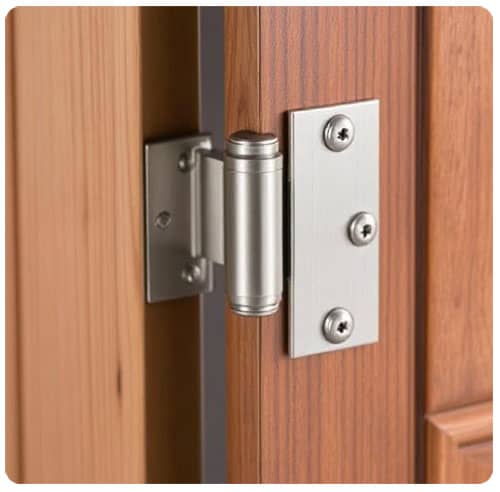
6. Spring Hinges
Built with a spring mechanism, these hinges allow automatic door closing. Common in commercial spaces, they serve as a self-closing solution.
Applications:
- Office doors
- Fire-rated doors
- Restroom doors
Advantages:
- Maintains privacy and temperature
- Enhances fire safety
- Reduces noise
7. Strap Hinges
Featuring long leaf plates, strap hinges are both functional and decorative, commonly used in rustic or antique-style architecture.
Applications:
- Gates
- Barn doors
- Decorative wooden doors
Advantages:
- Strong load-bearing capacity
- Adds vintage charm
- Highly visible aesthetic
8. Flush Hinges
Flush hinges allow one leaf to fit inside the other, making them ideal for lightweight doors where minimal space is available.
Applications:
- Cupboards
- Small cabinets
Advantages:
- Minimal projection
- Easy to install
- Economical choice
9. Offset Hinges
These hinges allow the door to swing completely clear of the frame, increasing the width of the opening.
Applications:
- Handicap-accessible doors
- Medical facilities
- Churches
Advantages:
- Increases clearance space
- Ideal for accessibility
- Quick installation
Materials Used in Door Hinges
The performance and longevity of a hinge depend significantly on its material composition. Below are the most common materials used:
Stainless Steel
- Corrosion-resistant
- Suitable for exterior doors
- Durable under extreme conditions
Brass
- Attractive golden finish
- Resists tarnish
- Ideal for luxury interiors
Bronze
- Rustic appeal
- Excellent corrosion resistance
- Suitable for marine environments
Zinc Alloy
- Economical
- Lightweight
- Good for indoor use
Aluminum
- Lightweight and rust-resistant
- Used in low-traffic or budget-sensitive applications
Factors to Consider When Choosing a Door Hinge
To select the right hinge, keep the following in mind:
- Weight of the door: Heavier doors require more robust hinges like ball bearing or pivot hinges.
- Frequency of use: High-traffic areas benefit from continuous or spring hinges.
- Aesthetic preferences: For modern spaces, concealed hinges offer a seamless look.
- Environmental conditions: Use stainless steel or bronze in coastal or humid locations.
- Fire safety requirements: Opt for spring-loaded or fire-rated hinges in accordance with building codes.
Specialty Door Hinges
Double Action Hinges
These allow the door to swing in both directions and return to center automatically.
Best For:
- Kitchen doors in restaurants
- Saloon-style doors
Lift-Off Hinges
Designed to easily remove the door without unscrewing the hinge. Commonly used in maintenance-heavy environments.
Best For:
- Machine enclosures
- Rooms requiring periodic access
Installation Tips for Door Hinges
- Always use appropriate screw length based on the door thickness.
- Ensure precise alignment of hinge leaves for smooth operation.
- Use shims or spacers if the frame is uneven.
- Pre-drill pilot holes to prevent wood splitting.
- For heavier doors, three or more hinges are recommended.
Maintenance of Door Hinges
Proper care extends the life and performance of hinges:
- Lubricate regularly with oil or silicone spray.
- Tighten screws periodically to avoid sagging.
- Inspect for rust or wear and replace if necessary.
- Clean with mild detergent to preserve the finish.
Conclusion
Door hinges are more than just mechanical connectors - they're pivotal in ensuring the functionality, safety, and elegance of any structure. With a wide range of types, materials, and designs available, selecting the right hinge for your application can significantly improve the longevity and performance of your door systems.
By understanding the nuances and capabilities of different hinge types, we empower ourselves to make better architectural and functional choices for both residential and commercial environments.
Please watch the following short video for Door Hinges
Also Read:
 Fire Resistance in Concrete