
Types of Brick Bonds in Masonry Construction: A Complete Guide to English Bond, Flemish Bond, and More

Brick masonry is one of the oldest and most enduring forms of construction, offering strength, durability, and architectural appeal. Among the various aspects of masonry, the type of brick bond plays a pivotal role in determining not only the structural stability but also the aesthetic value of a building.
What is a Brick Bond?
A brick bond refers to the pattern in which bricks are laid in a masonry wall. It ensures load distribution, interlocking, and visual symmetry. The bond type chosen influences the strength, cost, material efficiency, and appearance of the structure.
1. English Bond: The Strongest Brick Bond
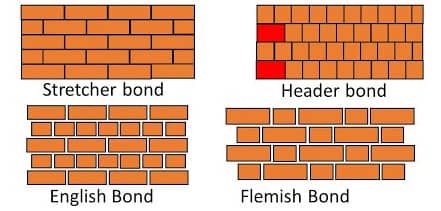
The English bond is one of the most commonly used and structurally sound bonds in brick masonry. It alternates headers and stretchers in each course.
Characteristics of English Bond
- Alternate courses of headers and stretchers.
- Vertical joints in alternate courses are aligned.
- Provides maximum strength and load-bearing capacity.
- Typically used in thick walls (above 1 1/2 brick thick).
Advantages
- Superior structural integrity.
- Ideal for foundations and load-bearing walls.
- Simpler bonding pattern aids in quick construction.
Applications
- Retaining walls
- Bridge abutments
- Thick structural walls in buildings
2. Flemish Bond: Aesthetic and Efficient
The Flemish bond, also known as the Dutch bond, is known for its decorative pattern that mixes stretchers and headers in the same course.
Types of Flemish Bond
- Single Flemish Bond: Combines Flemish bond on the face with English bond backing, ideal when strength and appearance are both required.
- Double Flemish Bond: Headers and stretchers alternate in every course on both faces, offering symmetry and visual appeal.
Features
- Each course contains alternate headers and stretchers.
- The headers are placed centrally over the stretchers in the course below.
Advantages
- Better aesthetic appearance.
- Suitable for exposed brickworks.
- Uniform load distribution.
Limitations
- Requires skilled labor.
- Slightly more expensive than English bond due to increased cutting and labor.
3. Stretcher Bond: Common in Partition Walls
The Stretcher bond consists of bricks laid only as stretchers, with each brick overlapping the one below it halfway.
Usage
- Suitable for walls of half-brick thickness.
- Commonly used in interior walls, partition walls, and non-load bearing structures.
Advantages
- Easy to lay and economical.
- Minimum wastage of materials.
Disadvantages
- Not ideal for load-bearing structures.
- Offers limited strength compared to other bonds.
4. Header Bond: Compact and Strong
In a header bond, all bricks are laid with their ends (headers) facing the wall face. This bond is ideal for walls with more than one brick thickness.
Key Features
- Shorter bonding length.
- Effective for curved structures like wells and arches.
Benefits
- Strong transverse bonding.
- Preferred where wall thickness is more.
5. Stack Bond: Modern and Visual Appeal
The stack bond places bricks directly on top of each other, with joints aligned vertically and horizontally. It is mainly used for decorative purposes.
Applications
- Used in cladding, feature walls, and non-load bearing facades.
- Provides a clean and contemporary look.
Downsides
- Weak interlocking, hence not suitable for load-bearing walls.
- May require reinforcement to improve stability.
6. English Cross Bond: Enhanced Variation
The English cross bond is a modification of the English bond, where stretchers in every stretcher course are centered on the stretchers below.
Highlights
- Provides a neater alignment.
- Offers aesthetic symmetry.
- Retains the strength of traditional English bond.
7. Zigzag Bond: For Decorative Flooring
The zigzag bond is a non-structural decorative bond used mainly in flooring and paving. Bricks are laid in a zigzag pattern, enhancing visual interest.
Key Points
- Best suited for pathways, courtyards, and landscapes.
- Offers excellent drainage and non-slip properties.

8. Garden Wall Bonds: Strength with Style
There are multiple variations of garden wall bonds, combining strength and appearance for garden boundary walls and parapets.
Types
- English Garden Wall Bond: Three stretchers between each header.
- Flemish Garden Wall Bond: Alternating headers and stretchers, but with three stretchers between headers.
Benefits
- Reduces brick consumption.
- Moderate strength suitable for low-height walls.
Choosing the Right Bond: A Practical Guide
| Bond Type | Strength | Aesthetics | Best Used For |
|---|---|---|---|
| English Bond | High | Medium | Foundations, load-bearing walls |
| Flemish Bond | Medium | High | Exposed walls, aesthetics |
| Stretcher Bond | Low | Low | Partition walls |
| Header Bond | High | Low | Curved walls, thicker structures |
| Stack Bond | Very Low | High | Decorative facades, interiors |
| English Cross Bond | High | Medium | Strong and aligned walls |
| Garden Wall Bond | Medium | Medium | Boundary walls |
Conclusion: Mastering Brick Construction with the Right Bond
In masonry construction, selecting the appropriate brick bond is vital for achieving strength, durability, and design goals. Whether you need a load-bearing wall with high strength like the English bond, or a visually appealing façade with a Flemish bond, understanding the properties and applications of each bond empowers smarter decisions during construction.
Proper workmanship, brick alignment, and joint filling also play crucial roles in the performance of brickwork. Always ensure skilled labor is employed to realize the full benefits of any chosen bond.
<Please view the following short video for Types of Brick Bonds in Masonry Construction: A Complete Guide to English Bond, Flemish Bond, and More/p>