
What is Under-Reamed Pile Foundation, Uses, Advantages & Disadvantages
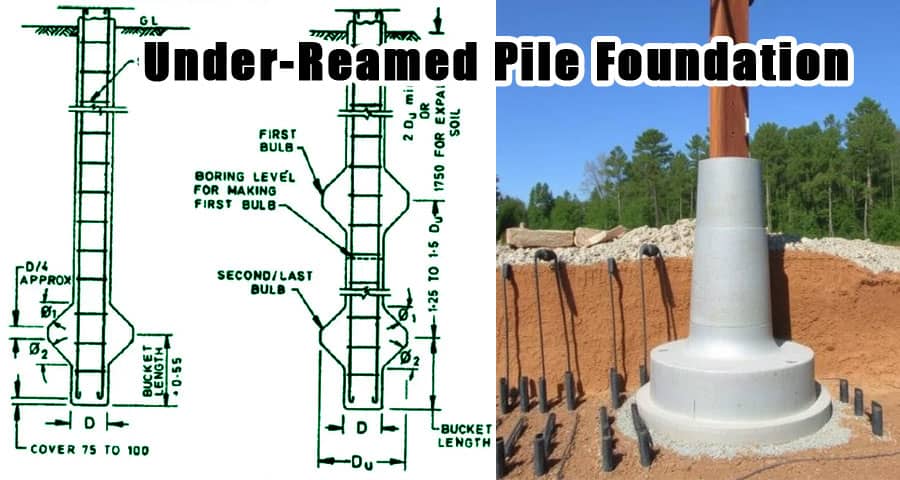
Under-reamed pile foundation is a specialized type of deep foundation predominantly used in regions with expansive clay soils. These soils exhibit significant volume changes due to moisture variation, which leads to instability in traditional shallow foundations. To overcome this, under-reamed piles are constructed with bulb-shaped enlargements (called under-reams) at one or more levels below the ground surface, enhancing load-bearing capacity and resistance to uplift forces.
What is Under-Reamed Pile Foundation?
An under-reamed pile is a cast-in-situ concrete pile with one or more bulbs (under-reams) formed at its base or along the shaft. These bulbs act like anchors, offering superior stability in expansive or shrink-swell soils such as black cotton soil. The standard diameter of an under-reamed pile ranges between 200 mm to 500 mm, with bulb diameters typically 2.5 times the shaft diameter.
The construction involves boring a vertical hole using a spiral auger and then deploying a special under-reaming tool to form the bulbs. Once excavation is complete, the hole is filled with concrete, and reinforcement is inserted if required.
Uses of Under-Reamed Pile Foundations
Under-reamed piles are widely adopted in civil engineering and infrastructure projects due to their adaptability to difficult soil conditions. Here are the key applications:
Residential and Low-Rise Buildings
Under-reamed piles are ideal for residential buildings in black cotton soil areas, where seasonal moisture variation causes heavy ground movement.
Telecommunication and Transmission Towers
These piles are extensively used to anchor transmission towers, masts, and poles, providing resistance against uplift and lateral forces due to wind.
Industrial Structures
In factories or warehouses built on unstable or loose soils, under-reamed piles provide the needed load support and prevent settlement-related issues.
Bridges and Flyovers
They are employed in the substructures of bridges and flyovers, especially in areas prone to soil expansion, enhancing durability and minimizing differential settlement.
Pumping Stations and Water Tanks
Under-reamed piles provide necessary anchorage and reduce uplift risk in water-saturated soils where traditional foundations may fail.
Construction Process of Under-Reamed Pile Foundation
The construction process involves precise steps to ensure structural integrity and performance:
- Site Investigation: Conduct thorough soil testing to determine soil type, depth of expansive strata, and water table level.
- Boring the Hole: Use an auger to bore a vertical hole to the required depth.
- Formation of Bulbs: Deploy the under-reaming tool to excavate bulb-shaped enlargements at predetermined depths.
- Reinforcement Placement: Insert the steel reinforcement cage into the bored hole.
- Concreting: Pour concrete into the borehole using a tremie pipe to avoid segregation.
- Curing: After concreting, proper curing ensures strength development.
Advantages of Under-Reamed Pile Foundations
Under-reamed pile foundations offer multiple technical and economic benefits:
Excellent Uplift Resistance
The bulb-shaped enlargements provide anchorage, making the system highly effective in resisting uplift forces from swelling soils or hydrostatic pressure.
High Load-Bearing Capacity
Under-reamed piles transfer loads deep into stable soil layers, enabling support for heavier structures with reduced pile length compared to straight-shaft piles.
Economical Solution
Due to reduced length and fewer piles required, the overall cost of the foundation can be significantly lower than traditional pile systems.
Suitable for Expansive Soils
They are specifically designed to combat shrink-swell behavior in expansive soils, minimizing differential settlement risks.
Minimal Site Disturbance
Under-reamed pile installation causes less noise and vibration, making it suitable for urban and sensitive areas.
Customizable Design
The number of bulbs and depth of piles can be customized according to load requirements and soil profile, offering flexibility in design.
Disadvantages of Under-Reamed Pile Foundations
Despite numerous advantages, there are some limitations associated with under-reamed pile foundations:
Limited Applicability in Hard Strata
The formation of bulbs is not feasible in rocky or very hard soils, which restricts its usage in such terrains.

Skilled Labor Requirement
Construction requires specialized equipment and trained personnel for accurate bulb formation and concreting.
Water Table Challenges
High water tables can hinder the process of boring and under-reaming, necessitating dewatering and special construction techniques.
Not Ideal for High-Rise Buildings
For structures requiring deep foundations with very high loads, other piling systems like bored cast-in-situ piles or driven piles may be more appropriate.
Quality Control Dependence
Any deviation in borehole size, bulb shape, or reinforcement placement can significantly affect performance, thus requiring strict quality assurance.
Design Considerations for Under-Reamed Piles
To ensure optimal performance, design should be based on:
- Safe bearing capacity of soil
- Depth of expansive soil strata
- Number and size of bulbs
- Spacing between piles
- Type of superstructure
- Uplift and lateral force requirements
The Indian Standard IS 2911 (Part 3) offers comprehensive guidelines for the design and execution of under-reamed pile foundations.
Comparison with Other Pile Foundations
| Parameter | Under-Reamed Pile | Straight Bored Pile | Driven Pile |
|---|---|---|---|
| Soil Suitability | Expansive clay soils | All soils (excluding hard rock) | Alluvial and loose soils |
| Load Capacity | Moderate to High | High | Very High |
| Uplift Resistance | Excellent | Moderate | Low |
| Construction Cost | Economical | Expensive | Costly |
| Equipment Required | Specialized tools for bulbs | Standard boring rigs | Driving hammers |
Conclusion
Under-reamed pile foundations are a technically sound and cost-effective solution for buildings and structures built on expansive soils. Their unique bulb configuration enhances stability, resists uplift forces, and ensures longevity of the structure. Despite certain limitations, when used under appropriate site conditions and with proper supervision, under-reamed piles deliver excellent performance and durability.
If you are planning a project in challenging soil conditions, under-reamed piles offer a reliable and proven foundation system that safeguards structural integrity and optimizes construction cost.
Please watch the following short video for Under-Reamed Pile Foundation