
What Is Bitumen and Its Types
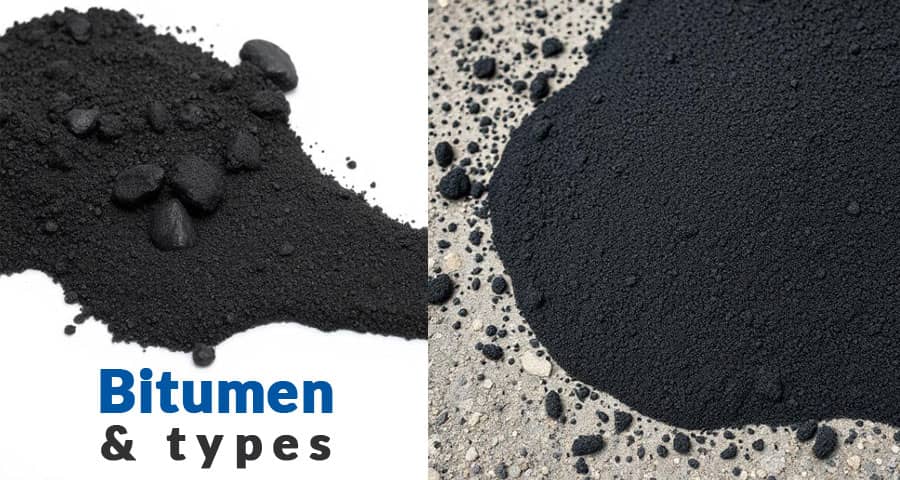
Bitumen is a versatile, black, sticky, and highly viscous liquid or semi-solid form of petroleum. It plays a crucial role in construction, particularly in road construction, waterproofing, and roofing applications. Bitumen is primarily used as a binder in asphalt concrete, offering excellent adhesion, durability, and resistance to water and environmental degradation.
What Is Bitumen?
Bitumen is a hydrocarbon compound derived either naturally or as a by-product of crude oil distillation. It is insoluble in water, highly adhesive, and waterproof, making it ideal for road construction and sealing purposes.
Chemically, bitumen contains complex hydrocarbons and minerals such as sulphur, nitrogen, oxygen, and heavy metals. It remains thermoplastic, meaning it softens upon heating and hardens upon cooling, enabling flexible application methods.
Properties of Bitumen
Understanding the physical and chemical properties of bitumen is essential to determining its suitability for different applications. The key characteristics include:
- Adhesiveness: Strong binding capability with aggregates.
- Waterproofing Ability: Impermeable to water.
- Ductility: Flexibility under stress or temperature changes.
- Viscosity: Resistance to flow at different temperatures.
- Durability: Long-lasting and resistant to weathering.
- Temperature Susceptibility: Performance varies with temperature range.
Classification of Bitumen
Bitumen can be broadly classified into two categories:
1. Natural Bitumen
Natural bitumen, also known as asphaltite or gilsonite, occurs in nature as a result of the gradual transformation of petroleum deposits over millions of years.
Types of Natural Bitumen
- Rock Asphalt: Bitumen impregnated in porous rocks like limestone or sandstone. It is used in pavements and roofing applications.
- Gilsonite: A natural resinous hydrocarbon found primarily in the United States. It is hard, brittle, and soluble in aromatic solvents, often used in inks, paints, and as an additive in asphalt.
- Tar Sands/Bituminous Sands: A mixture of clay, sand, water, and bitumen. Found predominantly in Canada and Venezuela, it is a major source of unconventional petroleum.
2. Refined Bitumen (Petroleum Bitumen)
Refined bitumen is obtained from the distillation of crude oil. It is the most widely used type in construction and paving due to its controlled composition and availability.
Types of Bitumen Based on Penetration Grade
Penetration grade bitumen is classified according to the depth (in tenths of a millimeter) a standard needle penetrates into a sample under specified conditions.
Common Penetration Grades:
- 30/40 Penetration Grade: Harder grade, suitable for hot climates.
- 60/70 Penetration Grade: Standard grade used in road construction.
- 80/100 Penetration Grade: Softer grade, suitable for cold climates.
These numbers indicate hardness, influencing application based on climate and traffic conditions.
Types of Bitumen Based on Viscosity Grade (VG Bitumen)
Viscosity grade classification is more reliable than penetration grading and has become the preferred method in many countries, including India.
Viscosity Grades:
- VG-10: Ideal for spraying applications and cold climates.
- VG-20: Suitable for moderately cold regions.
- VG-30: Most commonly used for road construction in hot and moderate climates.
- VG-40: Suitable for heavy traffic areas and hot weather conditions.
The higher the grade, the more viscous (thicker) the bitumen is.
Types of Bitumen Based on Performance Grade (PG Bitumen)
PG bitumen is classified based on its performance at various temperature extremes, both high and low.
Examples of PG Grades:
- PG 58-22: Performs well at 58°C (max) and -22°C (min).
- PG 64-22: Used in warmer climates.
- PG 76-10: Ideal for very hot regions.
This system is widely used in the United States and is part of the Superpave (Superior Performing Asphalt Pavements) system.
Modified Bitumen
To improve the performance and longevity of standard bitumen, it can be modified with polymers or rubber compounds.
Types of Modified Bitumen:
- Polymer Modified Bitumen (PMB): Includes polymers like SBS (Styrene-Butadiene-Styrene) or APP (Atactic Polypropylene). Provides improved elasticity, high-temperature resistance, and fatigue performance.
- Crumb Rubber Modified Bitumen (CRMB): Made by blending crumb rubber from recycled tires with bitumen. Enhances resilience, skid resistance, and durability.
Modified bitumen is used in high-stress areas, such as highways, bridges, and airport runways.
Emulsified Bitumen
Emulsified bitumen is a mixture of bitumen, water, and emulsifying agents. It allows bitumen to be applied at lower temperatures, making it environmentally friendly and safer to handle.
Types of Emulsions:
- Cationic Emulsions (Positive charge): Preferred in most applications due to better adhesion to negatively charged aggregates.
- Anionic Emulsions (Negative charge): Less commonly used.
Based on setting time:
- Rapid Setting (RS)
- Medium Setting (MS)
- Slow Setting (SS)
These are widely used in surface dressing, tack coating, and patch repairs.
Cutback Bitumen
Cutback bitumen is made by adding a volatile solvent (like kerosene or naphtha) to reduce its viscosity. Once applied, the solvent evaporates, leaving behind the bitumen.
Types of Cutback Bitumen:
- Rapid Curing (RC): High volatility solvent, used for spray applications.
- Medium Curing (MC): Medium volatility, used in road mixing.
- Slow Curing (SC): Low volatility, ideal for priming of granular surfaces.
Cutbacks are used where emulsified bitumen is unsuitable, especially in cold weather.
Blown Bitumen (Oxidized Bitumen)
Blown bitumen is produced by passing air through hot bitumen, increasing its softening point and decreasing penetration.
Properties:
- More elastic and resistant to temperature fluctuations.
- Used in roofing, waterproofing, and industrial applications.
Typical grades include 85/25, 90/15, 115/15, where the first number denotes the softening point and the second the penetration value.
Industrial Applications of Bitumen
Bitumen is not limited to roads. Its waterproofing, adhesive, and sealing properties make it valuable in:
- Roofing felts and membranes
- Pipe coatings
- Soundproofing materials
- Sealing compounds for joints and cracks
- Electrical cable coatings
Its non-corrosive, flexible, and durable nature ensures widespread usage across multiple sectors.
Environmental Considerations
While bitumen is derived from fossil fuels, innovations such as bitumen emulsions, reclaimed asphalt pavement (RAP), and warm-mix asphalt are improving its environmental footprint.
Future trends focus on:
- Recycling and reusability
- Sustainable sourcing
- Low-emission binders
- Bio-based bitumen alternatives
Conclusion
Bitumen is a critical component of modern infrastructure, particularly in paving and waterproofing. With various types such as penetration grade, viscosity grade, performance grade, modified, emulsified, and natural bitumen, each suited for specific environmental and functional requirements, the choice of bitumen significantly impacts the durability, performance, and cost-effectiveness of construction projects.
Also Read:
 Know about Land Surveys & its Types
Please watch the following short video for What Is Bitumen and Its Types