
Difference Between OPC and PPC Cement

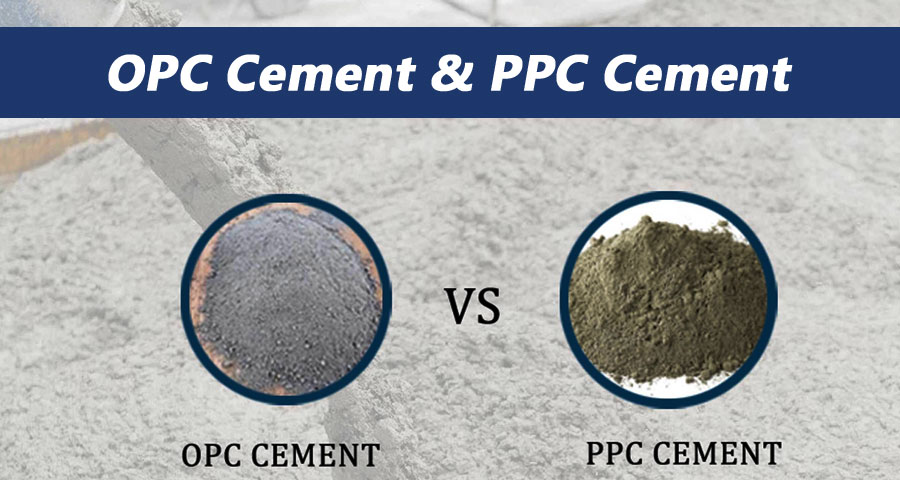
Cement is one of the most vital building materials in the construction industry, forming the backbone of infrastructure development worldwide. Among the most commonly used types are Ordinary Portland Cement (OPC) and Portland Pozzolana Cement (PPC). While both serve similar fundamental purposes, they differ significantly in composition, properties, applications, durability, and cost-effectiveness.
What is Ordinary Portland Cement (OPC)?
Ordinary Portland Cement (OPC) is the most widely used type of cement in construction. It is manufactured by grinding clinker (produced from limestone and other raw materials) with a small amount of gypsum. OPC is classified into three grades based on compressive strength:
- OPC 33 Grade - Provides 33 MPa strength after 28 days
- OPC 43 Grade - Provides 43 MPa strength after 28 days
- OPC 53 Grade - Provides 53 MPa strength after 28 days
This cement is known for its quick setting time, high compressive strength, and versatility, making it ideal for projects requiring early strength.
What is Portland Pozzolana Cement (PPC)?
Portland Pozzolana Cement (PPC) is a blended cement produced by grinding clinker, gypsum, and pozzolanic materials such as fly ash, volcanic ash, or calcined clay. The addition of pozzolanic materials enhances the cement's properties by improving durability, reducing permeability, and making it more resistant to chemical attacks.
PPC has a slower setting time compared to OPC, but it gains strength progressively over time and is particularly beneficial in mass concrete structures where low heat of hydration is desired.
Composition: OPC vs. PPC
- OPC Composition
- Clinker: 95 - 97%
- Gypsum: 3 - 5%
- PPC Composition
- Clinker: 65 - 75%
- Gypsum: 3 - 5%
- Pozzolanic materials (Fly ash, volcanic ash, etc.): 15 - 30%
The presence of pozzolanic materials in PPC enhances long-term strength and durability, while OPC provides early high strength due to its higher clinker content.
Strength and Setting Time
- OPC Strength
- Achieves high compressive strength within 7 days.
- Ideal for projects requiring fast construction.
- PPC Strength
- Strength develops slowly in the early stages but surpasses OPC over a longer period.
- Provides better durability in aggressive environmental conditions.
- Setting Time
- OPC sets faster (Initial setting: 30 minutes; Final setting: 280 - 300 minutes).
- PPC sets slower (Initial setting: 30 - 40 minutes; Final setting: up to 600 minutes).

Durability and Performance
- OPC Durability
- Higher permeability compared to PPC.
- Prone to chemical attacks in sulfate or chloride-rich environments.
- Less resistant to weathering.
- PPC Durability
- Low permeability, preventing the ingress of water and harmful chemicals.
- Superior resistance to sulfates, chlorides, and alkali-aggregate reactions.
- Suitable for marine structures, sewage treatment plants, and hydraulic constructions.
Workability and Heat of Hydration
- OPC Workability
- Generates more heat during hydration, which can cause cracks in large pours.
- Suitable for smaller construction works.
- PPC Workability
- Lower heat of hydration, making it excellent for mass concreting projects such as dams, bridges, and foundations.
- Provides smoother finishes and better workability due to the presence of fine particles of fly ash.
Applications of OPC Cement
- High-rise buildings requiring early strength
- Precast concrete production
- Roads, pavements, and runways
- Bridges and flyovers
- Structures where fast setting and early load-bearing are essential
Applications of PPC Cement
- Marine structures (ports, harbors, docks)
- Dams and hydraulic structures
- Sewage pipes and water tanks
- Foundations and mass concrete works
- Residential constructions requiring long-term durability
Environmental Impact
One of the major advantages of PPC over OPC lies in its eco-friendliness. PPC uses industrial by-products like fly ash, which reduces environmental waste and minimizes carbon emissions. OPC, on the other hand, involves higher clinker content, resulting in greater CO2 emissions during manufacturing.
Thus, PPC is often considered the sustainable choice for modern construction.
Cost Difference
- OPC is generally more expensive because of its higher clinker content and faster strength development.
- PPC is usually cheaper due to the inclusion of fly ash and other pozzolanic materials, making it more economical for large-scale projects.
Key Differences Between OPC and PPC Cement
| Aspect | OPC (Ordinary Portland Cement) | PPC (Portland Pozzolana Cement) |
|---|---|---|
| Composition | Clinker + Gypsum | Clinker + Gypsum + Pozzolanic Material |
| Grades | 33, 43, 53 | No specific grades |
| Setting Time | Faster | Slower |
| Early Strength | High | Low |
| Long-term Strength | Moderate | Higher |
| Durability | Moderate | High (resistant to chemicals & salts) |
| Heat of Hydration | High | Low |
| Permeability | High | Low |
| Cost | Relatively higher | More economical |
| Eco-friendliness | Less sustainable | More eco-friendly |
| Best Applications | Roads, bridges, high-rises | Dams, marine works, mass concreting |
Which Cement Should You Choose?
The choice between OPC and PPC cement depends on the nature of the project:
- If your project demands early strength, fast setting, and quick turnaround, OPC is the right choice.
- If your project requires long-term durability, resistance to chemicals, and eco-friendliness, PPC is the better option.
For residential buildings, PPC is often preferred due to its cost-effectiveness, better finish, and sustainability. For infrastructure projects like highways, bridges, and runways, OPC remains the most reliable choice.
Conclusion
Both OPC and PPC cement play vital roles in construction, each with its unique strengths. While OPC excels in early strength and quick setting, PPC stands out for its long-term durability, cost-effectiveness, and environmental benefits. Selecting the right cement depends on the specific requirements of your project, budget, and sustainability considerations.
Please watch the following short video for Difference Between OPC and PPC Cement
Also Read:
 Types of Basement Foundations that every builder must know