
Difference Between CPM and PERT: A Complete Guide for Effective Project Management

In modern project management, choosing the right planning and scheduling technique directly affects project success. Among the most widely used methods are the Critical Path Method (CPM) and the Program Evaluation and Review Technique (PERT). Although both tools aim to streamline workflow, enhance planning accuracy, and minimize risks, they differ significantly in purpose, application, flexibility, and time estimation.
This comprehensive guide explores the key differences between CPM and PERT, their advantages, characteristics, and practical applications. By the end, you will have a complete understanding of how each method works and when to use them for improved project outcomes.
What Is CPM (Critical Path Method)?
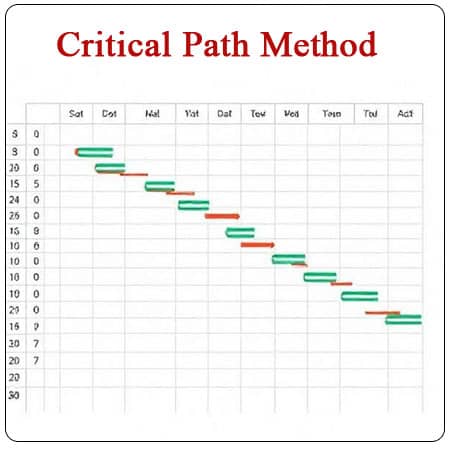
The Critical Path Method (CPM) is a deterministic project scheduling technique used when activity durations are predictable. It focuses on identifying the critical path, the longest sequence of activities that determines the minimum project duration.
Key Characteristics of CPM
- Deterministic Approach: Uses fixed, known durations for all project activities.
- Time-Cost Trade-offs: CPM allows adjustment of time and cost through crashing and fast tracking.
- Focuses on Critical Activities: Emphasizes tasks that directly impact project completion.
- Used for Repetitive Activities: Ideal for construction, manufacturing, and engineering projects.
When to Use CPM
- When activity durations are well-defined
- When project tasks are repetitive
- When cost-time optimization is required
- When the focus is on resource allocation and cost control
What Is PERT (Program Evaluation and Review Technique)?
The Program Evaluation and Review Technique (PERT) is a probabilistic method used for projects with uncertain or unpredictable activity durations. It applies three-time estimates to calculate expected completion time.
Key Characteristics of PERT
- Probabilistic Approach: Uses optimistic, pessimistic, and most likely time estimates.
- Focus on Uncertainty: Helps manage risk and variability in complex projects.
- Visual Network Diagram: Represents tasks and dependencies to estimate completion time.
- Ideal for Research and Development: Used in software development, defense, R&D projects, and new product development.

When to Use PERT
- When activity durations are uncertain or variable
- When risk analysis is required
- When dealing with non-repetitive, innovative, or experimental projects
- When precise timelines are difficult to predict
Major Differences Between CPM and PERT
Below is a detailed comparison highlighting the fundamental differences between the two project scheduling techniques.
1. Nature of the Technique
- CPM: Deterministic
- PERT: Probabilistic
CPM relies on fixed estimates, while PERT accommodates uncertainty using multiple time estimates.
2. Usage and Application
- CPM is best suited for construction, manufacturing, and engineering projects.
- PERT is ideal for research, development, and innovation-based projects.
3. Time Estimates
- CPM: Requires one time estimate per activity.
- PERT: Requires three time estimates - optimistic (O), pessimistic (P), and most likely (M).
4. Focus
- CPM: Focuses on time and cost trade-offs.
- PERT: Focuses on uncertainty and risk reduction.
5. Basis of Scheduling
- CPM: Activity-oriented
- PERT: Event-oriented
CPM concentrates on tasks, while PERT focuses on milestones or events.
6. Cost Considerations
- CPM incorporates cost optimization and allows for cost control.
- PERT does not emphasize cost directly; it prioritizes time management.
7. Flexibility
- CPM: Less flexible, suited for defined processes.
- PERT: Highly flexible and suitable for dynamic environments.
8. Critical Path Identification
- CPM: Critical path is fixed and based on set durations.
- PERT: Critical path varies due to probabilistic time estimates.
9. Suitable Project Types
- CPM: Repetitive, well-defined projects.
- PERT: Non-repetitive, uncertain projects.
Formula Used in PERT
PERT uses the following formula to determine the expected time (TE):
TE = (O + 4M + P) / 6
This formula provides a weighted average estimate considering uncertainties.
Advantages of CPM
- Clear visibility of critical activities
- Improves time and cost efficiency
- Ideal for resource allocation
- Enables effective monitoring and control
- Useful for complex, structured workflows
Advantages of PERT
- Accounts for uncertainty
- Improves decision-making under risk
- Ideal for new and unpredictable processes
- Provides realistic time estimates
- Helpful in high-stakes, long-duration projects
CPM vs PERT: Comparison Table
| Criteria | CPM | PERT |
|---|---|---|
| Approach | Deterministic | Probabilistic |
| Time Estimates | Single | Three-time estimates |
| Focus | Time and cost | Time uncertainty |
| Project Type | Repetitive | Research-based |
| Orientation | Activity-oriented | Event-oriented |
| Flexibility | Low | High |
| Critical Path | Fixed | Variable |
| Cost Consideration | Included | Not emphasized |
| Ideal For | Construction & manufacturing | R&D, software, innovation |
Which One Should You Choose?
Selecting between CPM and PERT depends on the nature of your project:
- Use CPM when tasks are predictable, and cost control is a priority.
- Use PERT when dealing with innovation, uncertainty, or experimental activities.
In many cases, project managers combine both techniques to leverage the strengths of each. This hybrid approach improves overall planning accuracy and resource efficiency.
Final Thoughts
Understanding the difference between CPM and PERT is crucial for successful project management, especially when managing complex tasks and tight deadlines. Both techniques offer unique strengths that enhance planning, scheduling, and decision-making. By applying the right method to the right scenario, organizations can improve performance, reduce risks, and complete projects more efficiently.
Please watch the following short video for Difference Between CPM and PERT
Also Read:
 Safe Bearing Capacity of Soil | Types of Soil Bearing Capacity