
Purpose, Formula and Methods of Superelevation in Roads

Designing safe and efficient highways requires meticulous attention to several engineering factors. Among them, superelevation in roads plays a critical role in ensuring smooth vehicular movement, minimizing lateral skidding, and improving overall road safety. Superelevation, often referred to as cant or banking of roads, is the transverse slope provided to the road surface, which helps counteract the effect of centrifugal force when vehicles move along horizontal curves.
What is Superelevation in Roads?
Superelevation is the tilting of the roadway surface at curves by raising the outer edge with respect to the inner edge. This inclination allows vehicles to negotiate curves at design speed without skidding or overturning. It balances the centrifugal force acting on a moving vehicle by introducing a component of the road's weight to counteract lateral forces.
Typically, superelevation values range from 4% to 10%, depending on road classification, design speed, and climatic conditions.
Purpose of Superelevation
The implementation of superelevation serves several essential objectives in road construction and design:
- Safety of Vehicles - Superelevation reduces the risk of skidding and overturning by counteracting centrifugal force during curvilinear motion.
- Driver Comfort - It ensures smooth vehicle operation, reducing discomfort caused by side thrust on passengers.
- Structural Efficiency - By evenly distributing stresses on pavements and vehicles, it enhances the life of both.
- Higher Design Speed - Superelevation allows roads to be designed for higher speeds without compromising safety.
- Reduced Maintenance - Proper drainage facilitated by road banking prevents waterlogging, reducing road surface damage.
Forces Acting on a Vehicle on a Curve
When a vehicle moves along a curve, three main forces come into play:
- Centrifugal Force (Fc): Acts outward from the center of curvature.
- Weight of Vehicle (W): Acts vertically downward due to gravity.
- Frictional Force (F): Acts between the tires and the road surface to resist sliding.
Superelevation ensures that these forces are balanced, improving stability during motion.
Formula for Superelevation
The general formula for superelevation (e) is derived from equilibrium conditions of the forces acting on a vehicle negotiating a curve:
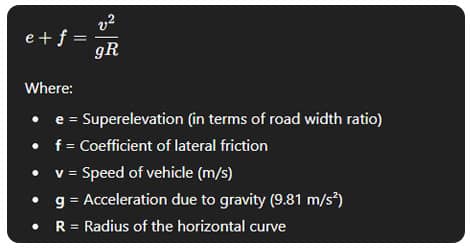
This equation shows that superelevation depends on vehicle speed, curve radius, and frictional resistance.
Methods of Providing Superelevation
The process of constructing superelevation involves gradually raising the outer edge of the pavement while maintaining smooth transitions. The main methods include:
1. Rotation About the Centerline
- The pavement is rotated around the centerline axis.
- Both edges are adjusted equally - one is raised, the other lowered.
- Commonly used in urban roads with restricted space.
2. Rotation About the Inner Edge
- The inner edge of the road remains fixed, and the outer edge is gradually raised.
- Provides efficient drainage.
- Preferred in highway construction for smoother transitions.
3. Rotation About the Outer Edge
- The outer edge remains fixed, and the inner edge is lowered.
- Rarely used due to drainage challenges.
Stages of Providing Superelevation
Superelevation is introduced in stages to ensure gradual adjustment for vehicles:
- Transition Length - A transition curve is provided before the circular curve begins, gradually introducing superelevation.
- Rotation of Pavement - Pavement is tilted by raising or lowering edges to achieve the required slope.
- Full Superelevation - Achieved at the curve's midpoint, ensuring maximum safety at design speed.
Factors Affecting Superelevation
Several factors determine the optimum value of superelevation:
- Design Speed of Road - Higher speed requires greater superelevation.
- Radius of Curve - Sharper curves need more banking.
- Type of Terrain - Plains, hills, or urban areas influence permissible limits.
- Climatic Conditions - In snow-prone regions, lower superelevation is adopted to prevent vehicles from skidding inward.
- Traffic Composition - Roads with slow-moving heavy vehicles require moderate superelevation to balance speed differences.
Advantages of Superelevation
- Reduces chances of vehicle skidding and overturning.
- Enhances riding comfort for passengers.
- Permits higher design speeds without compromising safety.
- Reduces wear and tear of vehicle tires.
- Improves road drainage by preventing water accumulation.

Disadvantages of Excessive Superelevation
While superelevation is highly beneficial, excessive values can lead to issues:
- Difficulties for stationary vehicles at curves.
- Increased construction cost in steep terrains.
- Water drainage issues on inner edges.
- Unsuitability in urban roads with heavy pedestrian movement.
Conclusion
Superelevation is one of the most critical aspects of highway engineering, ensuring safety, comfort, and efficiency in road transportation. By understanding its purpose, calculation, and methods, engineers can design roads that support higher speeds, reduce accidents, and minimize maintenance costs.
Effective implementation of superelevation requires careful consideration of design speed, curve radius, and terrain. When executed correctly, it transforms highways into safer, more durable, and efficient transportation corridors.
Please view the following short video for Superelevation in Roads
Also Read:
 Marble Flooring | Types | Advantages | DisAdvantages
What Is M25 Grade | What is M30 Grade | Difference Between M25 and M30 Concrete
Methods of Underwater Concreting: Techniques and Best Practices
Properties of Hardened Concrete: Understanding Strength, Durability, and Beyond
How to Properly Dispose of Construction Waste: Sustainable Solutions