
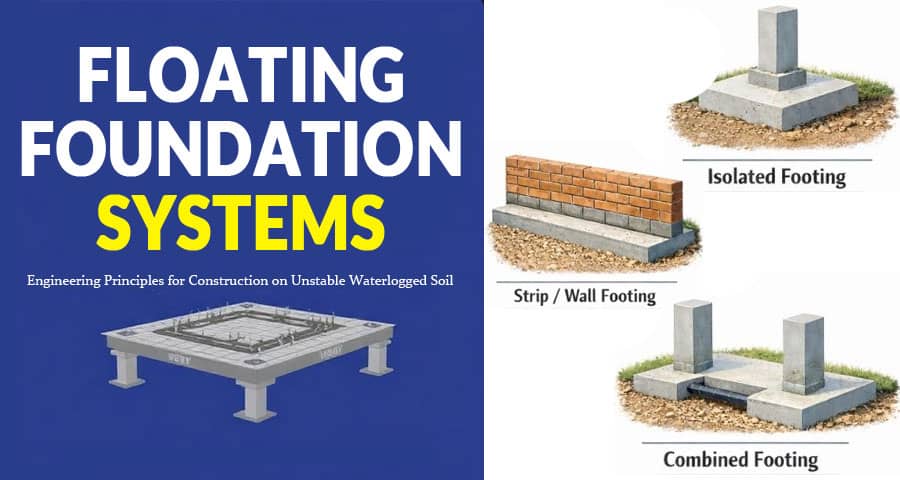
Floating Foundation Systems: Engineering Principles for Construction on Unstable Waterlogged Soil
Introduction to Floating Foundation Systems
Floating foundation systems are specialized foundation structures designed for construction on unstable, soft, marshy, or waterlogged soils where traditional shallow or deep foundations are not suitable. In such soil conditions, the bearing capacity is extremely low, and excessive settlement may occur if conventional foundations are used. Floating foundations distribute structural loads in such a way that the weight of the soil removed equals the weight of the structure, thereby minimizing settlement.
This method is widely used in coastal regions, riverbanks, reclaimed land, peat soil areas, and waterlogged construction sites where soil stability is a major concern.
Principle of Floating Foundation
Buoyancy Principle in Floating Foundations
The fundamental principle of floating foundation is based on Archimedes' principle, where a structure effectively "floats" on the soil by balancing the load with the soil removed during excavation.
In floating foundation design:
- Soil is excavated from the site
- The structure is built in the excavated space
- The weight of the structure equals or nearly equals the weight of excavated soil
- Net pressure on soil remains minimal
- Settlement is significantly reduced
This concept is also known as compensated foundation because the load of the structure is compensated by soil removal.
When Floating Foundations Are Used
Soil Conditions Suitable for Floating Foundations
Floating foundations are used in the following soil conditions:
- Soft clay soil
- Peat soil
- Marine clay
- Loose saturated sand
- Waterlogged ground
- Reclaimed land
- Marshy land
- Areas with high water table
- Highly compressible soil
These foundations are especially useful where deep foundations like piles are expensive or impractical.
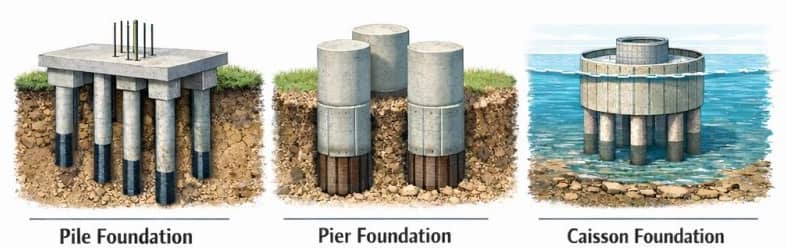
Types of Floating Foundation Systems
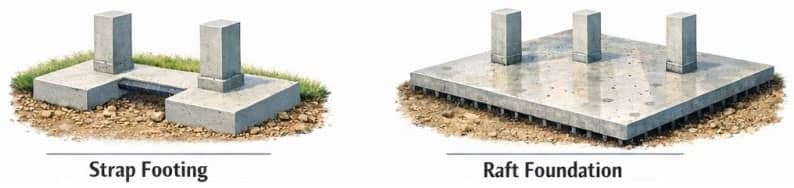
1. Raft Foundation (Mat Foundation)
Raft foundation is the most common type of floating foundation. It consists of a large reinforced concrete slab covering the entire building area, distributing the load evenly over the soil.
Advantages of Raft Foundation
- Reduces differential settlement
- Suitable for low bearing capacity soil
- Economical for large area structures
- Provides floor slab and foundation together
- Suitable for waterlogged areas
Applications
- Residential buildings
- Commercial buildings
- Warehouses
- Industrial buildings
- Buildings on reclaimed land
2. Cellular Raft Foundation
A cellular raft foundation consists of a grid of beams and slabs forming hollow cells that increase stiffness and reduce settlement.
Features
- High rigidity
- Reduced concrete consumption
- Suitable for heavy structures
- Better load distribution
- Suitable for weak soil
3. Box Foundation
A box foundation is a hollow box-like reinforced concrete structure placed below the ground surface. It is suitable for structures built on very soft soil.
Advantages
- High structural strength
- Reduced settlement
- Suitable for waterlogged soil
- Can be used for underground structures
Design Considerations for Floating Foundations
Load Calculations
The total load considered in floating foundation design includes:
- Dead load of structure
- Live load
- Wind load
- Seismic load
- Foundation weight
- Soil pressure
- Water pressure
The design ensures that:
Weight of building ≈ Weight of excavated soil
This condition minimizes settlement and prevents excessive soil pressure.
Bearing Capacity Analysis
Even though floating foundations reduce soil pressure, engineers must still check:
- Safe bearing capacity of soil
- Settlement analysis
- Consolidation settlement
- Differential settlement
- Shear failure of soil
Soil investigation is essential before design.
Construction Procedure of Floating Foundation
Step-by-Step Construction Process
Step 1 - Soil Investigation
- Boreholes are drilled
- Soil samples collected
- Laboratory testing performed
- Water table level determined
- Bearing capacity calculated
Step 2 - Excavation
- Soil excavated to required depth
- Excavation depth depends on structure weight
- Dewatering may be required
Step 3 - Soil Preparation
- Base soil compacted
- Sand layer provided
- PCC (Plain Cement Concrete) laid
- Waterproof membrane installed
Step 4 - Reinforcement Work
- Steel reinforcement placed
- Raft slab reinforcement arranged
- Beam reinforcement fixed
- Column starter bars provided
Step 5 - Concreting
- Raft slab concrete poured
- Vibrators used for compaction
- Proper curing done
Step 6 - Backfilling
- Side areas backfilled
- Compaction done in layers
Advantages of Floating Foundation Systems
Major Benefits
Floating foundations provide several engineering advantages:
- Suitable for low bearing capacity soil
- Reduces differential settlement
- Economical compared to deep foundations
- Suitable for waterlogged and marshy areas
- Provides uniform load distribution
- Reduces soil pressure
- Suitable for multi-storey buildings
- Can be constructed in high water table areas
- Minimizes foundation failure risk
- Provides structural stability
Disadvantages of Floating Foundations
Limitations and Challenges
Despite many advantages, floating foundations have some disadvantages:
- Requires careful soil investigation
- Not suitable for very heavy structures
- Construction may be difficult in deep waterlogged areas
- Requires dewatering
- Waterproofing is necessary
- Skilled design required
- Initial excavation cost may be high
Applications of Floating Foundations
Where Floating Foundations Are Used
Floating foundations are commonly used in:
- Buildings on reclaimed land
- Construction near rivers and lakes
- Coastal area construction
- Bridges and culverts
- Water tanks
- Basements in waterlogged soil
- Industrial buildings
- Storage tanks
- Warehouses
- Apartment buildings
- Marshy land construction
Difference Between Floating Foundation and Raft Foundation
| Floating Foundation | Raft Foundation |
|---|---|
| Based on soil weight compensation | Based on load distribution |
| Used in waterlogged soil | Used in low bearing capacity soil |
| Excavation depth important | Excavation depth not main factor |
| Settlement minimized by compensation | Settlement minimized by load spreading |
| Also called compensated foundation | Also called mat foundation |
Engineering Principles Behind Floating Foundations
Key Engineering Concepts
Floating foundation design is based on the following engineering principles:
- Soil Mechanics
- Bearing Capacity Theory
- Consolidation Theory
- Settlement Analysis
- Hydrostatic Pressure
- Buoyancy Principle
- Load Distribution Theory
- Structural Stability
- Groundwater Pressure Analysis
- Reinforced Concrete Design
These principles ensure that the structure remains stable even on very weak soil conditions.
Conclusion
Floating foundation systems are one of the most effective engineering solutions for construction on unstable, soft, and waterlogged soils. By balancing the weight of the structure with the weight of the excavated soil, these foundations significantly reduce settlement and improve structural stability. They are widely used in coastal regions, reclaimed land, marshy areas, and high water table zones where conventional foundations are not feasible.
Proper soil investigation, structural design, waterproofing, and construction techniques are essential for the successful performance of floating foundations. When designed correctly, floating foundations provide long-term stability, cost efficiency, and safety for structures built on weak soil conditions.
Please watch the following short video for Floating Foundation Systems
Also Read:
 Weep Holes: Function and Types