
Isolated Footing Foundation: Types, Design, Construction Process, Advantages, and Structural Details
What Is an Isolated Footing Foundation?
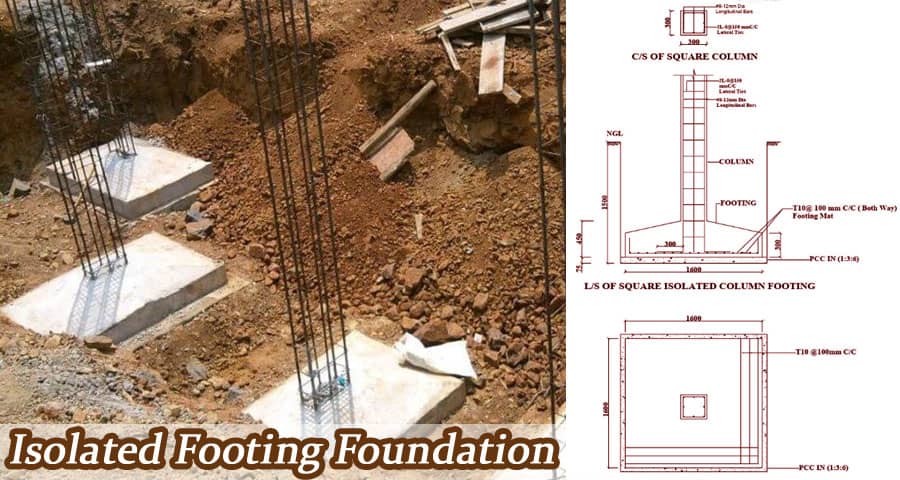
An isolated footing foundation is one of the most widely used shallow foundations in residential, commercial, and industrial construction projects. It is designed to support a single column and safely transfer the structural load from the column to the soil beneath. This type of footing is generally constructed using reinforced cement concrete (RCC) and is suitable where the soil has good bearing capacity and column loads are moderate.
The isolated footing is also known as a pad footing because it acts like a pad beneath the column. It distributes concentrated loads over a larger area to prevent excessive settlement and maintain structural stability.
Purpose of Isolated Footing in Building Construction
The main purpose of an isolated footing foundation is to:
- Transfer structural loads safely to the ground
- Reduce differential settlement
- Provide stability against overturning and sliding
- Support columns individually
- Ensure uniform load distribution on soil
This foundation type is highly economical for structures where columns are placed at sufficient distances from one another.
Types of Isolated Footing Foundation
Different types of isolated footings are used depending on structural loads, soil conditions, and design requirements.
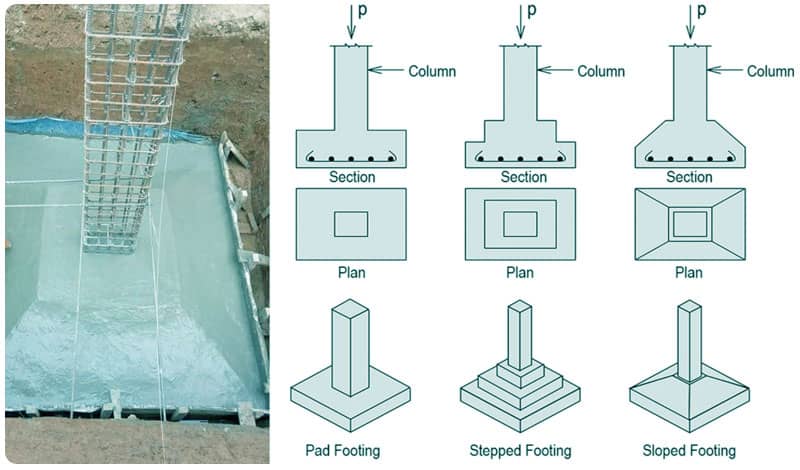
1. Flat Isolated Footing
A flat isolated footing has a uniform thickness throughout. It is commonly used for light structures and moderate soil bearing capacities.
Features
- Simple design
- Easy reinforcement detailing
- Economical construction
2. Stepped Footing
Stepped footing consists of multiple concrete layers placed in steps. It is used when heavy loads require a larger base area.
Benefits
- Better load distribution
- Reduced bending stress
- Suitable for deeper foundations
3. Sloped Footing
In sloped footing, the top surface is inclined while the bottom remains flat.
Advantages
- Reduces concrete consumption
- Provides aesthetic structural geometry
- Suitable for medium and heavy loads
4. Combined Isolated Footing
When two columns are closely spaced and individual footings overlap, a combined footing is provided.
Applications
- Boundary columns
- Congested construction areas
- Unequal column spacing
Components of Isolated Footing Foundation
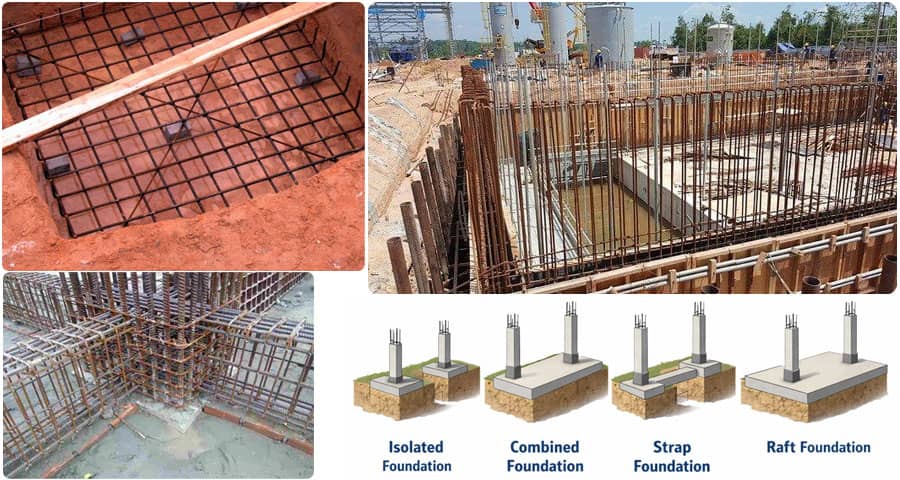
An isolated footing foundation mainly consists of the following parts:
1. PCC Layer
A Plain Cement Concrete (PCC) layer is laid below the footing to provide a clean and level surface.
Functions
- Prevents direct soil contact with reinforcement
- Protects steel from corrosion
- Ensures proper alignment
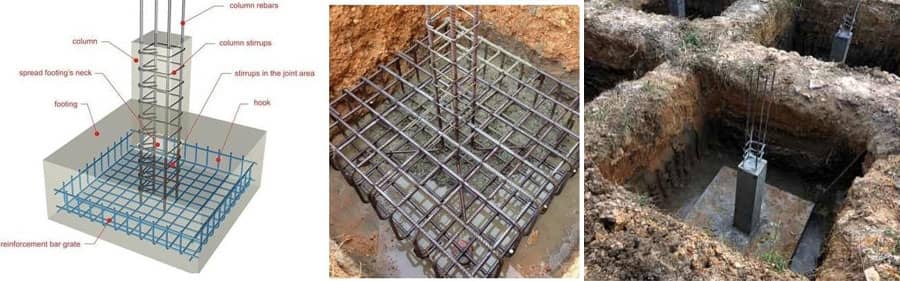
2. RCC Footing
The RCC footing is the primary load-bearing component.
Materials Used
- Cement
- Sand
- Aggregate
- Reinforcement steel
3. Column Starter Bars
Steel bars extend from the footing to connect the footing with the column.
4. Reinforcement Mesh
Steel reinforcement is placed in both directions to resist bending and shear forces.
Design of Isolated Footing Foundation
The design of isolated footing depends on several engineering parameters.
Factors Considered in Design
1. Safe Bearing Capacity of Soil
The soil must safely resist structural loads without excessive settlement.
2. Column Load
Dead load, live load, and seismic load are considered during footing design.
3. Footing Area
The footing size is determined by:
A = p/q
Where:
- A = Area of footing
- P = Load on column
- q = Safe bearing capacity of soil
4. Thickness of Footing
Thickness is calculated based on:
- One-way shear
- Two-way shear
- Bending moment
5. Reinforcement Requirement
Steel reinforcement is provided according to structural design calculations.
Standard Size of Isolated Footing
There is no universal footing size because dimensions vary depending on:
- Building load
- Soil condition
- Column size
- Structural design
However, commonly used isolated footing sizes include:
| Column Size | Typical Footing Size | Thickness |
| 230 mm x 230 mm | 1.2 m x 1.2 m | 300 mm |
| 300 mm x 300 mm | 1.5 m x 1.5 m | 450 mm |
| 450 mm x 450 mm | 2.0 m x 2.0 m | 600 mm |
These dimensions are indicative and should always be verified through structural analysis.
Construction Process of Isolated Footing Foundation
1. Site Marking
The exact footing location is marked according to structural drawings.
2. Excavation
Excavation is carried out to the required depth based on soil conditions and design levels.
3. Compaction of Soil
The bottom soil is compacted properly to achieve stability.
4. PCC Work
A PCC bed of approximately 75 mm to 100 mm thickness is laid.
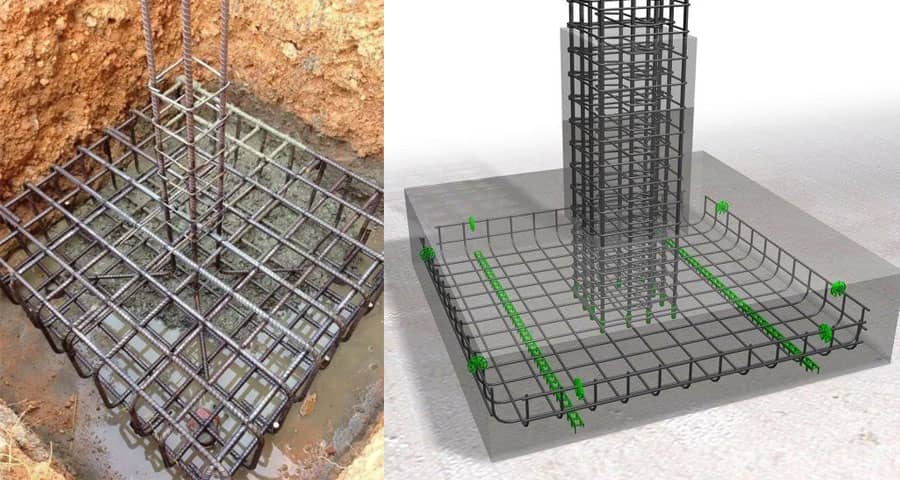
5. Reinforcement Placement
Steel bars are tied according to the footing reinforcement drawing.
Important Checks
- Proper cover blocks
- Correct bar spacing
- Adequate anchorage length
6. Shuttering Work
Formwork is installed to maintain the footing shape during concreting.
7. Concrete Pouring
Concrete is poured continuously and compacted using vibrators.
8. Curing
Proper curing is essential to achieve desired strength and durability.
Advantages of Isolated Footing Foundation
1. Economical Construction
It requires less excavation and less concrete compared to deep foundations.
2. Simple Design
The structural design process is relatively straightforward.
3. Faster Construction
Construction can be completed quickly due to simple procedures.
4. Low Material Consumption
It consumes less steel and concrete compared to raft or pile foundations.
5. Suitable for Good Soil Conditions
It performs effectively where soil bearing capacity is adequate.
Disadvantages of Isolated Footing
Despite its advantages, isolated footing has certain limitations.
1. Not Suitable for Weak Soil
Poor soil conditions may lead to excessive settlement.
2. Limited Load Capacity
It cannot support extremely heavy structural loads.
3. Differential Settlement Risk
Uneven soil conditions can cause unequal settlement.
4. Unsuitable for Waterlogged Areas
High groundwater levels may affect footing stability.
Difference Between Isolated Footing and Combined Footing
| Feature | Isolated Footing | Combined Footing |
| Supports | Single column | Two or more columns |
| Cost | Lower | Higher |
| Construction | Simple | Complex |
| Area Requirement | More spacing needed | Suitable for limited space |
| Reinforcement | Less | More |
Reinforcement Details in Isolated Footing
Proper reinforcement detailing is critical for structural safety.
Bottom Reinforcement
Main steel bars are generally placed at the bottom because tensile stresses develop there.
Top Reinforcement
Additional top steel may be provided for heavy loads.
Development Length
Adequate development length ensures proper force transfer between steel and concrete.
Concrete Cover
Standard footing cover usually ranges between 50 mm to 75 mm.
Soil Bearing Capacity for Isolated Footing
| Soil Type | Safe Bearing Capacity |
| Soft Clay | 50 - 100 kN/m2 |
| Medium Clay | 100 - 200 kN/m2 |
| Dense Sand | 250 - 450 kN/m2 |
| Gravel | 450 - 600 kN/m2 |
The performance of an isolated footing largely depends on soil bearing capacity.
Typical SBC Values
A proper soil investigation must always be conducted before foundation design.
Applications of Isolated Footing Foundation
Isolated footing foundations are commonly used in:
- Residential buildings
- Small commercial buildings
- Schools
- Hospitals
- Warehouses
- Industrial sheds
They are particularly effective for structures with moderate column loads and good soil conditions.
Important Precautions During Construction
1. Soil Testing Must Be Done
Never start footing work without geotechnical investigation.
2. Maintain Proper Concrete Cover
Insufficient cover can lead to steel corrosion.
3. Use Quality Materials
High-quality cement, aggregate, and steel improve foundation durability.
4. Ensure Proper Compaction
Poor compaction may create voids and reduce strength.
5. Avoid Water Accumulation
Standing water inside excavation pits should be removed before concreting.
Conclusion
The isolated footing foundation remains one of the most efficient and economical foundation systems used in modern construction. Its simplicity, cost-effectiveness, and ease of construction make it ideal for residential and low-rise commercial structures. When designed correctly and constructed using proper engineering practices, isolated footings provide excellent structural stability and long-term durability.
Proper soil investigation, accurate structural design, quality reinforcement placement, and careful concreting are essential to ensure the performance of isolated footing foundations. By understanding the types, components, design principles, and construction procedures, engineers and builders can achieve safe and durable building foundations for a wide range of construction projects.
Please view the following short video for Isolated Footing Foundation
Also Read:
 Spread Footing Foundation