
What Are the Differences Between Shear Slump and Collapse Slump in Slump Test?
Introduction to Slump Test and Its Types
In the realm of concrete technology, the slump test stands as a primary and widely used method to assess the workability and consistency of fresh concrete. This simple yet effective test provides invaluable insights into the water-cement ratio, uniformity, and mix characteristics before placement. While conducting a slump test, concrete can exhibit different slump profiles, each reflecting unique workability conditions. Two critical types are shear slump and collapse slump, both of which are essential indicators for interpreting concrete behavior on-site.
Understanding the Slump Test Procedure
The slump test involves filling a standard slump cone (also known as Abrams cone) in three layers of concrete, each layer tamped 25 times with a standard rod. The cone is then lifted vertically, and the subsidence of concrete is measured to determine the slump value. The slump observed can fall into one of three categories: true slump, shear slump, or collapse slump.
- True Slump: Concrete subsides uniformly without any lateral movement.
- Shear Slump: Concrete slips sideways due to lack of cohesion.
- Collapse Slump: Concrete collapses entirely, indicating an overly wet mix.
Defining Shear Slump in Slump Test
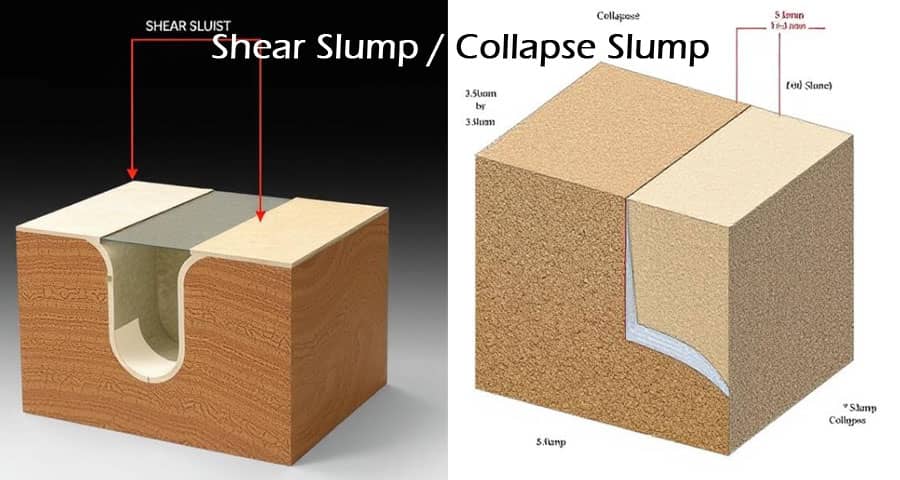
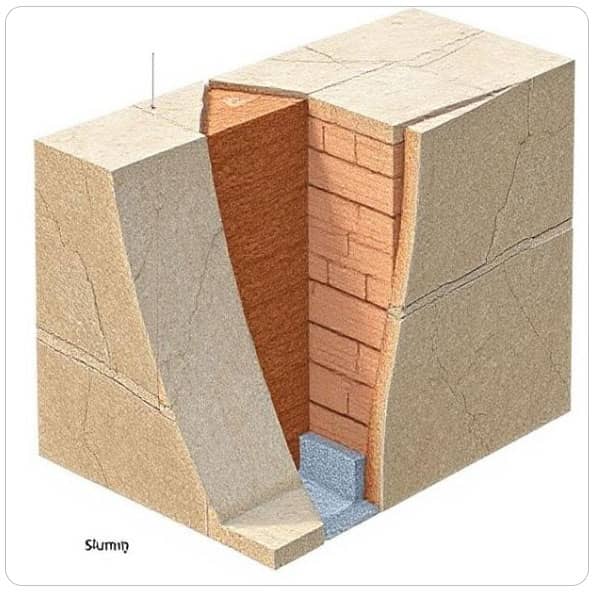
Shear slump occurs when concrete shears off and slips sideways along a plane, giving a distinct inclined profile instead of subsiding vertically. This slump type indicates marginal stability in the concrete mix, typically caused by inadequate cohesiveness or segregation-prone mix proportions.
Causes of Shear Slump
- Low Cohesion: Insufficient fine materials (cement, fine aggregates) leading to poor paste matrix.
- Incorrect Water Content: Slightly higher or lower water-cement ratios than optimal.
- Non-uniform Mixing: Poorly mixed concrete with inconsistent distribution of fines.
Implications of Shear Slump
- Workability Concerns: Suggests potential for segregation during handling and compaction.
- Placement Issues: May require adjustments in mix design to ensure proper placement without bleeding or honeycombing.
- Strength Variability: Uneven distribution of materials could cause inconsistent compressive strength.
Defining Collapse Slump in Slump Test
Collapse slump happens when concrete completely collapses upon removal of the slump cone, spreading laterally without any recognizable slump shape. This indicates that the concrete is extremely wet, with a very high water-cement ratio leading to excessive workability but compromised stability.
Causes of Collapse Slump
- Excessive Water Content: Water-cement ratio far above the designed value.
- Overdose of Water-Reducing Admixtures: High dosages of plasticizers or superplasticizers.
- Improper Proportioning: Incorrect batching, especially in site-mixed concrete.
Implications of Collapse Slump
- High Segregation Risk: Cement paste and aggregates separate, resulting in laitance and weak zones.
- Poor Surface Finish: Excess water leads to bleeding, resulting in dusty or powdery surfaces.
- Reduced Strength and Durability: High water content increases porosity, lowering compressive strength and long-term durability.
Key Differences Between Shear Slump and Collapse Slump
Visual Difference
- Shear Slump: Concrete slides sideways along an inclined plane but maintains partial cohesion.
- Collapse Slump: Concrete loses shape entirely, flowing outward uncontrollably.
Indication of Mix Quality
- Shear Slump: Indicates borderline workability with risk of segregation but manageable adjustments can rectify it.
- Collapse Slump: Signals a mix that is unfit for most structural applications due to excessive fluidity.
Adjustments Needed
- Shear Slump Correction: Increase fines, optimize water content, or improve mixing practices.
- Collapse Slump Correction: Reduce water content, reassess admixture dosages, or redesign mix proportions.
Usability
- Shear Slump: Concrete can be used in certain applications like thin sections or areas requiring medium flow but must be placed carefully.
- Collapse Slump: Generally unsuitable for structural work without significant adjustments.
Best Practices to Avoid Shear and Collapse Slump
Optimal Water-Cement Ratio
Maintaining the designed water-cement ratio is critical. Use precise measurement tools during batching, especially in site-mixed concrete where manual measurements often lead to variations.
Controlled Admixture Dosages
Overuse of plasticizers can push concrete from a true slump directly into a collapse slump. Always follow manufacturer guidelines and perform trial mixes to find the right dosage.
Consistent Mixing
Uneven distribution of cement paste leads to localized areas of different consistency, causing shear slump. Ensure mechanical mixing for uniform distribution, especially for large batches.
Aggregate Gradation
Poorly graded aggregates can cause excessive voids requiring more water for workability, which in turn increases risk of collapse slump. Opt for well-graded aggregates to reduce water demand.
Regular Slump Testing
Conducting slump tests frequently during concreting helps in early detection of inconsistencies, enabling timely corrections to maintain quality and uniformity.
Applications of Shear and Collapse Slump Insights
Understanding these slump behaviors enables concrete professionals to make informed decisions on-site:
- Adjust mix designs for pumpable concrete, where high workability is essential without risking collapse.
- Optimize workability for complex formworks that require flowable concrete with sufficient stability.
- Prevent segregation in thin structural elements where maintaining consistent cross-section strength is critical.
Conclusion
Identifying and differentiating shear slump and collapse slump in a slump test is vital for controlling fresh concrete properties, ensuring uniform workability, and achieving the desired strength and durability of hardened concrete. Recognizing these differences allows us to fine-tune concrete mixes effectively, avoid placement issues, and maintain structural integrity across diverse construction projects.
Please watch the following short video for Differences Between Shear Slump and Collapse Slump in Slump Test