
Buttress Dams: Structure, Types, Advantages, and Applications
Introduction to Buttress Dams
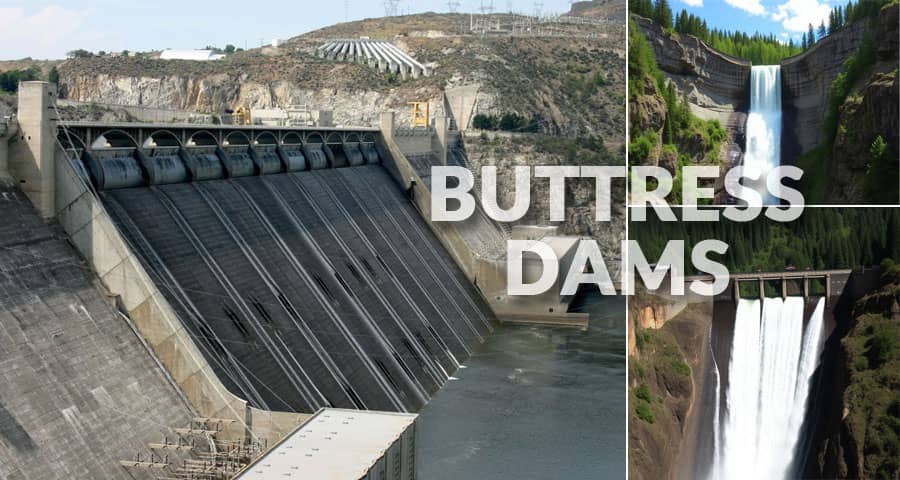
Buttress dams are a type of dam constructed using a watertight upstream face supported at intervals by a series of supports called buttresses. These dams are designed to resist water pressure through structural support rather than relying entirely on mass like gravity dams. Because of this structural system, buttress dams require less construction material and are often more economical where suitable foundation conditions exist.
We use buttress dams primarily in locations where strong foundations are available and where reducing construction material and cost is important. These dams are suitable for medium to high heights and are widely used for water storage, irrigation, hydroelectric power generation, and flood control.
Structure of Buttress Dams
The structure of a buttress dam consists of several important components that work together to resist water pressure and transfer loads safely to the foundation.
Main Components of Buttress Dam
1. Upstream Face or Deck
- This is the water-retaining surface of the dam.
- Usually made of reinforced concrete slabs.
- It may be flat or curved.
- It transfers water pressure to buttresses.
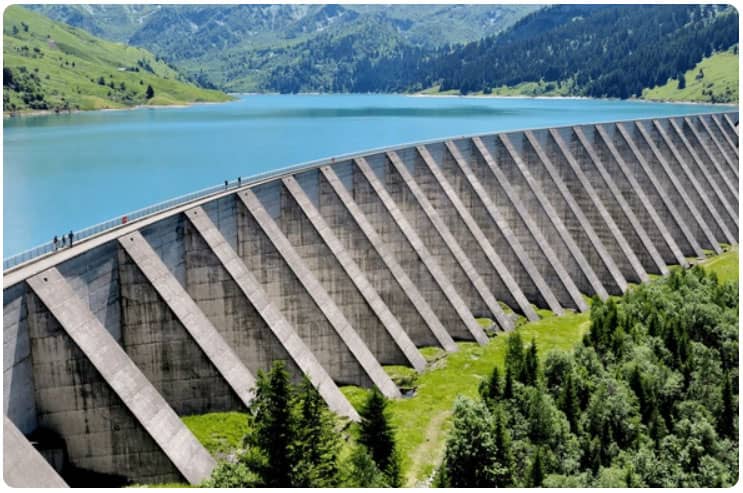
2. Buttresses
- These are triangular or rectangular supports.
- They transfer the load from the deck slab to the foundation.
- Buttresses are spaced at regular intervals.
3. Foundation
- Buttress dams require strong rock foundations.
- The foundation must safely transfer loads from buttresses.
4. Spillway Section
- Provided to discharge excess water safely.
- Usually located in the central section of the dam.
5. Inspection Gallery
- Provided for inspection and maintenance.
- Helps detect leakage and structural issues.
The load transfer mechanism is simple: Water pressure → Deck slab → Buttresses → Foundation.
Types of Buttress Dams
Buttress dams are classified based on the shape of the upstream face and structural arrangement.
1. Deck Slab Buttress Dam
This is the most common type of buttress dam.
Features:
- Flat reinforced concrete slab supported by buttresses.
- Buttresses are equally spaced.
- Economical in construction.
- Easy to maintain.
This type is widely used for medium-height dams.
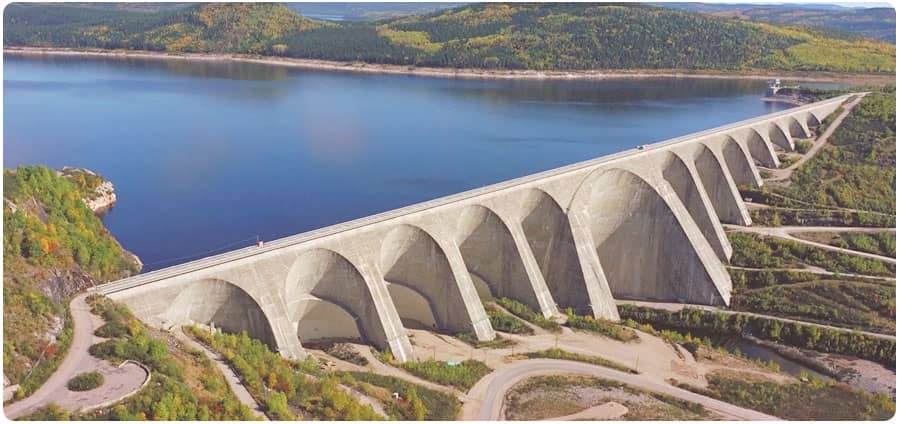
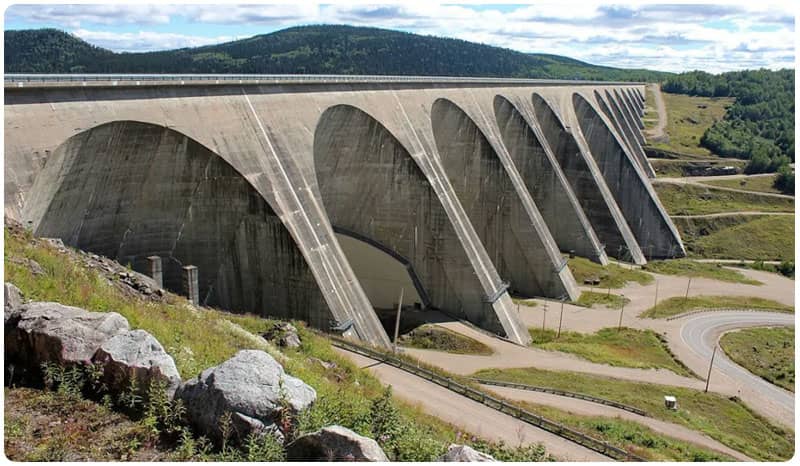
2. Multiple Arch Buttress Dam
In this type, the upstream face consists of multiple arches instead of flat slabs.
Features:
- Arches transfer water pressure to buttresses.
- Requires less concrete than deck slab type.
- Suitable for narrow valleys.
- More complex design.
This type is very efficient structurally.
3. Massive Head Buttress Dam
This type consists of massive heads at the upstream face supported by buttresses.
Features:
- Combines gravity dam and buttress dam principles.
- Strong and stable.
- Requires more material than other buttress dams.
- Used for higher dams.
4. Columnar Buttress Dam
In this type, columns are used instead of solid buttresses.
Features:
- Reduces material usage.
- Requires skilled construction.
- Suitable for lighter loads.
Advantages of Buttress Dams
Buttress dams offer several advantages compared to gravity dams and arch dams.
Major Advantages
- Less Construction Material
- Requires less concrete than gravity dams.
- Reduces construction cost.
- Economical Construction
- Suitable where cement and concrete are expensive.
- Faster construction compared to gravity dams.
- Reduced Uplift Pressure
- Because of open spaces between buttresses.
- Improves stability.
- Easy Inspection and Maintenance
- Open spaces allow inspection of foundation and leakage.
- Repairs are easier.
- Suitable for Weak Foundation Compared to Gravity Dam
- Load is transferred at intervals through buttresses.
- Less Heat Generation
- Less concrete means less heat of hydration.
- Reduces cracking risk.
Disadvantages of Buttress Dams
Despite advantages, buttress dams also have some limitations.
Major Disadvantages
- Requires Skilled Design and Construction
- Maintenance Cost May Be Higher
- Not Suitable for Very High Dams
- Requires Strong Foundation
- Complex Formwork
- More Steel Reinforcement Required
Applications of Buttress Dams
Buttress dams are used in many hydraulic engineering projects.
Main Applications
- Water Storage Reservoirs
- Hydroelectric Power Generation
- Irrigation Projects
- Flood Control
- Water Supply Schemes
- River Regulation
- Industrial Water Storage
These dams are particularly useful in wide valleys where foundation conditions are good and construction material needs to be minimized.
Comparison Between Buttress Dam and Gravity Dam
| Feature | Buttress Dam | Gravity Dam |
|---|---|---|
| Construction Material | Less | More |
| Cost | Economical | Expensive |
| Foundation Requirement | Strong | Very Strong |
| Construction Time | Less | More |
| Maintenance | Moderate | Low |
| Height Suitability | Medium | High |
| Structural Type | Slab + Buttress | Solid Mass |
Design Considerations of Buttress Dams
While designing buttress dams, several engineering factors must be considered.
Important Design Factors
- Water pressure
- Uplift pressure
- Wind pressure
- Earthquake forces
- Temperature stresses
- Foundation strength
- Spacing of buttresses
- Thickness of deck slab
- Drainage system
- Stability against sliding and overturning
Proper design ensures structural stability, durability, and safety of the dam.
Construction Procedure of Buttress Dam
The construction of buttress dams involves several steps.
Construction Steps
- Site investigation and survey
- Foundation excavation
- Foundation preparation
- Construction of buttresses
- Construction of deck slab or arches
- Spillway construction
- Drainage and inspection gallery construction
- Finishing and water filling
Proper curing and quality control are essential during construction.
Conclusion
Buttress dams are an efficient and economical type of dam structure that uses buttresses to support the upstream water-retaining face, reducing the amount of construction material required. These dams are suitable for medium-height dams, strong foundation conditions, irrigation projects, hydroelectric projects, and water storage reservoirs. Their structural efficiency, reduced material usage, and economic advantages make them an important type of dam in hydraulic engineering projects. Proper design, foundation preparation, and construction practices ensure the long-term stability and performance of buttress dams in water resource engineering projects.
Please watch the following short video for Buttress Dams
Also Read:
 Repointing Brick and Its Types: A Complete Guide