
What Is RQD | Advantages of Rock Quality Designation | Limitations of Rock Quality Designation
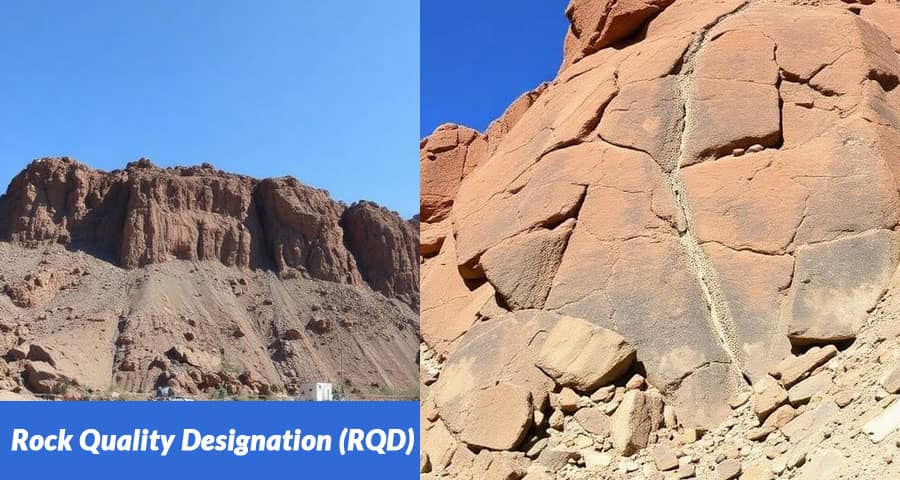
Introduction to Rock Quality Designation (RQD)
Rock Quality Designation (RQD) is a fundamental geotechnical parameter used globally to evaluate the quality, degree of fracturing, and mechanical integrity of rock masses. Developed by D.U. Deere in 1964, RQD has become an essential index for tunnel design, foundation engineering, slope stability analysis, mining operations, and underground excavations.
We use RQD as a quantifiable measure to determine how competent a rock formation is, based on core recovery data obtained during drilling and site exploration. By assessing the length of intact rock pieces greater than 100 mm, RQD expresses rock quality as a percentage, offering a clear, standardized grading method for engineers.
Definition of RQD (Rock Quality Designation)
RQD is defined as:
The percentage of the total length of intact core pieces longer than 100 mm recovered from a drill run, divided by the total length of the core run.
Mathematically:
RQD (%) = (Sum of lengths of core pieces > 100 mm / Total length of core run) x 100
This evaluation helps engineers determine whether the rock formation is suitable for structural loads, excavation methods, and long-term stability planning.
Classification of Rock Quality Based on RQD Values
| RQD Value (%) | Rock Quality Description |
|---|---|
| 0 - 25% | Very Poor Rock |
| 25 - 50% | Poor Rock |
| 50 - 75% | Fair Rock |
| 75 - 90% | Good Rock |
| 90 - 100% | Excellent Rock |
These classifications guide engineers in selecting appropriate excavation techniques, support systems, and stabilization measures.
Importance of RQD in Geotechnical Engineering
RQD plays a key role in:
- Assessing tunnel stability
- Designing foundations on rocky terrains
- Determining excavation method feasibility
- Evaluating discontinuity frequency and jointing
- Predicting water ingress and weathering effects
- Preparing geotechnical risk assessments
Because of its simplicity and reliability, RQD remains one of the most trusted indicators for rock quality globally.
How RQD Is Measured in the Field
1. Drilling and Core Recovery
Rock cores are extracted using diamond core drilling, ensuring minimal disturbance to the rock structure.
2. Core Logging
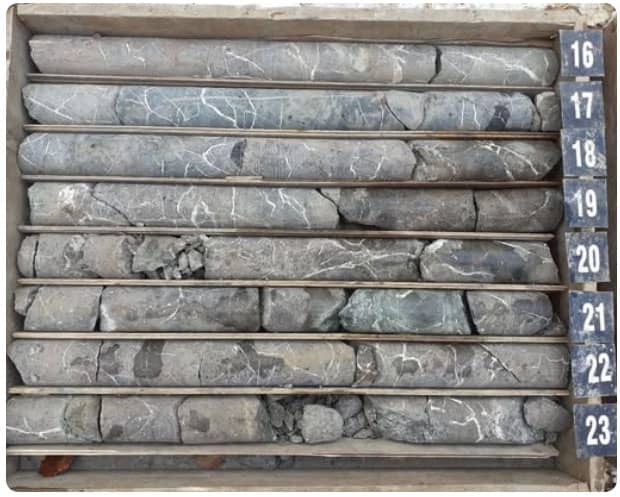
The recovered core is laid out in core boxes and examined visually. The geotechnical engineer identifies and measures only those fragments longer than 100 mm.
3. RQD Calculation
Using the earlier formula, the percentage is computed and used to classify rock quality.
4. Reporting
The final RQD value is included in the geotechnical log, often accompanied by descriptive notes on joint orientation, weathering, fractures, and mineral composition.
Advantages of Rock Quality Designation
1. Simple and Cost-Effective Evaluation Method
RQD requires no sophisticated instruments - only accurate core measurement. This reduces cost and effort during preliminary site investigations.
2. Helps Determine Rock Mass Stability
A high RQD signifies low fracturing and increased rock strength, enabling informed decisions about excavation and support requirements.
3. Enhances Tunnel and Underground Design Accuracy
RQD helps estimate potential risks such as:
- Rock falls
- Overbreak
- Water seepage
- Structural deformation
This allows engineers to implement safer, optimized excavation methods.
4. Universal Acceptance and Standardization
RQD has achieved global recognition as a standard geotechnical parameter, making it easier to compare rock quality across projects and regions.
5. Supports Comprehensive Rock Mass Classification Systems
RQD is integrated into major rock classification systems such as:
- RMR (Rock Mass Rating)
- Q-System
- GSI (Geological Strength Index)
These systems rely heavily on RQD to determine overall rock mass competency.
6. Effective for Preliminary Site Assessment
It helps quickly categorize sites as suitable or unsuitable for:
- High-rise foundations
- Dams
- Tunnels
- Retaining structures
- Mining excavations
Limitations of Rock Quality Designation
While widely used, RQD has certain limitations:
1. Sensitive to Drilling Technique
Improper drilling may cause artificial fractures, reducing the RQD value and resulting in misleading interpretations.
2. Not Suitable for Highly Weathered or Soft Rock
RQD works best for hard, brittle rock types. Weathered or soft rock cores tend to crumble, making accurate measurement difficult.
3. Overlooks Joint Orientation and Spacing
RQD only measures percentage of intact pieces, not the orientation or nature of joints, which can significantly affect stability.
4. Biased Against Thinly Bedded Rocks
Rocks with naturally thin layers may appear poor in terms of RQD, even if they possess acceptable engineering strength.
5. Affected by Core Recovery Quality
If the core recovery is low, RQD automatically produces a low value, even when intact rock quality may be good.
6. Not Fully Representative of Rock Mass
RQD is derived from a single borehole axis, which may not fully represent the three-dimensional nature of the rock mass.
Applications of RQD in Civil Engineering and Mining
1. Tunnel Design and Support Systems
Engineers use RQD to determine:
- Support pressure needs
- Type and spacing of rock bolts
- Shotcrete thickness
- Excavation methods
2. Dam Foundations and Hydro Projects
RQD helps assess rock stability under hydrostatic pressure, seepage forces, and differential settlement.
3. Highway and Railway Cut Slopes
RQD guides slope stabilization measures such as anchors, retaining walls, or drainage systems.
4. Mining Operations
In mining, RQD provides insight into:
- Ore extraction feasibility
- Underground support design
- Safety risk assessments
5. High-Rise and Heavy Structures
RQD ensures the rock foundation can safely withstand structural loads.
Improving Accuracy of RQD Measurements
To enhance the reliability of RQD values:
- Use controlled, high-quality core drilling methods
- Document core orientation and condition
- Inspect cores immediately after recovery
- Combine RQD with RMR, Q-System, and GSI for a holistic assessment
- Avoid counting mechanically induced fractures
These practices help generate more realistic and dependable rock quality assessments.
Conclusion
Rock Quality Designation (RQD) remains one of the most powerful and widely accepted tools for evaluating rock mass conditions in geotechnical engineering. While it offers significant advantages - such as simplicity, reliability, and universal acceptance - it also has limitations that require careful interpretation. When used wisely alongside other classification systems, RQD provides engineers with a strong foundation for designing safe, efficient, and long-lasting structures.
Please watch the following short video for Rock Quality Designation (RQD)
Also Read:
 Enhancing Bridge Column Reinforcement for Structural Integrity
Geogrids - its Types, Functions, Applications and Advantages
Designing Staircase Reinforcement Bars for Structural Stability
Bridge structure analysis with inclined column calculation
Mastering Concrete Cube Strength: Expert Tips and Techniques