
Calculate Bar Bending Schedule of Octagonal Footing
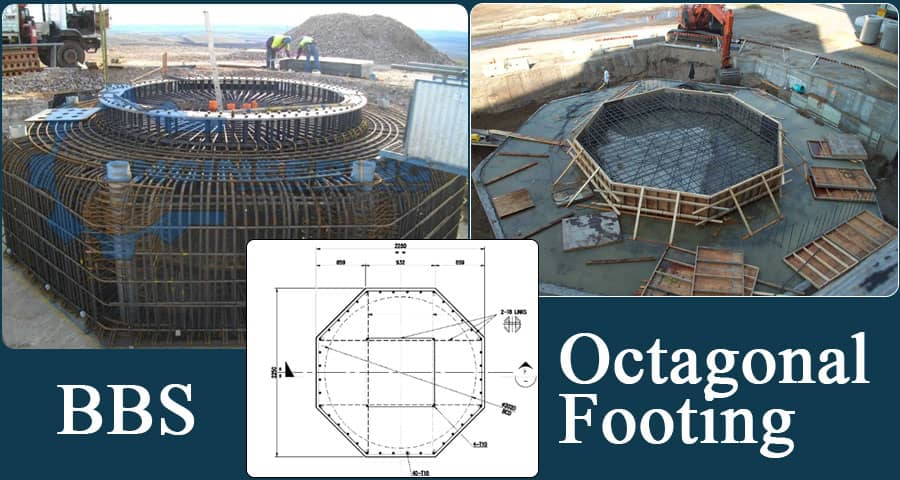
Introduction to Bar Bending Schedule of Octagonal Footing
In reinforced concrete construction, the Bar Bending Schedule (BBS) is an essential document that provides complete details of reinforcement bars including bar shape, length, number of bars, cutting length, bending length, and total steel quantity. When dealing with octagonal footing, the calculation becomes slightly more complex compared to square or rectangular footing due to its geometric shape. Therefore, we must follow a systematic method to calculate reinforcement steel accurately.
The Bar Bending Schedule of Octagonal Footing helps in estimating steel quantity, reducing wastage, planning procurement, and controlling project cost.
Understanding Octagonal Footing Geometry
An octagonal footing consists of eight equal sides, usually formed by cutting corners of a square footing. The reinforcement arrangement is generally provided in both bottom mesh and top mesh, along with column dowel bars.
Components of Reinforcement in Octagonal Footing
We normally calculate reinforcement for:
- Bottom reinforcement bars (both directions)
- Top reinforcement bars (if provided)
- Column dowel bars
- Extra bars at edges or corners
- Distribution bars
- Chairs (if required)
Before starting BBS calculation, we must know:
- Footing size
- Thickness of footing
- Clear cover
- Bar diameter
- Spacing of reinforcement
- Column size
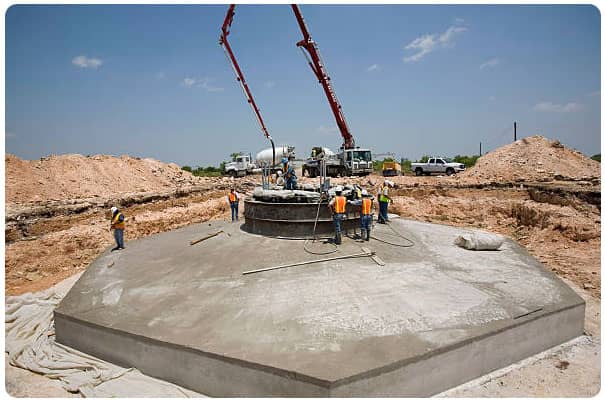
Step-by-Step Calculation of Bar Bending Schedule
Step 1 - Calculate Effective Length of Footing
Effective length is calculated by subtracting clear cover from both sides.
Formula:
Effective Length = Footing Size - 2 x Clear Cover
For example:
- Footing size = 2.4 m
- Clear cover = 50 mm
Effective length = 2400 - 2 x 50
Effective length = 2300 mm
This effective length will be used to calculate bar length.
Step 2 - Calculate Number of Bars
Number of bars is calculated using spacing.
Formula:
Number of Bars = (Effective Length / Spacing) + 1
Example:
- Effective length = 2300 mm
- Spacing = 150 mm
Number of bars = 2300 / 150 + 1
Number of bars = 15.33 + 1
Number of bars = 17 Bars
We calculate bars in both directions.
Step 3 - Cutting Length of Bottom Bars
Cutting length of reinforcement bar includes:
- Effective length
- Bend allowance
- Hook length (if provided)
Hook Length Formula
Hook Length = 9d (where d = bar diameter)
Bend Length Formula
Bend Length = 2d
Cutting Length Formula
Cutting Length = Effective Length + Hook Length + Bend Length
Example:
- Effective length = 2300 mm
- Bar diameter = 12 mm
Hook length = 9 x 12 = 108 mm
Bend length = 2 x 12 = 24 mm
Cutting length = 2300 + 108 + 24
Cutting length = 2432 mm
Step 4 - Calculate Total Length of Bars
Total length = Number of bars x Cutting length
Example:
Total length = 17 x 2.432 m
Total length = 41.34 m
We calculate this for both directions.
Step 5 - Calculate Weight of Steel Bars
Steel Weight Formula
Weight per meter = d2 / 162
Where d = diameter in mm
Example for 12 mm bar:
Weight per meter = 122 / 162
Weight per meter = 144 / 162
Weight per meter = 0.888 kg/m
Total weight = Total length x Weight per meter
Total weight = 41.34 x 0.888
Total weight = 36.71 kg
Repeat this process for all reinforcement bars.
Bar Bending Schedule Table for Octagonal Footing
| Bar Mark | Bar Diameter | Spacing | No. of Bars | Cutting Length (m) | Total Length (m) | Weight (kg) |
| B1 | 12 mm | 150 mm | 17 | 2.432 | 41.34 | 36.71 |
| B2 | 12 mm | 150 mm | 17 | 2.432 | 41.34 | 36.71 |
| Dowel | 16 mm | - | 8 | 1.2 | 9.6 | 15.17 |
Total Steel Required = Sum of all weights
Important Bending Allowances
| Bend Angle | Bend Length |
| 45° | 1d |
| 90° | 2d |
| 135° | 3d |
| Hook | 9d |
These values are used while calculating cutting length.
Calculation of Column Dowel Bars
Column dowel bars extend from footing into column.
Dowel Bar Length Formula
Dowel Length = Footing Thickness - Cover + Development Length + Column Lap Length
Development length formula:
Development Length = 50d
Example:
- Bar diameter = 16 mm
- Development length = 50 x 16 = 800 mm
Total dowel length may be around 1.2 m to 1.5 m depending on design.
Final Steel Quantity Calculation
Total Steel = Bottom Bars + Top Bars + Dowel Bars + Extra Bars
Example Summary:
- Bottom steel = 73.42 kg
- Top steel = 55.10 kg
- Dowels = 15.17 kg
Total Steel Required = 143.69 kg
Advantages of Preparing Bar Bending Schedule
The Bar Bending Schedule for Octagonal Footing provides:
- Accurate steel quantity
- Cost estimation
- Reduced steel wastage
- Easy site execution
- Proper planning and inventory control
- Time saving during construction
- Better structural quality control
Conclusion
The Bar Bending Schedule of Octagonal Footing is calculated by determining effective length, number of bars, cutting length, total bar length, and steel weight. Proper calculation ensures accurate steel estimation, reduced wastage, and efficient construction management. By following systematic steps and standard formulas for hook length, bend allowance, and steel weight, we can prepare a precise and professional BBS for octagonal footing used in reinforced concrete structures.
Please watch the following short video for Calculate Bar Bending Schedule of Octagonal Footing
Also Read:
 Winter Centerpieces for Table: Modern, Luxurious, and Light Ideas