
10 Difference Between Compaction and Consolidation
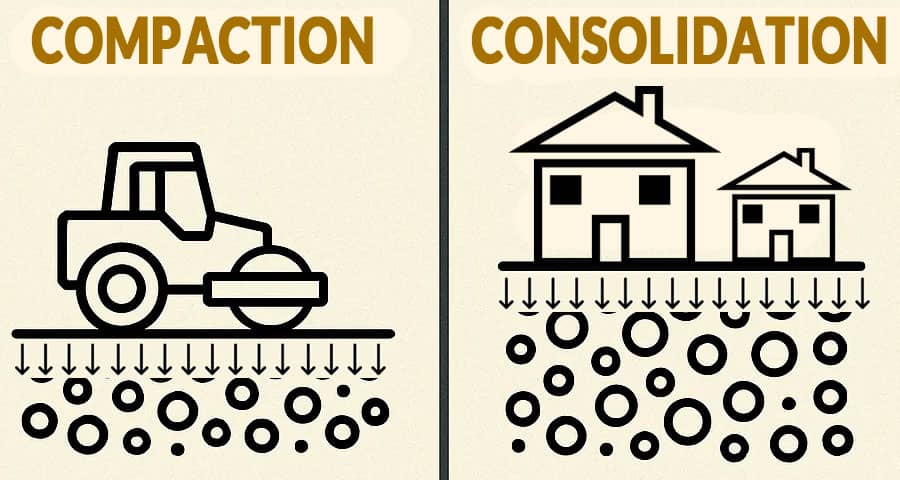
In geotechnical engineering and soil mechanics, compaction and consolidation are two fundamental processes that directly influence the behavior, strength, stability, and settlement characteristics of soil. Although these terms are often used together in civil engineering discussions, they are not the same. We must distinguish them clearly because each process occurs under different conditions, involves different mechanisms, and produces different engineering outcomes.
Understanding the difference between compaction and consolidation is essential in the design of foundations, embankments, highways, earth dams, retaining structures, and building platforms. If we treat one as the other, we risk poor construction quality, excessive settlement, reduced bearing capacity, and structural distress.
What Is Compaction in Soil Mechanics?
Compaction is the process of densifying soil by mechanical means. In this process, soil particles are forced closer together by applying external energy through methods such as rolling, ramming, tamping, kneading, or vibration. The primary result is a reduction in air voids within the soil mass.
Compaction is generally performed during construction activities to improve soil properties. It increases the dry density of the soil, enhances shear strength, reduces compressibility, lowers permeability in some soils, and improves the overall load-bearing capacity of the ground.
In practical construction, compaction is controlled by adjusting the moisture content, selecting the appropriate compaction equipment, and applying sufficient compactive effort. The process is rapid and can usually be achieved in a short duration during site preparation or earthwork operations.
What Is Consolidation in Soil Mechanics?
Consolidation is the process by which soil decreases in volume over time due to the expulsion of water from its voids under sustained load. It is most significant in saturated fine-grained soils, especially clays.
When a load is applied to saturated soil, the water in the pores initially carries a large portion of that load. Over time, as the pore water gradually escapes through drainage paths, the stress is transferred to the soil skeleton, causing the soil structure to compress and settle. This time-dependent reduction in volume is called consolidation.
Consolidation is responsible for long-term settlement beneath structures such as buildings, tanks, highways, bridge abutments, and embankments. Unlike compaction, consolidation is not an immediate construction activity but a natural or induced response of soil under loading.
Why the Difference Between Compaction and Consolidation Matters
The distinction between compaction and consolidation matters because each process affects soil differently. Compaction is used deliberately to improve soil before or during construction. Consolidation, by contrast, is typically an effect that engineers must predict, manage, and control after loading.
Where compaction improves the engineering behavior of soil by reducing air voids, consolidation changes soil volume by reducing water-filled voids under pressure. One is intentional and immediate, while the other is gradual and load-dependent.
10 Difference Between Compaction and Consolidation
1. Basic Definition of Compaction and Consolidation
The first and most important difference is in the basic definition.
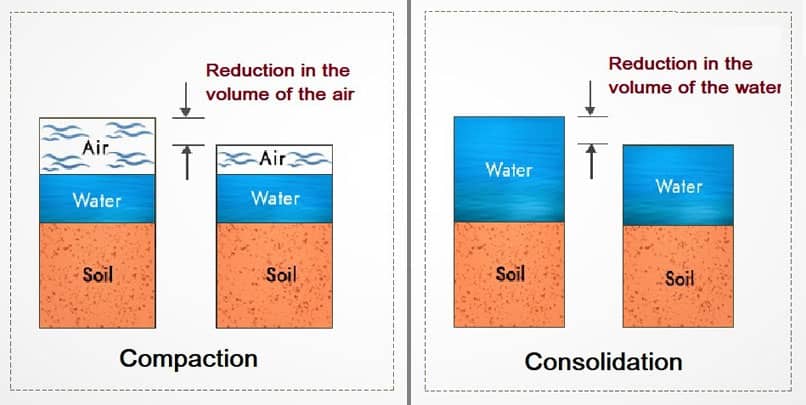
Compaction is the artificial densification of soil by mechanical energy, mainly through the reduction of air voids.
Consolidation is the gradual reduction in soil volume under sustained load, mainly through the expulsion of water from voids.
This distinction forms the foundation of soil behavior analysis in civil engineering.
2. Cause of the Process
The second major difference lies in what causes the process to occur.
Compaction is caused by external mechanical effort. Rollers, vibratory compactors, rammers, and tampers apply force that rearranges soil particles into a denser state.
Consolidation is caused by static loading over time. Loads from buildings, embankments, fills, or foundations increase pressure on saturated soils, leading to slow drainage and compression.
In simple terms, compaction is driven by construction equipment, while consolidation is driven by applied structural load.
3. Type of Void Reduced
Another critical difference is the type of void space that decreases.
In compaction, the reduction occurs mainly in air voids. The soil contains air in its pores, and mechanical energy pushes particles closer, decreasing the space occupied by air.
In consolidation, the reduction occurs mainly in water-filled voids. The pore water is expelled slowly as the load acts over time.
This distinction is vital because it explains why compaction can be fast and why consolidation is usually slow.
4. Soil Condition Required
The fourth difference concerns the type and condition of soil in which each process is prominent.
Compaction can occur in partially saturated soils, especially in granular soils, silts, and engineered fills. Moisture content is important, but the soil is not necessarily fully saturated.
Consolidation is most significant in fully saturated cohesive soils, especially soft clays and silty clays. Without pore water pressure and drainage, classical consolidation does not occur in the same way.
Thus, compaction is commonly associated with construction fill materials, whereas consolidation is strongly associated with saturated clay deposits.
5. Time Required for the Process
Time is one of the clearest differences between compaction and consolidation.
Compaction is generally an immediate process. Once the required mechanical effort is applied, the soil densifies almost instantly.
Consolidation is a time-dependent process. It may take days, months, or even years, depending on soil permeability, drainage conditions, thickness of the compressible layer, and the magnitude of loading.
This is why settlement analysis is essential for clayey subsoil but not usually for freshly compacted fill alone.
6. Nature of Water Movement
The sixth difference is related to drainage and water movement.
During compaction, there is typically little or no significant drainage of water from the soil mass. The process mainly rearranges soil particles and removes air.
During consolidation, water drainage is the core mechanism. Excess pore water pressure develops under load, and consolidation proceeds as water escapes from the soil voids.
This makes permeability a central factor in consolidation but a less dominant factor in compaction behavior.
7. Engineering Objective
The purpose behind each process also differs.
The objective of compaction is to improve soil properties for construction. We compact soil to achieve higher density, greater stability, reduced settlement potential, increased bearing capacity, and better pavement or foundation support.
The objective associated with consolidation is not improvement by direct action alone; rather, it is the natural compression behavior of soil under sustained loading that engineers must account for in design. In some projects, preloading or surcharge is used intentionally to accelerate consolidation before construction, but consolidation itself is primarily a settlement process.
Therefore, compaction is a construction technique, while consolidation is a soil response phenomenon.
8. Effect on Soil Strength
Compaction and consolidation both affect soil strength, but they do so differently.
Compaction usually produces an immediate increase in shear strength because the soil becomes denser and particles interlock more effectively. A well-compacted soil layer is generally stronger and more stable under applied loads.
Consolidation may increase effective stress and improve the long-term strength of some cohesive soils, but it also causes settlement, which can be harmful to structures if not anticipated. The benefit in strength is secondary to the settlement behavior that consolidation produces.
From a practical point of view, compaction is used directly to gain strength, while consolidation is managed mainly to limit deformation.
9. Testing Methods Used
The laboratory and field methods used to study compaction and consolidation are different.
For compaction, the common laboratory test is the Proctor Compaction Test, including the Standard Proctor Test and Modified Proctor Test. These tests determine the optimum moisture content and maximum dry density of soil.
For consolidation, the standard laboratory test is the Oedometer Test or One-Dimensional Consolidation Test. This test measures the amount and rate of compression of a saturated soil specimen under different loading stages.
The difference in testing methods reflects the different engineering concerns: density control for compaction and settlement prediction for consolidation.
10. Field Examples of Compaction and Consolidation
The final difference becomes clear through real-world applications.
Compaction is commonly performed in:
- road subgrades
- railway embankments
- earth dams
- backfill around retaining walls
- foundation pads
- airfield pavements
- land development and site preparation
Consolidation is commonly observed in:
- soft clay beneath building foundations
- settlement under storage tanks
- embankments constructed over marshy land
- loaded reclaimed land
- bridge approaches
- large raft foundations on saturated clay deposits
These field cases show that compaction is a planned operation, while consolidation is an expected soil behavior under service loads.
Tabular Difference Between Compaction and Consolidation
| Basis of Difference | Compaction | Consolidation |
|---|---|---|
| Definition | Densification by mechanical effort | Volume reduction under sustained load |
| Main Void Reduced | Air voids | Water voids |
| Cause | External mechanical energy | Static load over time |
| Soil Condition | Usually partially saturated soil | Usually saturated fine-grained soil |
| Time Required | Immediate | Gradual and time-dependent |
| Drainage Involved | Minimal drainage | Water drainage essential |
| Typical Soils | Fills, sands, silts, mixed soils | Clays and saturated cohesive soils |
| Purpose | Improve soil for construction | Settlement response under load |
| Main Test | Proctor Test | Oedometer Test |
| Practical Result | Higher density and strength | Settlement and stress transfer |
Compaction and Consolidation in Construction Practice
In actual engineering projects, we often deal with both processes together. For example, when constructing an embankment on clayey ground, the fill material is compacted layer by layer to ensure stability. At the same time, the weight of that embankment may induce consolidation in the soft clay foundation beneath it.
This combined behavior is why geotechnical design must carefully separate the two concepts. The upper fill may perform well because of excellent compaction, while the subsoil beneath may still undergo long-term consolidation settlement. Good construction practice alone cannot eliminate settlement if the underlying soil is highly compressible and saturated.
Importance of Moisture Content in Compaction
Moisture content plays a decisive role in compaction. At low water content, soil particles resist movement, and adequate density cannot be achieved. As moisture increases, lubrication improves particle rearrangement, allowing the soil to reach its maximum dry density at the optimum moisture content. Beyond that point, excess water begins to occupy space and reduce dry density.
This behavior is unique to compaction control and is one of the reasons compaction is treated as a carefully monitored construction process.
Importance of Drainage Path in Consolidation
In consolidation, the rate of settlement depends heavily on the drainage path and soil permeability. Thick clay layers with poor drainage consolidate slowly because water has difficulty escaping. Engineers often accelerate this process using vertical drains, preloading, or surcharge loading to reduce future settlement before permanent construction begins.
This highlights another major distinction: compaction depends on mechanical effort and water content, while consolidation depends on load, permeability, and drainage time.
Conclusion: Difference Between Compaction and Consolidation
The difference between compaction and consolidation lies in their mechanism, timing, purpose, and engineering impact. Compaction is the rapid densification of soil by reducing air voids through mechanical means, mainly to improve construction quality and soil performance. Consolidation is the slow compression of saturated soil due to the expulsion of pore water under sustained loading, mainly associated with settlement behavior.
When we clearly understand these two processes, we can design safer foundations, construct stronger embankments, control settlement more effectively, and improve the long-term performance of civil engineering structures. In soil mechanics, this distinction is not merely theoretical. It is one of the most practical and essential concepts for successful construction and geotechnical design.
In summary, compaction is immediate, mechanical, and air-void reduction based, while consolidation is gradual, load-induced, and water-expulsion based. That single distinction explains why both terms matter so much in engineering practice.
Please watch the following short video for Difference Between Compaction and Consolidation
Also Read:
 Rate Analysis for Concrete: A Comprehensive Guide