
Thickness of Strip Foundation in Construction
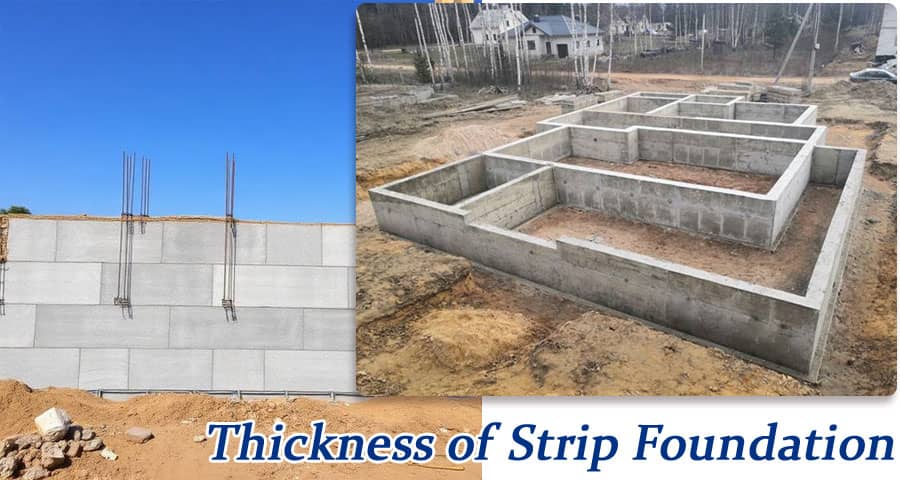
Understanding the Thickness of Strip Foundation in Building Construction
The thickness of strip foundation in construction plays a critical role in ensuring the stability, durability, and load-bearing performance of a structure. In residential, commercial, and industrial buildings, strip foundations are among the most commonly used shallow foundations because of their simplicity, cost-effectiveness, and efficiency in transferring loads safely to the soil.
When designing a strip foundation, the thickness cannot be selected randomly. It depends on several engineering parameters such as soil bearing capacity, wall load, building type, reinforcement details, and local construction standards. A properly designed strip footing minimizes settlement, prevents structural cracks, and improves the long-term performance of the building.
What Is a Strip Foundation?
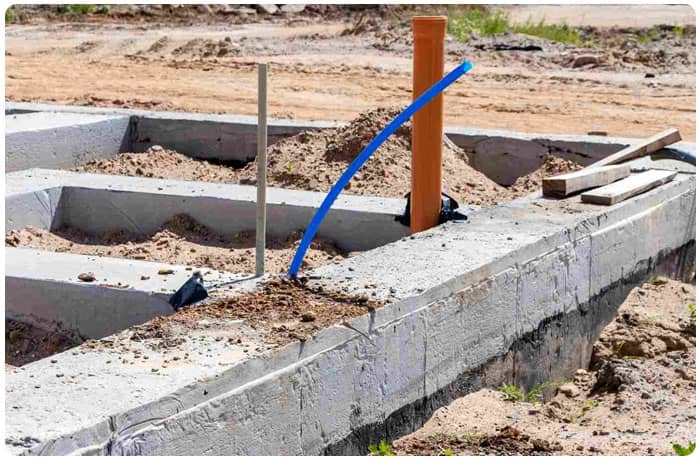
A strip foundation is a continuous strip of concrete constructed beneath load-bearing walls to distribute structural loads evenly into the ground. It is widely used for low-rise buildings where the soil has sufficient bearing capacity near the surface.
Strip foundations are usually constructed using:
- Plain cement concrete (PCC)
- Reinforced cement concrete (RCC)
- Brick masonry foundations
- Reinforced strip footings
These foundations run continuously under walls and transfer the load over a wider area to reduce pressure on the soil.
Standard Thickness of Strip Foundation
The standard thickness of a strip foundation depends on the structural load and soil conditions. However, typical construction practices follow these general guidelines:
| Building Type | Typical Thickness |
| Single-story building | 150 mm to 200 mm |
| Double-story building | 200 mm to 300 mm |
| Heavy-load structures | 300 mm to 450 mm |
| Reinforced strip footing | 250 mm to 500 mm |
In most residential projects, a strip footing thickness of 200 mm to 300 mm is commonly adopted.
Factors Affecting Strip Foundation Thickness
1. Soil Bearing Capacity
The bearing capacity of soil is one of the most important factors in foundation design. Weak soils require thicker and wider foundations to distribute loads safely.
Typical Soil Bearing Capacities
When the soil bearing capacity is low, engineers increase the foundation thickness to prevent excessive settlement.
| Soil Type | Bearing Capacity |
| Hard rock | Very high |
| Dense gravel | High |
| Sand | Moderate |
| Clay | Low |
| Loose soil | Very low |
2. Structural Load
The total load from walls, slabs, beams, columns, and roofs directly influences the thickness requirement.
Heavier buildings require:
- Greater footing depth
- Increased concrete thickness
- Additional reinforcement
For lightweight structures, thinner strip foundations may be sufficient.
3. Width of Foundation
The width and thickness of a strip footing are interconnected. Wider foundations generally require greater thickness to resist bending and shear forces.
Common Width-to-Thickness Ratio
A common engineering practice is:
Thickness ≈ width⁄2 to width⁄3
For example:
600 mm wide footing → 200 mm to 300 mm thick
900 mm wide footing → 300 mm thick
4. Reinforcement Requirement
Reinforced strip foundations can safely carry higher loads with reduced thickness compared to plain concrete foundations.
Plain Concrete Strip Foundation
- Requires larger thickness
- Suitable for lighter structures
RCC Strip Foundation
- Uses steel reinforcement
- Better bending resistance
- Suitable for multi-story buildings
5. Frost Depth and Environmental Conditions
In colder regions, foundations must extend below frost level to avoid frost heaving. Although frost depth mainly affects foundation depth, environmental conditions can also influence thickness requirements.
Minimum Thickness of Strip Foundation
The minimum thickness generally recommended for residential construction is:
tmin = 150 mm
However, in practical construction, engineers often prefer a minimum thickness of 200 mm for improved durability and strength.
Ideal Thickness for Residential Buildings
Single-Story House
For a standard single-story brick wall house:
- Thickness: 150 mm to 200 mm
- Width: 450 mm to 600 mm
This is sufficient for normal soil conditions.
Double-Story House
For two-story buildings:
- Thickness: 200 mm to 300 mm
- Reinforcement is usually recommended
This ensures better resistance against bending moments and soil settlement.
Multi-Story Buildings
For heavier structures:
- Thickness: 300 mm to 500 mm
- RCC strip footing is essential
Structural engineers perform detailed calculations before finalizing dimensions.
Thickness Calculation of Strip Foundation
The thickness of strip footing is determined based on bending moment and shear calculations.
Basic Structural Principle
The footing behaves like an inverted cantilever slab projecting from the wall face.
Simplified Relationship
M = (qL2)⁄2
Where:
- M = bending moment
- q = soil pressure
- L = projection length
The thickness is then designed to resist the calculated moment safely.
Concrete Grade Used in Strip Foundations
The concrete grade significantly influences foundation strength and thickness.
| Concrete Grade | Common Use |
| M10 | PCC bed |
| M15 | Light structures |
| M20 | Residential RCC footing |
| M25 and above | Heavy structures |
Higher concrete grades may allow optimized footing dimensions.
Reinforcement Details in Strip Footing
Reinforced strip foundations use steel bars to improve tensile strength.
Typical Reinforcement
- Main bars: 10 mm to 16 mm diameter
- Distribution bars: 8 mm to 10 mm diameter
- Cover: 50 mm minimum
The reinforcement arrangement depends on the load and footing thickness.
Difference Between Width and Thickness of Strip Foundation
Many people confuse footing width with thickness.
Width
- Horizontal dimension
- Helps distribute load
Thickness
- Vertical depth of concrete
- Provides structural strength against bending and shear
Both dimensions are equally important in foundation stability.
Advantages of Proper Strip Foundation Thickness
Improved Structural Stability
Adequate thickness prevents cracking and differential settlement.
Better Load Distribution
A properly sized footing spreads the building load uniformly.
Increased Durability
Thicker foundations resist moisture penetration and environmental deterioration.
Reduced Settlement
Correct thickness minimizes uneven settlement that can damage walls and floors.
Common Problems Due to Insufficient Thickness
When strip foundations are too thin, several structural issues may occur:
- Foundation cracking
- Excessive settlement
- Wall cracks
- Uneven floors
- Structural instability
- Reduced building lifespan
Poor foundation design can lead to costly repairs later.
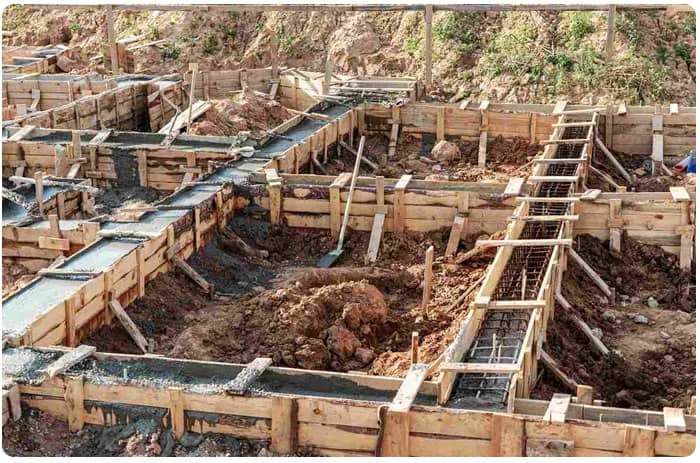
Construction Procedure for Strip Foundation
1. Site Marking
The layout of walls and foundation trenches is marked accurately.
2. Excavation
Trenches are excavated according to design width and depth.
3. PCC Layer
A plain cement concrete layer is placed as a leveling course.
4. Reinforcement Placement
Steel reinforcement is fixed as per structural drawings.
5. Formwork Installation
Shuttering is installed to maintain footing dimensions.
6. Concrete Pouring
Concrete is poured and compacted properly.
7. Curing
The foundation is cured for at least 7 to 14 days for strength development.
Recommended Thickness Based on Soil Conditions
| Soil Condition | Recommended Thickness |
| Hard soil | 150 mm to 200 mm |
| Medium soil | 200 mm to 300 mm |
| Soft soil | 300 mm to 450 mm |
| Expansive clay | Structural design required |
Strip Foundation Thickness for Brick Walls
230 mm Brick Wall
Typical foundation dimensions:
- Width: 600 mm to 750 mm
- Thickness: 200 mm to 300 mm
115 mm Partition Wall
Typical foundation dimensions:
- Width: 300 mm to 450 mm
- Thickness: 150 mm to 200 mm
Importance of Engineering Design
Although standard guidelines are available, the final thickness should always be determined by a qualified structural engineer. Every construction site has unique conditions including:
- Soil properties
- Groundwater level
- Structural load
- Seismic considerations
- Building usage
Professional design ensures safety and compliance with local building codes.
Conclusion
The thickness of strip foundation in construction is one of the most important aspects of structural safety and building durability. A properly designed strip footing provides adequate load distribution, minimizes settlement, and enhances the overall stability of the structure. In residential buildings, strip foundation thickness commonly ranges from 150 mm to 300 mm, while heavier structures may require much thicker reinforced footings.
The correct thickness depends on several factors including soil bearing capacity, building load, footing width, reinforcement details, and environmental conditions. Careful engineering analysis and proper construction practices ensure that the foundation performs effectively throughout the life of the building.
By selecting the appropriate strip foundation thickness, we create stronger, safer, and longer-lasting structures capable of withstanding various structural and environmental stresses.
Frequently Asked Questions (FAQs)
What is the standard thickness of strip foundation?
The standard thickness generally ranges from 150 mm to 300 mm depending on building load and soil condition.
What is the minimum thickness of strip footing?
The minimum recommended thickness is usually 150 mm, though 200 mm is preferred for residential construction.
Which concrete grade is used for strip foundations?
M15 to M20 concrete grades are commonly used in residential strip foundations.
Can strip foundations be reinforced?
Yes, RCC strip foundations are widely used for heavier buildings and weak soil conditions.
How is strip foundation thickness calculated?
It is calculated based on structural load, bending moment, shear force, and soil bearing capacity using engineering design principles.
Is strip foundation suitable for all soil types?
Strip foundations work best on soils with good bearing capacity. Weak or expansive soils may require special foundation systems.
Please view the following short video tutorial for Thickness of Strip Foundation in Construction
Also Read:
 Hard Hat | Hard Hat Colour Definition | Different Hard Hat Colour Codes | Types of Safety Helmets | Classification of Hard Hats