
Weir: Types, Advantages, Disadvantages, Operation, Limitations, and Location of Weirs
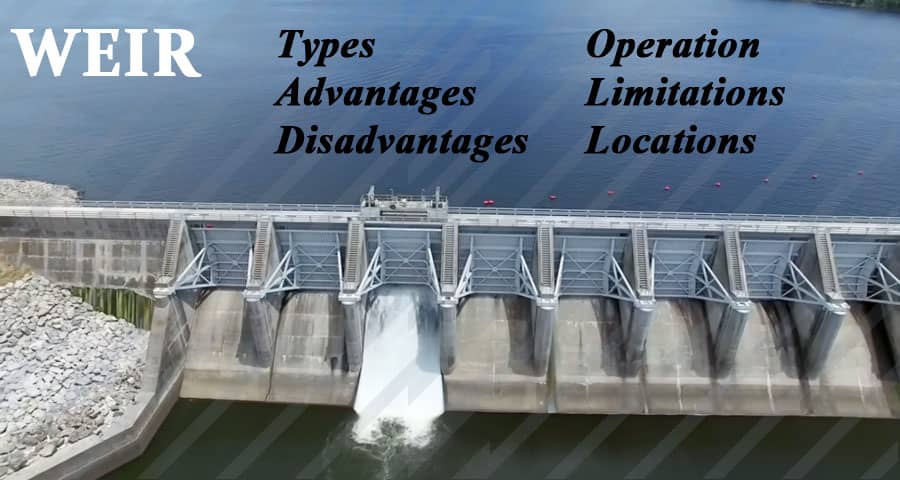
A weir is a carefully engineered hydraulic structure constructed across an open channel or river to control, measure, and regulate the flow of water. Weirs play a critical role in water resource management, irrigation systems, flood control, wastewater treatment plants, and hydrological studies. By obstructing and raising the water level upstream, a weir allows accurate discharge measurement and controlled distribution of water downstream.
In modern civil and environmental engineering, weirs are valued for their simplicity, accuracy, reliability, and cost-effectiveness. Their design varies depending on the purpose, site conditions, and flow characteristics.
What Is a Weir in Civil Engineering
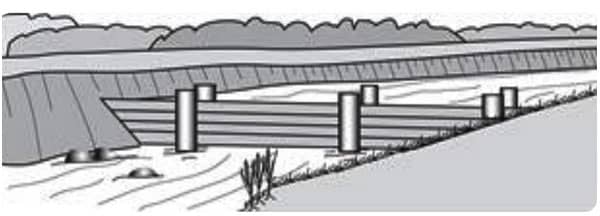
In civil engineering terms, a weir is a barrier built perpendicular to the direction of flow, over which water flows at a controlled elevation known as the crest level. The height of water above the crest determines the discharge rate, making weirs highly suitable for flow measurement in open channels.
Weirs differ from dams in scale and function. While dams primarily store water, weirs are designed to regulate and measure flow without significant storage capacity.
Purpose and Functions of Weirs
Weirs serve multiple essential purposes in hydraulic systems:
- Measurement of water discharge
- Raising upstream water level for irrigation canals
- Flow regulation and distribution
- Sediment control
- Flood management
- Energy dissipation
- Wastewater flow monitoring
Their adaptability makes them indispensable in both small-scale channels and large river systems.
Types of Weirs
Weirs are classified based on shape, crest profile, hydraulic behavior, and purpose. Each type is designed to suit specific flow conditions.
1. Sharp-Crested Weir
A sharp-crested weir has a thin crest edge that causes water to spring clear of the crest.
Subtypes of Sharp-Crested Weirs
- Rectangular Weir
- Triangular (V-Notch) Weir
- Trapezoidal (Cipolletti) Weir
Applications
- Laboratory experiments
- Flow measurement in small channels
- Wastewater treatment plants
Key Characteristics
- High accuracy
- Suitable for low flows
- Simple construction
2. Broad-Crested Weir
A broad-crested weir has a long, flat crest over which water flows with nearly parallel streamlines.
Applications
- Rivers and canals
- Irrigation systems
- Flood control structures
Key Characteristics
- Stable flow conditions
- Suitable for large discharges
- Low maintenance
3. Ogee Weir
An ogee weir has an S-shaped crest profile designed to match the natural trajectory of water flow.
Applications
- Spillways of dams
- High-head structures
Key Characteristics
- High discharge efficiency
- Reduced energy loss
- Excellent structural stability
4. Submerged Weir
A submerged weir operates when downstream water level partially or fully submerges the crest.
Applications
- Tidal rivers
- Backwater conditions
Key Characteristics
- Reduced discharge accuracy
- Requires correction factors
5. Proportional Weir
A proportional weir maintains a constant relationship between water depth and discharge.
Applications
- Automatic flow regulation
- Sewage systems
Operation of a Weir
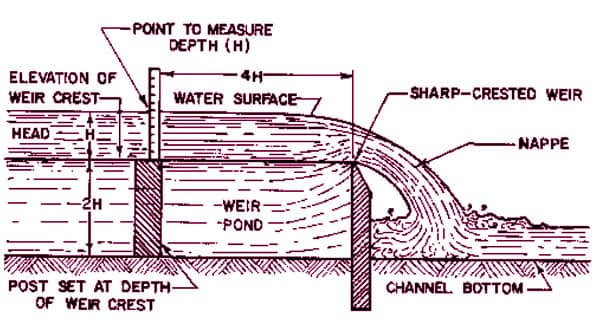
The operation of a weir is governed by the principle that discharge is a function of head over the crest. As water approaches the weir:
- Velocity decreases upstream
- Water level rises
- Flow accelerates over the crest
- A free nappe forms downstream (in free-flow conditions)
The discharge is calculated using standardized equations based on:
- Crest shape
- Head of water
- Coefficient of discharge
Accurate operation requires proper installation, calibration, and maintenance.
Hydraulic Behavior of Weirs
The hydraulic performance of a weir depends on:
- Upstream approach velocity
- Crest geometry
- Downstream water level
- Flow regime (free or submerged)
Maintaining free-flow conditions is essential for accurate discharge measurement.
Advantages of Weirs
Weirs offer several practical and economic advantages:
- High accuracy in flow measurement
- Simple design and construction
- Low installation cost
- Minimal maintenance
- Suitable for a wide range of flows
- Durable and long-lasting
- Easy visual inspection
- Reliable performance
These benefits make weirs a preferred choice in hydraulic engineering projects worldwide.
Disadvantages of Weirs
Despite their benefits, weirs have certain limitations:
- Not suitable for sediment-laden flows
- Can cause upstream flooding if poorly designed
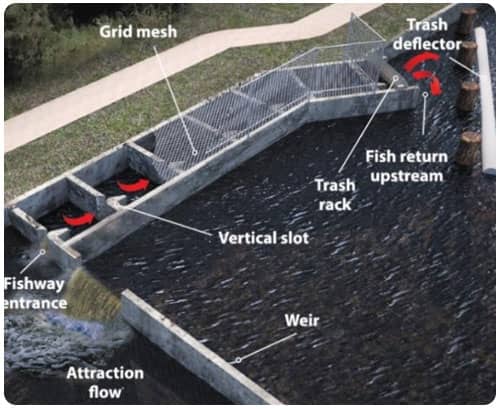
- Obstruction to fish migration
- Limited capacity during extreme floods
- Accuracy affected by submergence
- Requires sufficient head loss
Limitations of Weirs
The limitations of weirs must be carefully evaluated during design:
- Performance reduces under submerged conditions
- Sediment deposition upstream affects accuracy
- Debris accumulation requires regular cleaning
- Not ideal for very large rivers
- Seasonal flow variations impact calibration
Understanding these limitations ensures safe and efficient weir operation.
Location of Weirs
The location of weirs is critical to their effectiveness and longevity. Ideal locations include:
- Straight reaches of rivers
- Uniform channel sections
- Stable riverbeds
- Areas with minimal sediment load
- Easily accessible sites for maintenance
Weirs should be placed where approach flow is uniform and free from turbulence to ensure reliable performance.
Design Considerations for Weirs
Key design factors include:
- Expected discharge range
- Crest height and shape
- Upstream and downstream water levels
- Channel geometry
- Structural stability
- Environmental impact
Proper design ensures accuracy, safety, and durability.
Applications of Weirs
Weirs are extensively used in:
- Irrigation engineering
- Hydropower projects
- Municipal water supply
- Wastewater treatment plants
- Flood control systems
- Hydrological research
Their versatility makes them indispensable in modern infrastructure.
Conclusion
A weir is a fundamental hydraulic structure that plays a vital role in water management systems. With various types such as sharp-crested, broad-crested, ogee, submerged, and proportional weirs, engineers can select the most suitable design for precise flow control and measurement. While weirs offer accuracy, simplicity, and reliability, their limitations and site conditions must be carefully considered to ensure optimal performance.
Please view the following short video for Weir
Also Read:
 How to Read Engineering Drawings | How to Study Civil Engineering Drawing