
Concrete of Spread Footing: Design, Construction, and Best Practices
Introduction to Concrete Spread Footing
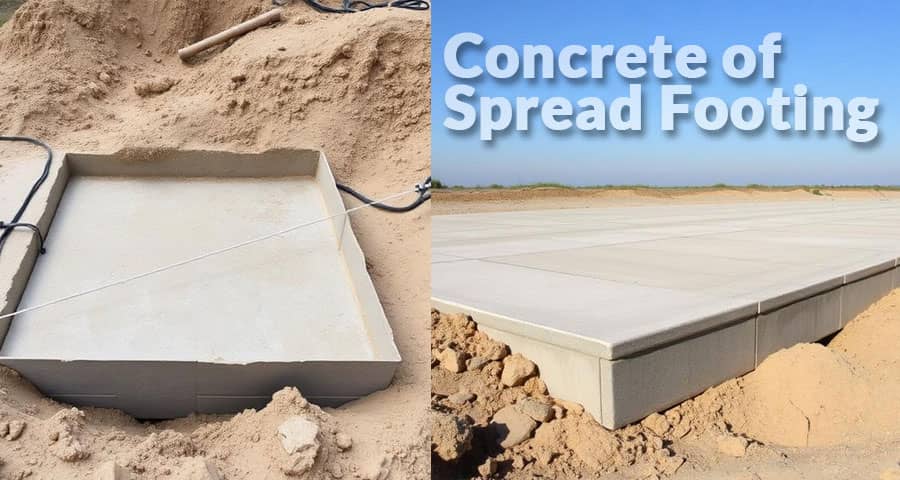
We define concrete spread footing as one of the most widely used shallow foundation systems in modern construction. It is specifically designed to transfer structural loads safely to the soil by distributing the weight over a larger area. This ensures stability, minimizes settlement, and enhances the durability of the structure.
Spread footings are commonly used for residential buildings, commercial structures, and light industrial facilities, where soil bearing capacity is adequate near the surface. Their simplicity, cost-effectiveness, and efficiency make them a preferred choice in foundation engineering.
Types of Spread Footings in Concrete Construction
We classify spread footings into several types based on structural requirements and load distribution:
1. Isolated Footing
Used for individual columns, isolated footings are square, rectangular, or circular in shape. They are ideal when columns are spaced far apart and loads are moderate.
2. Combined Footing
We use combined footings when two or more columns are close together, and their loads overlap. These footings can be rectangular or trapezoidal.
3. Strap Footing
A strap footing connects two isolated footings with a beam. It is used when one column is near a property boundary and cannot have a centered footing.
4. Continuous (Strip) Footing
Designed for load-bearing walls, continuous footings run along the length of the wall, distributing loads evenly.
5. Mat or Raft Foundation
Though technically a type of spread foundation, a mat footing supports multiple columns and walls over a large area, especially in low soil bearing conditions.
Materials Used in Concrete Spread Footing
We ensure that the quality of materials directly impacts the performance of the footing:
- Cement: High-grade cement ensures strength and durability
- Aggregates: Properly graded coarse and fine aggregates enhance load-bearing capacity
- Water: Clean and potable water is essential for proper hydration
- Reinforcement Steel: Steel bars provide tensile strength and prevent cracking
- Admixtures: Improve workability, setting time, and durability
Design Considerations for Spread Footing
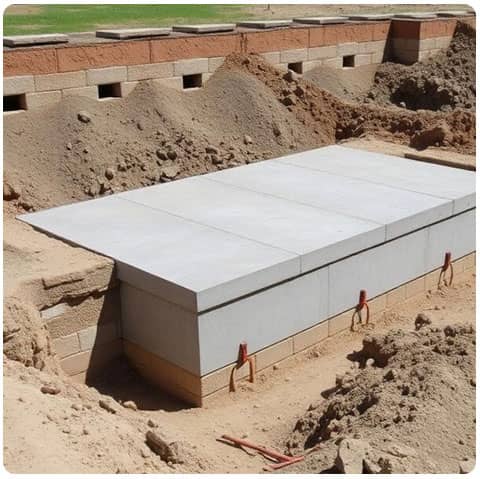
We carefully analyze several factors before designing a concrete spread footing:
Soil Bearing Capacity
The safe bearing capacity of soil determines the size and depth of the footing. Proper geotechnical investigation is essential.
Load Calculation
We consider dead loads, live loads, wind loads, and seismic loads while designing the footing.
Depth of Footing
Depth depends on frost level, soil type, and groundwater conditions.
Settlement Control
Uniform load distribution is critical to prevent differential settlement.
Reinforcement Detailing
We design reinforcement to resist bending moments, shear forces, and cracking.
Construction Process of Concrete Spread Footing
We follow a systematic approach to ensure quality construction:
1. Site Preparation
We clear and level the site, removing debris and organic materials.
2. Excavation
Excavation is carried out to the required depth and dimensions, ensuring stable side slopes.
3. Bed Preparation
A layer of plain cement concrete (PCC) is laid to provide a clean and level base.
4. Formwork Installation
We install formwork to shape the footing and retain concrete during pouring.
5. Reinforcement Placement
Steel bars are placed as per design specifications with proper spacing and cover.
6. Concrete Pouring
We pour high-quality concrete and compact it using vibrators to eliminate air voids.
7. Curing
Proper curing is maintained for at least 7 to 14 days to achieve desired strength.
Advantages of Concrete Spread Footing
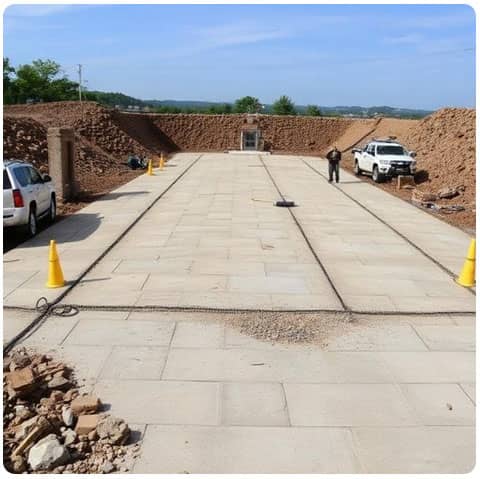
We highlight the key benefits that make spread footing a preferred foundation system:
- Cost-effective solution for shallow foundations
- Simple design and construction process
- Efficient load distribution
- Minimal excavation required
- Suitable for stable soil conditions
Limitations of Spread Footing
Despite its advantages, we acknowledge certain limitations:
- Not suitable for weak or highly compressible soils
- Limited application in high-rise buildings
- Risk of differential settlement if soil conditions vary
- Requires adequate space for load distribution
Reinforcement Details in Spread Footing
We ensure proper reinforcement to enhance structural performance:
- Bottom reinforcement resists tensile stresses
- Distribution bars maintain structural integrity
- Cover blocks ensure protection against corrosion
- Anchorage and lap lengths are provided as per standards
Quality Control Measures
We implement strict quality control to ensure durability:
- Material testing before use
- Monitoring water-cement ratio
- Ensuring proper compaction and curing
- Regular inspection of reinforcement placement
Common Failures and Prevention
We identify potential failures and apply preventive measures:
Shear Failure
Prevented by increasing footing thickness and reinforcement
Settlement Failure
Controlled through soil improvement and proper design
Cracking
Avoided by maintaining adequate curing and reinforcement
Best Practices for Concrete Spread Footing
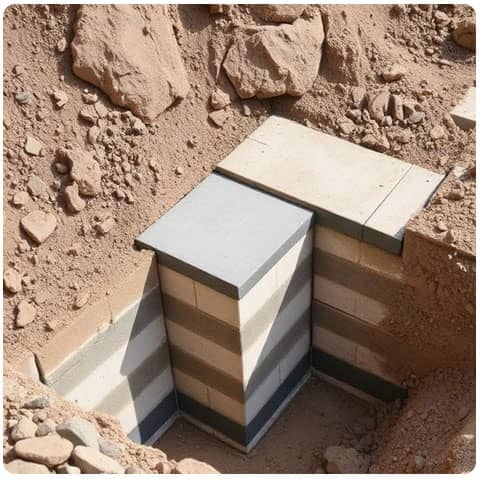
We adopt industry best practices to achieve optimal performance:
- Conduct detailed soil investigation
- Use high-quality materials
- Follow design codes and standards
- Ensure proper site supervision
- Maintain strict curing procedures
Applications of Spread Footing
We utilize concrete spread footing in various construction projects:
- Residential buildings
- Commercial complexes
- Industrial structures
- Boundary walls and small structures
Conclusion
We establish that concrete spread footing remains one of the most reliable and economical foundation systems in construction. Its ability to efficiently transfer loads, simplify construction, and reduce costs makes it indispensable in modern engineering practices. By following proper design principles, using quality materials, and maintaining construction standards, we ensure long-lasting and structurally sound foundations.
Please watch the following short video for Concrete of Spread Footing
Also Read:
 Differences Between Mild Steel and Stainless Steel
Difference Between CPM and PERT: A Complete Guide for Effective Project Management
Difference Between Sewerage and Storm Drain - A Complete Expert Guide
Dressing of Stone and Its Types: A Complete Guide for Construction Excellence
Difference Between Bridge and Culvert - A Complete Engineering Guide