
J-Ring Test in concrete: Equipment and Procedue
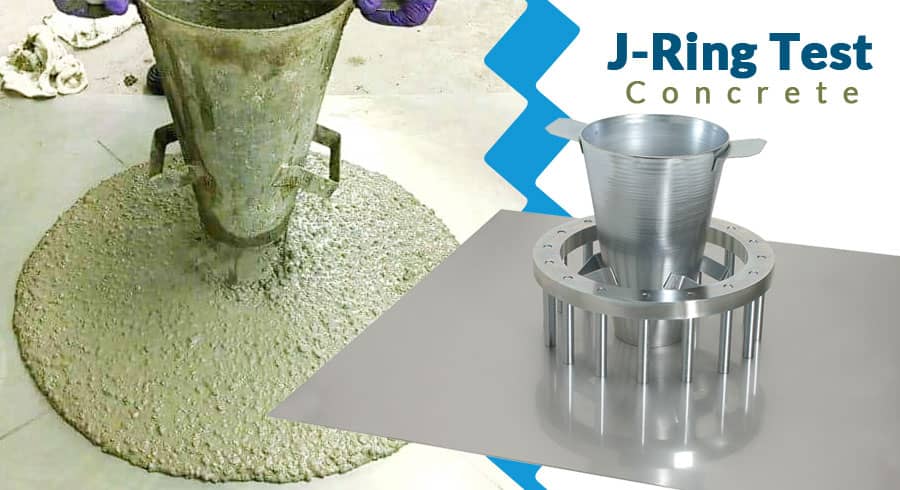
Introduction to J-Ring Test in Concrete
The J-Ring Test in concrete is a widely adopted method for evaluating the passing ability and flow characteristics of self-compacting concrete (SCC). In modern construction practices, where complex reinforcement and congested sections are common, ensuring that concrete can flow easily without segregation is critical. We use the J-Ring test to simulate real-world conditions where concrete must pass through obstacles such as reinforcement bars.
This test is essential for determining whether concrete possesses the necessary workability, flowability, and resistance to blocking, ensuring structural integrity and durability in advanced construction projects.
Purpose of J-Ring Test
The primary objective of the J-Ring Test is to measure the ability of fresh concrete to flow through tight spaces and around obstructions without segregation or blocking.
We rely on this test to:
- Evaluate passing ability of self-compacting concrete
- Determine flow consistency under restricted conditions
- Identify potential blocking due to aggregate size or mix design
- Ensure uniform filling in heavily reinforced structures
- Assess difference in flow between free flow and obstructed flow
Principle of J-Ring Test
The J-Ring test works on a simple but effective principle. We measure the difference in spread diameter and height of concrete flow with and without obstacles.
When concrete flows freely, it spreads uniformly. However, when a ring of vertical bars (J-Ring) is introduced, the flow gets restricted. The difference between these two conditions helps us determine the blocking tendency and passing ability.
A smaller difference indicates better performance, while a larger difference highlights potential issues in the concrete mix.
Equipment Required for J-Ring Test
To perform the J-Ring Test in concrete, we require a set of standardized equipment designed for accuracy and repeatability.
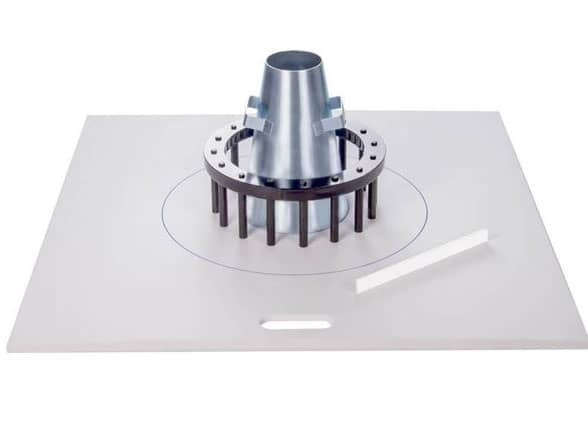
1. J-Ring Apparatus
The J-Ring consists of a circular ring fitted with evenly spaced vertical steel rods. These rods simulate reinforcement bars in actual structures.
Diameter: Typically 300 mm
Number of rods: Usually 16 rods
Rod spacing: Uniform to create obstruction
2. Slump Cone (Abrams Cone)
Used to measure the flow spread of concrete.
Height: 300 mm
Top diameter: 100 mm
Bottom diameter: 200 mm
3. Base Plate
A smooth, non-absorbent surface on which the test is conducted. It usually includes:
Concentric circles for measuring spread
Level surface for accurate readings
4. Measuring Scale
Used to measure:
Spread diameter
Height difference
Flow distribution
5. Stopwatch
Used to record the flow time, which indicates viscosity.
6. Trowel and Scoop
For handling and placing concrete in the cone.
Preparation Before Conducting the Test
Before starting the J-Ring test, we ensure:
- The base plate is clean and level
- All equipment is moist but free from excess water
- The J-Ring is placed centrally around the slump cone
- Concrete is freshly mixed and homogeneous
Proper preparation ensures accurate and reliable results.
Step-by-Step Procedure of J-Ring Test
We follow a systematic process to conduct the J-Ring Test in concrete:
Step 1: Placement of Equipment
We place the J-Ring centrally on the base plate, ensuring stability. The slump cone is then positioned inside the ring.
Step 2: Filling the Cone
We fill the slump cone with fresh concrete in one continuous layer without any compaction or tamping. This is crucial for self-compacting concrete.
Step 3: Lifting the Cone
We lift the cone vertically in a smooth motion within 2 - 5 seconds, allowing the concrete to flow freely through the J-Ring.
Step 4: Measuring Flow Spread
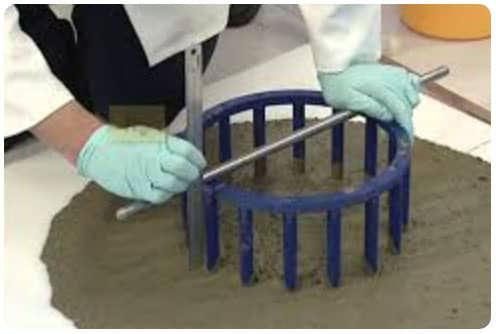
We measure the diameter of the spread concrete in two perpendicular directions and calculate the average.
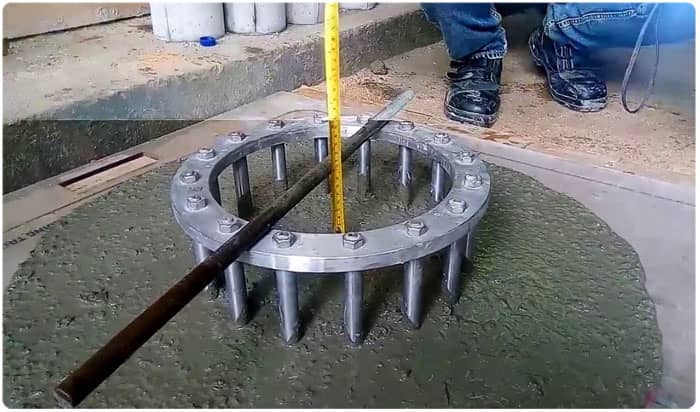
Step 5: Recording Height Difference
We measure the difference in height between the concrete inside and outside the J-Ring. This indicates the blocking effect.
Step 6: Observing Flow Behavior
We carefully observe:
- Uniformity of spread
- Any signs of segregation
- Blocking or uneven distribution
Key Observations and Measurements
During the test, we record the following critical parameters:
- Flow diameter (mm)
- T50 flow time (seconds) (time taken to reach 500 mm spread)
- Height difference (mm)
- Visual stability (segregation or bleeding)
These measurements help us evaluate the performance of the concrete mix.
Interpretation of Results
The results of the J-Ring Test provide valuable insights into the quality of self-compacting concrete.
1. Flow Diameter
- High spread (650 - 800 mm): Good flowability
- Low spread: Poor workability
2. Height Difference
- 0 - 10 mm: Excellent passing ability
- 10 - 20 mm: Moderate blocking
- >20 mm: Poor passing ability
3. Flow Pattern
- Uniform spread indicates good mix design
- Uneven flow suggests segregation or obstruction
Advantages of J-Ring Test
The J-Ring Test in concrete offers multiple benefits in practical applications:
- Accurate simulation of field conditions
- Easy and quick to perform
- Provides reliable assessment of passing ability
- Helps in optimizing mix design
- Suitable for quality control on-site
Limitations of J-Ring Test
Despite its usefulness, the test has certain limitations:
- Results may vary based on operator skill
- Not suitable for non-self-compacting concrete
- Requires careful calibration of equipment
- Limited in assessing long-term performance
Applications of J-Ring Test in Construction
We widely use the J-Ring test in projects involving:
- Heavily reinforced concrete structures
- Bridges and flyovers
- High-rise buildings
- Precast concrete elements
- Complex formwork designs
In such cases, ensuring proper flow without vibration is critical, making this test indispensable.
Factors Affecting J-Ring Test Results
Several factors influence the outcome of the test:
1. Aggregate Size and Shape
Larger aggregates can cause blocking between rods, affecting flow.
2. Water-Cement Ratio
Higher ratios improve flow but may lead to segregation.
3. Admixtures
Superplasticizers enhance flowability, while viscosity modifiers control stability.
4. Mix Proportion
Improper proportions can result in poor passing ability.
Comparison with Slump Flow Test
While both tests evaluate flowability, they differ significantly:
| Parameter | Slump Flow Test | J-Ring Test |
|---|---|---|
| Obstruction | None | Present |
| Purpose | Flowability | Passing ability |
| Accuracy | Basic | Advanced |
| Application | General SCC | Reinforced sections |
The J-Ring Test provides more realistic results for practical construction scenarios.
Best Practices for Accurate Testing
To achieve reliable results, we ensure:
- Consistent testing environment
- Proper handling of fresh concrete
- Accurate measurement techniques
- Clean and calibrated equipment
- Immediate testing after mixing
Following these practices enhances the precision and repeatability of the test.
Conclusion
The J-Ring Test in concrete is a crucial method for evaluating the passing ability and flow performance of self-compacting concrete under realistic conditions. By simulating reinforcement obstruction, we gain a clear understanding of how concrete behaves in complex structural environments.
Through precise equipment, systematic procedure, and careful observation, we ensure that the concrete mix meets the highest standards of workability, stability, and performance. This test remains a cornerstone in modern construction quality control, enabling the successful execution of advanced engineering projects.
Please watchs the following short video for J-Ring Test in concrete
Also Read:
 Built-Up Roof with Gravel: Purpose and Benefits
Mansard Roof: Replacement Cost, Advantages and Disadvantages
Concrete Screed: Specifications, Characteristics, Advantages & Disadvantages
Asphalt Paving: Types, Cost, Hot Mix, Warm Mix, and Cold Mix Asphalt
Roof Replacement and Roof Repair: Key Differences Every Homeowner Should Know