
Shell Structures: Types, Applications, Advantages & Disadvantages
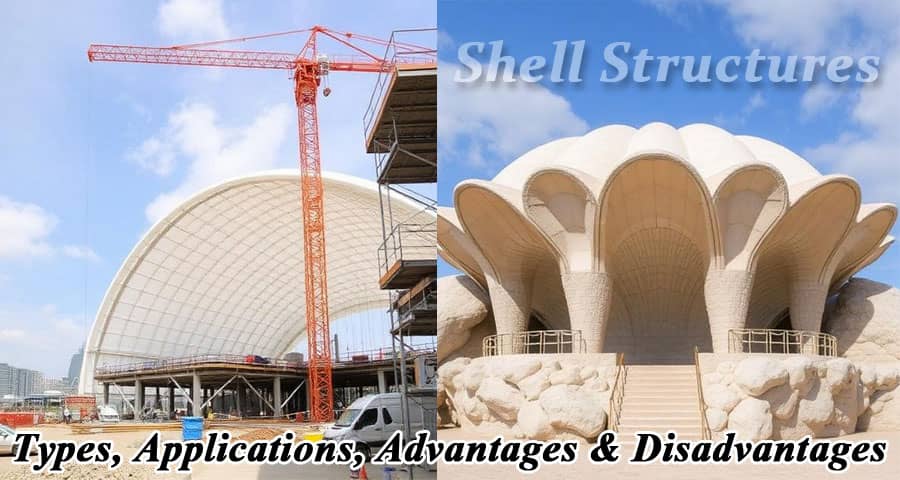
Shell structures represent one of the most efficient, elegant, and structurally advanced forms of construction in modern architecture and civil engineering. Characterized by their thin, curved surfaces and exceptional load-distribution capabilities, shell structures combine strength, economy, and aesthetics in a way few other structural systems can achieve.
What Are Shell Structures?
Shell structures are thin, curved structural elements that derive their strength primarily from their shape rather than mass. Unlike conventional beams or slabs, shells resist loads through membrane action, enabling them to span large areas with minimal material usage. Typically constructed using reinforced concrete, steel, or composite materials, shell structures are widely used in long-span roofs, domes, tanks, and architecturally expressive buildings.
Key Structural Characteristics of Shell Structures
- Curved geometry providing inherent stiffness
- Uniform stress distribution across the surface
- Minimal thickness compared to span
- High load-carrying efficiency
- Excellent resistance to compression and shear
These characteristics make shell structures structurally superior for large, column-free spaces.
Types of Shell Structures
1. Cylindrical Shell Structures
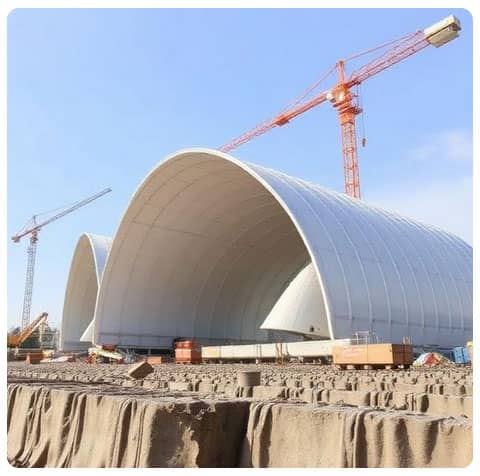
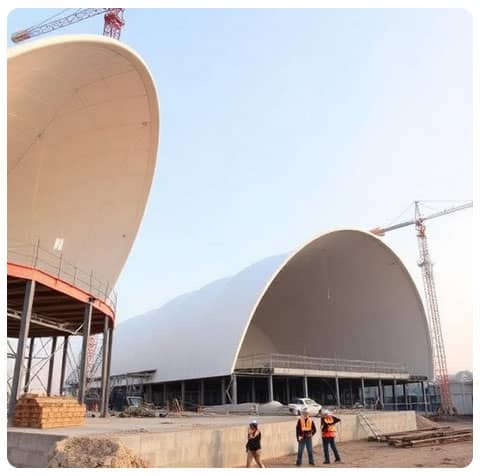
Cylindrical shells consist of a curved surface generated by moving a straight line parallel to itself along a curved path. They are commonly used where long spans and repetitive geometry are required.
Key Features:
- Simple geometry
- Economical formwork
- Efficient load transfer along the curve
Common Uses:
- Industrial sheds
- Aircraft hangars
- Warehouse roofs
2. Spherical Shell Structures
Spherical shells are formed from a portion of a sphere and exhibit exceptional structural efficiency due to their double curvature.
Key Features:
- Uniform stress distribution
- High resistance to external loads
- Minimal bending stresses
Common Uses:
- Domes
- Planetariums
- Storage tanks
3. Conical Shell Structures
Conical shells are generated by rotating a straight line around a fixed point, creating a cone-like geometry.
Key Features:
- Excellent stability
- Efficient vertical load transfer
- Strong aesthetic appeal
Common Uses:
- Industrial chimneys
- Cooling towers
- Architectural landmarks
4. Hyperbolic Paraboloid (Hypar) Shell Structures
Hypar shells are double-curved surfaces formed by straight lines, making them easier to construct while maintaining structural efficiency.
Key Features:
- Lightweight construction
- High rigidity
- Visually striking form
Common Uses:
- Stadium roofs
- Auditoriums
- Exhibition halls
5. Elliptical and Toroidal Shell Structures
These shells are used for specialized architectural and engineering applications where unique spatial or functional requirements exist.
Key Features:
- Complex geometry
- Advanced load resistance
- High architectural value
Common Uses:
- Space research facilities
- Specialized storage units
- Iconic public structures
Applications of Shell Structures
Shell structures are used across multiple industries due to their versatility, strength, and material efficiency.
Architectural Applications
- Large-span roofs for stadiums, theaters, and convention centers
- Religious structures such as temples, mosques, and churches
- Public landmarks emphasizing aesthetic excellence
Industrial Applications
- Oil and water storage tanks
- Cooling towers and silos
- Manufacturing plant roofs requiring wide column-free spaces
Infrastructure Applications
- Aircraft hangars
- Metro stations
- Transportation terminals
Specialized Engineering Applications
- Space research facilities
- Nuclear containment structures
- Marine and offshore structures
Advantages of Shell Structures
1. Exceptional Structural Efficiency
Shell structures carry loads primarily through compressive membrane action, resulting in significantly reduced bending moments.
2. Material Economy
Due to their thin sections and efficient stress distribution, shell structures require less concrete and steel, reducing overall construction cost.
3. Large Clear Spans
Shell structures easily span large areas without intermediate supports, providing unobstructed interior spaces.
4. Architectural Aesthetics
The smooth curves and flowing forms of shell structures offer iconic visual appeal, making them ideal for landmark buildings.
5. High Load-Bearing Capacity
Despite their thinness, shell structures can withstand heavy loads, wind forces, and seismic actions when properly designed.
6. Durability and Longevity
When constructed using quality materials and proper detailing, shell structures exhibit excellent long-term performance.
Disadvantages of Shell Structures
1. Complex Design Requirements
Shell structures require advanced structural analysis and precise mathematical modeling, increasing design complexity.
2. Skilled Construction Techniques
Construction demands highly skilled labor and strict quality control, particularly during formwork and reinforcement placement.
3. High Initial Planning Cost
Although material costs are lower, the initial design and engineering cost can be relatively high.
4. Sensitivity to Construction Errors
Small deviations in geometry can lead to significant stress concentrations, affecting structural performance.
5. Limited Flexibility for Modifications
Post-construction alterations are difficult due to the integrated nature of shell action.
Materials Used in Shell Structures
- Reinforced Cement Concrete (RCC) - Most commonly used due to versatility and durability
- Prestressed Concrete - Enhances load capacity and span
- Steel - Used for lightweight shells and special applications
- Composite Materials - Employed in advanced and experimental structures
Design Considerations for Shell Structures
- Accurate geometric modeling
- Proper load path identification
- Adequate edge support detailing
- Consideration of thermal and shrinkage effects
- Compliance with seismic and wind codes
Careful attention to these factors ensures structural safety and optimal performance.
Future of Shell Structures
With advancements in computational design, parametric modeling, and high-performance materials, shell structures are experiencing renewed interest. Sustainable construction practices further enhance their relevance by minimizing material usage while maximizing efficiency.
Conclusion
Shell structures stand as a testament to engineering precision and architectural innovation. Their ability to combine strength, economy, and beauty makes them indispensable in modern construction. By understanding the types, applications, advantages, and disadvantages of shell structures, we can leverage their full potential to create efficient, durable, and visually compelling structures that meet contemporary engineering demands.
Please watch the following short video for Shell Structures
Also Read:
 Various Types of Structural Steel Shapes | Sizes for Steel I-Beams
Septic Tank Design and Construction | How to Calculate Septic Tank Size
Requirements for a Good Staircase | Types of Stairs
Pier Foundation Construction | Benefits of a Pier Foundation
Bar Bending Schedule (BBS) for Pile Foundation: A Comprehensive Guide