
Different Between Clamp Burning and Kiln Burning
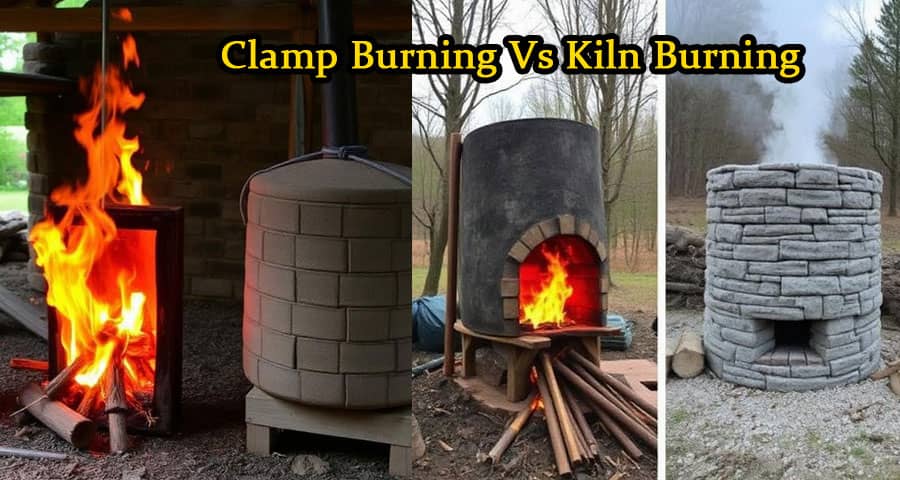
Introduction to Clamp Burning and Kiln Burning
In the field of brick manufacturing, the methods used for burning bricks play a crucial role in determining the strength, durability, color, and quality of the final product. Among the various brick burning techniques, Clamp Burning and Kiln Burning are the most commonly used methods. We use these methods to convert raw molded bricks into hard, durable, and weather-resistant bricks through controlled heating.
Understanding the difference between clamp burning and kiln burning is essential for civil engineering, construction, and brick manufacturing industries. Both methods differ in process, cost, fuel consumption, quality control, and production capacity.
What is Clamp Burning?
Clamp burning is a traditional method of brick burning in which bricks are stacked in layers with fuel placed between them and then covered with mud to retain heat. The fire is ignited, and bricks are burned slowly over several days or weeks.
This method is commonly used in rural areas or small-scale brick manufacturing where production quantity is low and investment is limited.
Process of Clamp Burning
The clamp burning process is carried out in the following steps:
- A dry ground is selected.
- A layer of fuel such as coal, wood, or agricultural waste is spread.
- A layer of raw bricks is placed over the fuel.
- Alternate layers of fuel and bricks are arranged.
- The entire stack is covered with mud to prevent heat loss.
- Fire is ignited from the bottom.
- Burning continues for several days.
- Bricks are cooled and removed.
This process is slow and uncontrolled, resulting in uneven burning of bricks.
Advantages of Clamp Burning
Some important advantages include:
- Low initial cost
- No need for permanent structure
- Suitable for small production
- Simple construction and operation
- Uses locally available fuel
Disadvantages of Clamp Burning
Clamp burning also has several disadvantages:
- Poor quality bricks
- Uneven burning
- High fuel consumption
- Air pollution
- Slow process
- Difficult temperature control
- Large number of broken bricks
What is Kiln Burning?
Kiln burning is a modern brick burning method in which bricks are burned inside a permanent structure called a kiln. The kiln provides controlled temperature, proper air circulation, and uniform burning, resulting in high-quality bricks.
Kiln burning is used in large-scale brick manufacturing industries where continuous production and quality control are required.
Process of Kiln Burning
The kiln burning process includes the following steps:
- Raw bricks are dried.
- Bricks are stacked inside the kiln.
- Fuel is supplied through fire holes.
- Temperature is gradually increased.
- Burning is carried out at high temperature (900°C - 1100°C).
- Temperature is maintained for proper burning.
- Bricks are cooled slowly.
- Finished bricks are removed.
This method ensures uniform heating and controlled burning.
Types of Kilns Used in Brick Burning
There are several types of kilns used in brick manufacturing:
- Bull's Trench Kiln
- Hoffmann Kiln
- Tunnel Kiln
- Intermittent Kiln
- Down Draft Kiln
- Up Draft Kiln
These kilns improve efficiency, production rate, and brick quality.
Advantages of Kiln Burning
Kiln burning offers many benefits:
- High-quality bricks
- Uniform burning
- Temperature control
- Less fuel consumption
- Large-scale production
- Less brick wastage
- Better strength and durability
- Environmentally better than clamp
Disadvantages of Kiln Burning
Some disadvantages include:
- High initial cost
- Requires skilled labor
- Permanent structure required
- Not suitable for very small production
Difference Between Clamp Burning and Kiln Burning
Below is the detailed comparison showing the difference between clamp burning and kiln burning.
| Basis | Clamp Burning | Kiln Burning |
|---|---|---|
| Structure | Temporary structure | Permanent structure |
| Cost | Low initial cost | High initial cost |
| Brick Quality | Poor to moderate | High quality |
| Burning Control | No temperature control | Proper temperature control |
| Fuel Consumption | High | Low |
| Production | Small scale | Large scale |
| Time Required | More time | Less time |
| Uniform Burning | Not uniform | Uniform |
| Pollution | More pollution | Less pollution |
| Labor Skill | Unskilled labor | Skilled labor |
| Brick Strength | Low strength | High strength |
| Wastage | More wastage | Less wastage |
Clamp Burning vs Kiln Burning - Detailed Comparison
1. Cost Comparison
Clamp burning requires very low investment, while kiln burning requires high investment for kiln construction.
2. Brick Quality Comparison
Bricks produced from kiln burning are stronger, more durable, and uniform, whereas clamp burned bricks are often under-burnt or over-burnt.
3. Fuel Efficiency
Kiln burning is fuel efficient because heat is controlled and reused, while clamp burning wastes heat and consumes more fuel.
4. Production Capacity
Clamp burning is suitable for small production, but kiln burning is used for mass production of bricks.
5. Temperature Control
Clamp burning has no temperature control, while kiln burning maintains controlled temperature throughout the burning process.
6. Environmental Impact
Clamp burning produces more smoke and pollution, whereas kiln burning produces less pollution due to controlled combustion.
Where Clamp Burning is Used
Clamp burning is generally used in:
- Rural areas
- Small brick fields
- Temporary brick production
- Low budget projects
- Small construction works
Where Kiln Burning is Used
Kiln burning is used in:
- Large brick manufacturing plants
- Commercial brick production
- Construction industries
- Infrastructure projects
- Urban construction projects
Conclusion
From the above discussion, we conclude that clamp burning and kiln burning are two different brick burning methods used in brick manufacturing. Clamp burning is a traditional, low-cost, and small-scale method, whereas kiln burning is a modern, controlled, and large-scale brick burning method.
Kiln burning produces better quality, stronger, more durable, and uniformly burned bricks, while clamp burning produces lower quality bricks with uneven burning. Although clamp burning is economical for small projects, kiln burning is preferred for large construction projects and commercial brick production due to its efficiency, quality control, and fuel efficiency.
Therefore, the main difference between clamp burning and kiln burning lies in cost, quality, production capacity, temperature control, and fuel efficiency, making kiln burning the more advanced and widely used brick burning method in modern construction.
Please view the following short video for Different Between Clamp Burning and Kiln Burning
Also Read:
 Specific Gravity Test of Bitumen