
Plate Load Test: Methods, Limitations, Advantages & Disadvantages
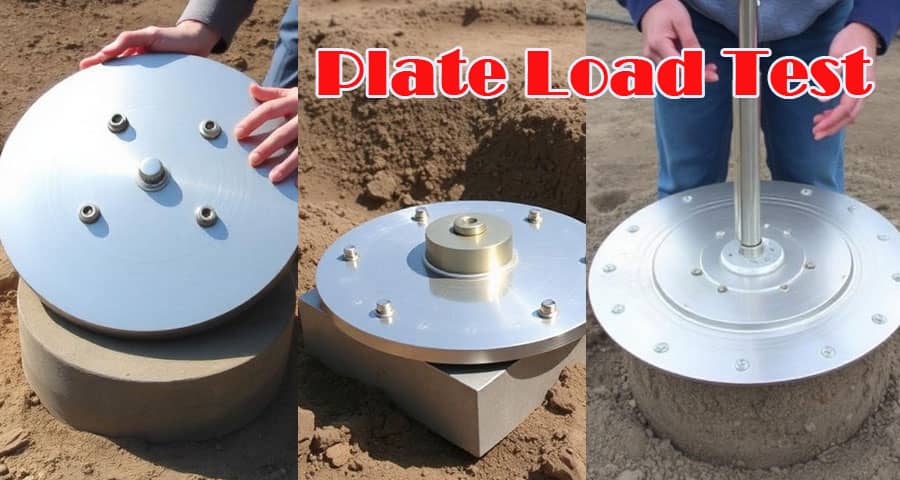
What Is Plate Load Test?
The Plate Load Test (PLT) is a field method used to determine the ultimate bearing capacity of soil and the allowable settlement of foundations. We conduct this test directly at the construction site to evaluate the behavior of soil under actual loading conditions. Unlike laboratory tests, the plate load test provides real-time performance data of soil strata in its natural state.
We use a rigid steel plate placed at the foundation level and apply incremental loads to measure settlement. The load-settlement curve obtained from the test allows us to assess:
- Ultimate bearing capacity of soil
- Safe bearing capacity
- Modulus of subgrade reaction
- Settlement characteristics of soil
This test is widely adopted in civil engineering projects such as buildings, bridges, towers, industrial structures, and heavy machinery foundations, where soil performance is critical for structural stability.
Purpose of Plate Load Test
We perform the plate load test to achieve the following objectives:
- Determine the safe load carrying capacity of soil at a specified depth.
- Evaluate the settlement characteristics under applied pressure.
- Identify soil behavior in cohesive and cohesionless soils.
- Design shallow foundations such as isolated footings, raft foundations, and strip footings.
- Calculate the modulus of subgrade reaction (k-value) for pavement design.
The test provides direct and practical results that closely represent site conditions.
Apparatus Required for Plate Load Test
To conduct the plate load test accurately, we use the following equipment:
- Mild steel bearing plate (300 mm to 750 mm diameter, 25 mm thick)
- Hydraulic jack with pressure gauge
- Reaction beam or truss system
- Dial gauges (minimum sensitivity 0.01 mm)
- Datum bar
- Loading platform or kentledge arrangement
- Excavation tools
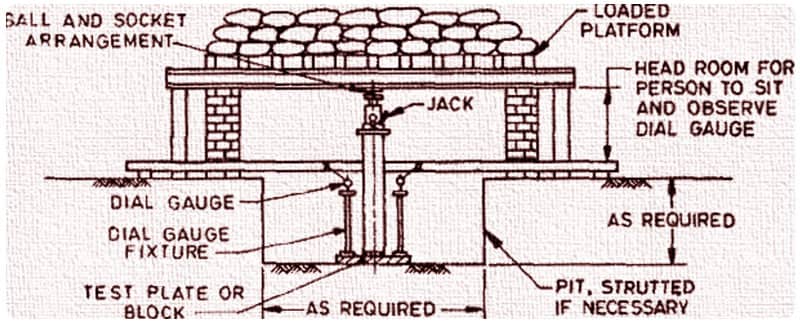
The plate size is generally chosen based on foundation dimensions and soil type.
Method of Plate Load Test
1. Preparation of Test Pit
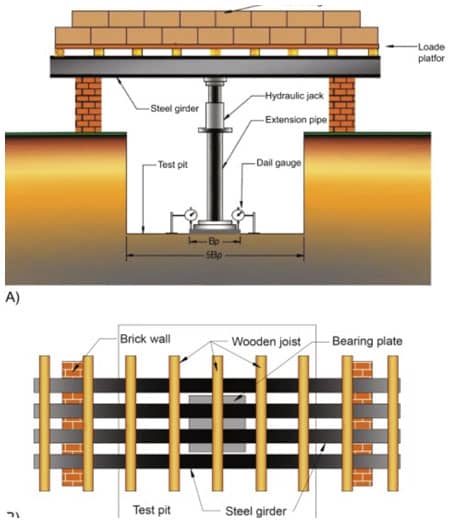
We excavate a pit at the exact location where the foundation is proposed. The depth of excavation corresponds to the proposed foundation level. The width of the pit should be at least five times the plate diameter to avoid boundary effects.
The bottom surface is leveled and compacted properly to ensure uniform contact between soil and plate.
2. Placement of Steel Plate
We carefully place the rigid steel plate at the center of the pit. The plate must rest firmly on the prepared soil surface without any tilting. A thin layer of sand may be spread to achieve uniform contact.
3. Reaction System Arrangement
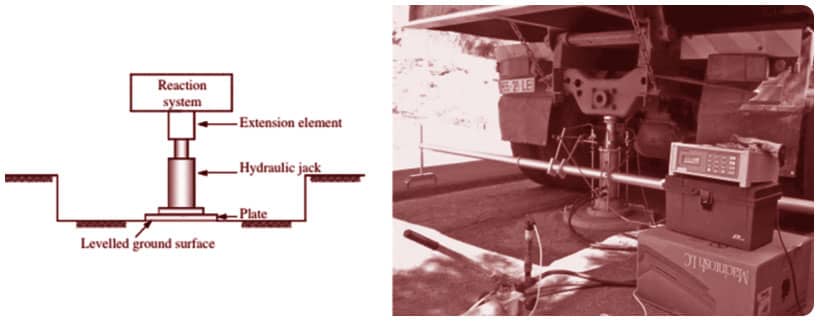
A reaction beam or loading truss system is installed above the plate. The hydraulic jack is positioned between the plate and the reaction system to apply vertical load. The reaction system must be sufficiently rigid to prevent unwanted deflection.
4. Installation of Dial Gauges
Dial gauges are mounted on independent datum bars that are not connected to the loading system. At least two dial gauges are installed to measure settlement accurately.
5. Application of Load
We apply load in incremental stages, typically equal to one-fifth of the estimated safe bearing capacity. Each load increment is maintained until the rate of settlement becomes negligible (usually 0.02 mm per hour).
The settlement readings are recorded at regular intervals such as:
- 1 minute
- 5 minutes
- 10 minutes
- 20 minutes
- 1 hour
Loading continues until:
- Shear failure occurs, or
- Settlement reaches 25 mm, or
- Load reaches twice the estimated safe bearing capacity
6. Load-Settlement Curve
We plot the load versus settlement graph. The curve typically shows:
- A linear region at initial stages
- A non-linear region near failure
- A sharp break indicating ultimate load
From this curve, we determine:
- Ultimate bearing capacity
- Safe bearing capacity (with factor of safety 2.5 to 3)
Calculation of Bearing Capacity from Plate Load Test
The ultimate bearing capacity (qu) is determined from the load-settlement curve at the point of failure. The safe bearing capacity (qs) is calculated as:
qs = (qu / Factor of Safety)
For cohesive soils, settlement criteria govern the design. For sandy soils, shear failure generally controls the safe capacity.
Interpretation of Plate Load Test Results
We interpret results based on soil type:
For Clayey Soil
- Failure is gradual.
- Settlement increases slowly.
- Ultimate load is determined from double tangent method.
For Sandy Soil
- Failure is sudden.
- Sharp break in load-settlement curve.
- Clear ultimate bearing capacity value.
Advantages of Plate Load Test
1. Direct Field Measurement
We obtain real-time data under actual field conditions, which provides more reliable results than laboratory tests.
2. Simple Procedure
The test method is straightforward and does not require highly sophisticated equipment.
3. Immediate Results
Unlike laboratory consolidation tests, results are obtained on-site without delay.
4. Accurate for Shallow Foundations
The test provides precise values for designing shallow foundations.
5. Useful for Pavement Design
It helps determine the modulus of subgrade reaction, essential for rigid pavement design.
Disadvantages of Plate Load Test
1. Limited Depth of Influence
The test only evaluates soil behavior up to a depth equal to 1.5 to 2 times the plate width. It does not represent deeper strata conditions.
2. Time-Consuming
In clayey soils, each load increment may require long durations to stabilize.
3. Expensive for Large Projects
For multiple test locations, the cost becomes significant.
4. Not Suitable for Very Soft Soils
In extremely soft soil conditions, maintaining reaction systems becomes difficult.
5. Scale Effect
Results from small plates may not perfectly represent full-size foundation behavior.
Limitations of Plate Load Test
While the plate load test is highly effective, we recognize certain limitations:
- It does not simulate long-term consolidation settlement.
- It does not account for seasonal groundwater variations.
- Results vary with plate size.
- It cannot evaluate deep foundation performance.
- Test accuracy depends heavily on proper reaction setup.
Therefore, we often combine it with other soil investigations such as SPT and borehole analysis for comprehensive geotechnical evaluation.
Factors Affecting Plate Load Test Results
Several parameters influence test outcomes:
- Soil type (cohesive or cohesionless)
- Groundwater table level
- Plate size and thickness
- Loading rate
- Excavation disturbance
- Reaction system stability
Proper control of these parameters ensures accurate and dependable results.
Applications of Plate Load Test
We widely use the plate load test in:
- Residential and commercial building construction
- Bridge foundation design
- Industrial equipment foundations
- Highway and rigid pavement construction
- Transmission tower foundations
It is particularly valuable where soil conditions are variable and design safety is critical.
Precautions During Plate Load Test
To achieve precise results, we follow strict precautions:
- Ensure firm contact between plate and soil.
- Avoid vibration near the test area.
- Maintain constant load increments.
- Use calibrated dial gauges.
- Protect setup from wind and disturbance.
Careful supervision is essential throughout the test duration.
Conclusion
The Plate Load Test remains one of the most reliable and practical field methods for determining bearing capacity and settlement characteristics of soil. We conduct this test to obtain direct field data essential for designing safe and economical shallow foundations. Although it has certain limitations, its ability to simulate real loading conditions makes it an indispensable tool in geotechnical engineering.
By understanding the method of plate load test, calculation procedures, advantages, disadvantages, and limitations, we ensure accurate foundation design and long-term structural safety.
Please watch the following short video for Plate Load Test
Also Read:
 Advanced Methods of Surveying: A Comprehensive Guide for the 21st Centur