
Bituminous Road Construction: Layers, Macadam, Construction Process, Advantages, Disadvantages and Applications
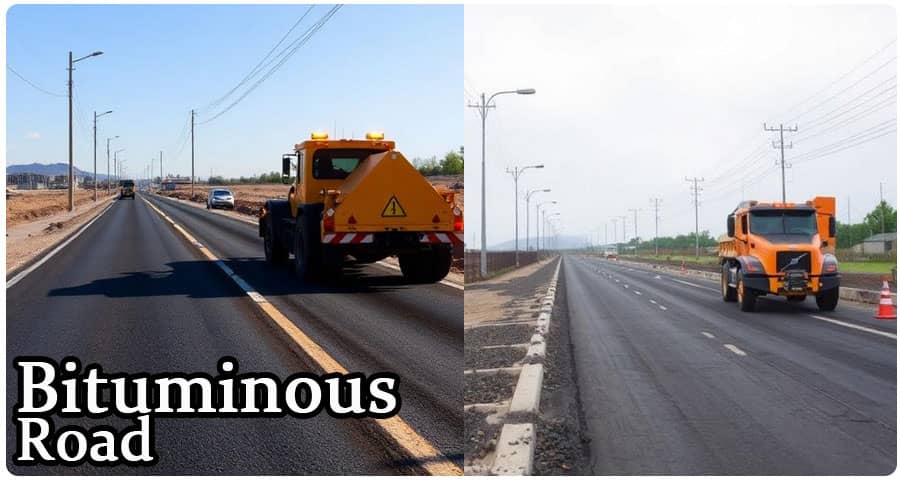
What Is Bituminous Road?
A bituminous road is a flexible pavement structure constructed using bitumen (asphalt binder) as a binding material combined with graded aggregates to form a durable, smooth, and weather-resistant road surface. In modern highway engineering, bituminous roads are the most widely adopted pavement type due to their cost-effectiveness, ease of construction, flexibility, and superior riding quality.
Bitumen is a viscoelastic, thermoplastic material obtained as a by-product of crude oil refining. When heated, it becomes fluid and coats aggregates uniformly; upon cooling, it binds aggregates together, creating a strong, water-resistant, and flexible pavement layer. This flexibility allows bituminous pavements to withstand traffic loads and minor subgrade deformations without cracking excessively.
We construct bituminous roads in layers over a prepared subgrade and base course, ensuring proper load distribution, drainage, and durability under repeated traffic loading.
Components of Bituminous Road Construction
The performance of a bituminous road depends on the quality and interaction of its primary components:
1. Bitumen (Asphalt Binder)
- Acts as a binding agent
- Provides waterproofing properties
- Offers flexibility and fatigue resistance
- Available in various penetration grades and viscosity grades
2. Aggregates
- Crushed stone, gravel, sand, and mineral fillers
- Provide strength and load-bearing capacity
- Ensure interlocking and structural stability
3. Mineral Filler
- Improves binding properties
- Enhances stability and density of the mix
Each component must meet strict grading, strength, and durability standards to ensure optimal pavement performance.
Bituminous Road Layers
Bituminous pavement consists of multiple structural layers, each serving a specific engineering purpose.
1. Subgrade
The subgrade is the natural soil layer compacted to required density. It acts as the foundation of the pavement structure.
- Must have adequate California Bearing Ratio (CBR)
- Should be properly compacted
- Must provide proper drainage
2. Sub-Base Course
The sub-base improves load distribution and prevents pumping of fine soil particles.
- Constructed using granular material
- Enhances structural strength
- Acts as a drainage layer
3. Base Course
The base course carries significant traffic load and distributes it to lower layers.
- May consist of Wet Mix Macadam (WMM) or Bituminous Macadam
- Provides structural rigidity
4. Binder Course
The binder course lies between base and surface course.
- Made of coarse bituminous mix
- Provides bulk strength
- Improves bonding between layers
5. Surface Course (Wearing Course)
The surface course is the topmost layer exposed to traffic.
- Ensures smooth riding quality
- Resists skid and abrasion
- Prevents water infiltration
Common surface courses include Dense Bituminous Macadam (DBM) and Bituminous Concrete (BC).
Bituminous Macadam
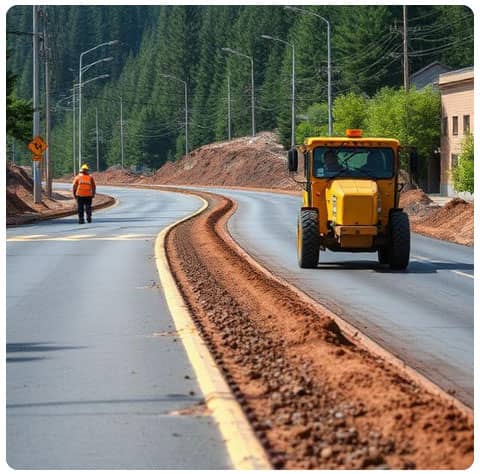
Bituminous Macadam (BM) is a pavement layer consisting of crushed aggregates bound with bitumen without strict grading control like dense mixes.
Characteristics of Bituminous Macadam:
- Open-graded aggregate structure
- High permeability
- Used as a base or binder course
Advantages of Bituminous Macadam:
- Cost-effective
- Easy to lay and compact
- Suitable for moderate traffic loads
Limitations:
- Requires proper sealing
- Less resistant to heavy traffic compared to dense bituminous concrete
Bituminous Macadam plays a crucial structural role in flexible pavement systems.
Bituminous Road Construction Process
The construction of bituminous roads involves systematic and technically controlled stages to ensure durability and performance.
Step 1: Preparation of Subgrade
- Clearing and grubbing
- Leveling and compaction
- Testing soil strength
- Ensuring proper drainage
Step 2: Laying Sub-Base and Base Course
- Spreading granular material
- Watering and rolling
- Achieving specified density
- Surface finishing
Step 3: Application of Prime Coat
- A prime coat is applied over the granular base to:
- Penetrate and bind loose particles
- Improve adhesion between layers
Step 4: Application of Tack Coat
The tack coat ensures bonding between existing surface and new bituminous layer.
Step 5: Preparation of Bituminous Mix
- Heating aggregates
- Heating bitumen
- Mixing in hot mix plant
- Maintaining temperature control
Step 6: Transportation and Laying
- Transporting mix using insulated tippers
- Laying using mechanical paver
- Ensuring uniform thickness and level
Step 7: Rolling and Compaction
Compaction is carried out using:
- Tandem rollers
- Pneumatic rollers
- Vibratory rollers
Proper compaction ensures:
- Reduced air voids
- Increased strength
- Improved durability
Step 8: Quality Control and Testing
- Density tests
- Bitumen content tests
- Thickness verification
- Surface evenness measurement
Proper quality control guarantees long service life and structural performance.
Advantages of Bituminous Road
Bituminous roads offer numerous structural and economic benefits:
1. Cost-Effective Construction
Lower initial cost compared to rigid pavements.
2. Faster Construction
Can be constructed and opened to traffic quickly.
3. Smooth Riding Surface
Provides excellent driving comfort and reduced vehicle wear.
4. Flexible Structure
Accommodates minor settlement and temperature variations.
5. Easy Maintenance
Repairs such as patchwork and resurfacing are simple and economical.
6. Skid Resistance
Improves safety under wet conditions.
7. Noise Reduction
Produces lower traffic noise compared to concrete roads.
Disadvantages of Bitumen Road
Despite their widespread use, bituminous roads have certain limitations:
1. Shorter Lifespan
Compared to rigid pavements, lifespan is relatively lower.
2. Susceptibility to Temperature
Softens in high temperatures and becomes brittle in cold climates.
3. Maintenance Requirement
Requires periodic resurfacing and sealing.
4. Rutting and Bleeding
Improper mix design may cause surface deformation.
5. Environmental Concerns
Bitumen production involves petroleum products.
Proper design, quality materials, and adequate drainage significantly reduce these disadvantages.
Applications of Bituminous Road
Bituminous roads are extensively used in various infrastructure sectors:
1. National Highways
Designed for heavy traffic and long-distance travel.
2. State Highways
Provide connectivity between major cities and towns.
3. Urban Roads
Used in city streets and municipal roads.
4. Rural Roads
Cost-effective solution for village connectivity.
5. Airport Runways
High-performance bituminous mixes are used for runways and taxiways.
6. Industrial Areas
Support heavy truck movement.
The versatility and adaptability of bituminous pavements make them suitable for diverse traffic and environmental conditions.
Design Considerations in Bituminous Pavement
For long-term durability, the following factors are crucial:
- Traffic intensity and axle load
- Climate conditions
- Subgrade strength
- Drainage system
- Bitumen grade selection
- Aggregate quality
Proper pavement design ensures optimal thickness and material selection to withstand anticipated traffic loads.
Maintenance of Bituminous Roads
Routine and periodic maintenance increases pavement life significantly:
- Crack sealing
- Surface dressing
- Pothole patching
- Overlay application
- Drainage improvement
Preventive maintenance is more economical than complete reconstruction.
Conclusion
A bituminous road remains the backbone of modern transportation infrastructure due to its flexibility, economic viability, ease of construction, and smooth riding characteristics. From Bituminous Macadam layers to advanced dense graded surface courses, each component plays a vital role in ensuring structural stability and performance. With proper design, quality control, and systematic maintenance, bituminous pavements deliver reliable service across highways, urban roads, and industrial corridors.
The combination of engineered materials, controlled construction processes, and effective maintenance strategies ensures that bituminous roads continue to serve as the preferred choice for flexible pavement construction worldwide.
Please watch the following short video for Bituminous Road Construction
Also Read:
 Top 10 Types of Stairs Used in Building Construction