
Vacuum Concrete : Applicaton, Advantages and Disdvantages
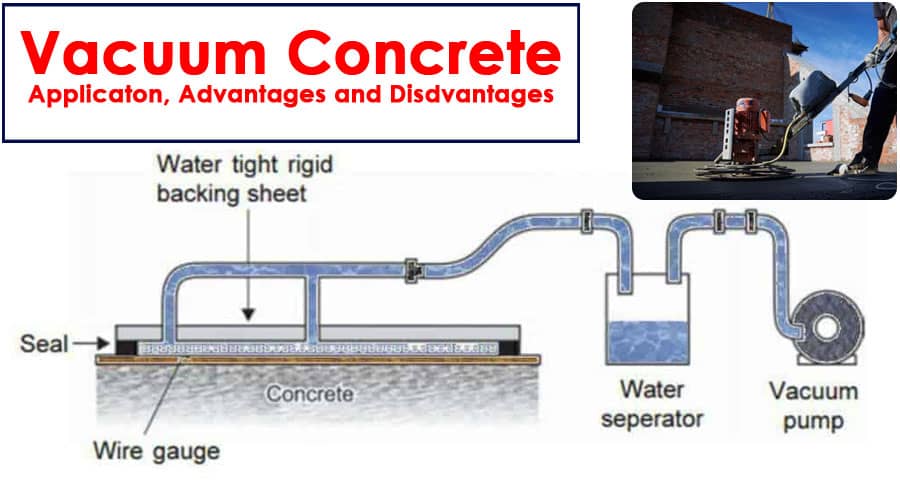
Concrete technology has evolved significantly to improve strength, durability, and performance in modern construction. One of the most efficient innovations developed to enhance concrete quality is Vacuum Concrete. This advanced technique removes excess water from freshly placed concrete using a vacuum pump, resulting in a denser, stronger, and more durable concrete surface.
Understanding this method is essential for engineers, contractors, and construction professionals seeking high-performance concrete solutions for modern infrastructure.
What Is Vacuum Concrete?
Vacuum Concrete is a special type of concrete in which excess water is removed from freshly placed concrete using a vacuum pump system before the concrete sets. The removal of surplus water reduces the water-cement ratio, which significantly improves the strength and durability of the concrete.
In conventional concrete mixing, extra water is added to improve workability and ease of placement. However, this additional water weakens the hardened concrete and increases porosity and shrinkage. Vacuum dewatering technology solves this problem by extracting unnecessary water after the concrete has been placed.
The vacuum process typically removes 15 - 25% of the mixing water, resulting in a compact and high-strength concrete layer. This makes vacuum concrete particularly suitable for industrial floors, pavements, highways, and heavy-duty slabs.
Principle of Vacuum Concrete
The working principle of Vacuum Concrete Technology is based on removing excess water from freshly poured concrete by creating a vacuum pressure on its surface.
The process involves placing filter pads and vacuum mats over the fresh concrete surface. A vacuum pump is then connected to these mats, creating negative pressure. This pressure extracts surplus water through the filter pads without disturbing the cement and aggregate particles.
Key outcomes of the vacuum process include:
- Reduction in water-cement ratio
- Increased density of concrete
- Improved early strength
- Reduced bleeding and shrinkage
- Enhanced durability
This controlled dewatering significantly improves structural performance and surface quality of the concrete.
Equipment Used in Vacuum Concrete
Several specialized components are required to perform the vacuum dewatering process effectively. These equipment systems ensure the safe extraction of water without affecting the concrete mixture.
1. Vacuum Pump
The vacuum pump is the core equipment used to create negative pressure. It pulls water from the concrete through the filter pads.
2. Vacuum Mat
Vacuum mats are rubber sheets fitted with filter layers that are placed over the concrete surface to collect and channel water during suction.
3. Filter Pads
Filter pads prevent cement particles and fine aggregates from escaping while allowing water to pass through.
4. Water Separator
The water separator collects the extracted water and prevents it from entering the vacuum pump.
5. Suction Hose
Flexible suction hoses connect the vacuum mat to the pump system, enabling efficient water removal.
These components together form a vacuum dewatering system, ensuring efficient removal of excess moisture from concrete.
Vacuum Concrete Construction Process
The process of preparing Vacuum Concrete involves several carefully executed steps to achieve maximum strength and surface quality.
1. Concrete Mixing
Concrete is mixed with a higher water-cement ratio to ensure good workability during placement.
2. Placing Concrete
The concrete is poured and spread evenly on the prepared formwork or surface.
3. Compaction
Mechanical vibrators are used to compact the concrete, eliminating air voids and ensuring uniform distribution.
4. Placement of Filter Pads
Filter pads are placed over the concrete surface to allow water extraction without removing cement particles.
5. Placing Vacuum Mats
Vacuum mats are laid on top of the filter pads.
6. Vacuum Pump Operation
The vacuum pump is activated, creating suction pressure that removes excess water from the concrete.
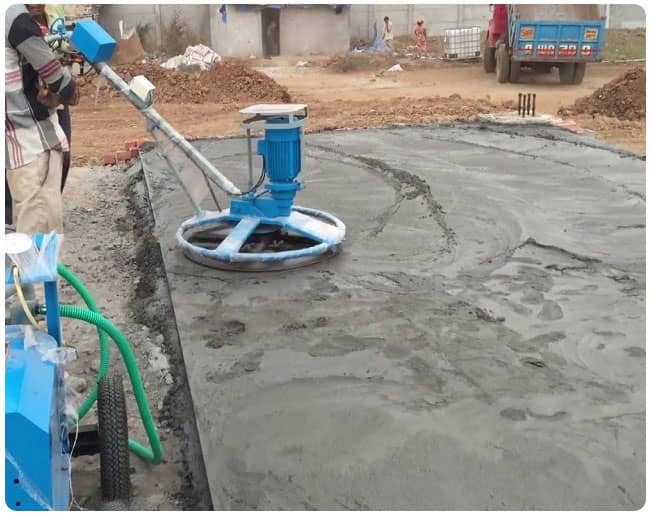
7. Surface Finishing
After the vacuum process, the concrete surface becomes stiff and can be finished quickly using trowels or power floats.
8. Curing
Proper curing is essential to maintain strength development and durability.
Applications of Vacuum Concrete
Due to its superior strength and durability, Vacuum Concrete Technology is widely used in modern construction projects.
1. Industrial Flooring
Vacuum concrete is extensively used for factory floors, warehouses, and workshops where high load-bearing capacity is required.
2. Airport Runways
Airports require high-strength concrete surfaces capable of handling heavy aircraft loads.
3. Highway Pavements
The method provides durable and crack-resistant road surfaces, making it suitable for highways and expressways.
4. Bridge Deck Slabs
Vacuum concrete improves structural durability and load resistance in bridge deck construction.
5. Parking Areas
Commercial parking structures benefit from strong, abrasion-resistant concrete surfaces.
6. Concrete Roof Slabs
The method reduces water seepage and improves slab durability, making it suitable for roof construction.
7. Storage Yards
Large storage yards and logistics centers require heavy-duty concrete floors, where vacuum concrete provides superior performance.
Advantages of Vacuum Concrete
The use of vacuum dewatering technology offers numerous advantages that make it a preferred choice in many large-scale construction projects.
1. Increased Strength
Removing excess water significantly increases the compressive strength of concrete.
2. Faster Construction
The vacuum process accelerates early strength gain, allowing quicker finishing and earlier use.
3. Reduced Shrinkage
Vacuum concrete minimizes drying shrinkage cracks, improving structural integrity.
4. Improved Surface Finish
The surface becomes dense, smooth, and abrasion-resistant, ideal for industrial applications.
5. Lower Water-Cement Ratio
By removing excess water, the water-cement ratio decreases, resulting in stronger concrete.
6. Early Formwork Removal
Due to rapid strength gain, formwork can be removed earlier, reducing construction time.
7. Better Durability
Vacuum concrete has lower permeability, making it more resistant to chemicals and environmental damage.
8. Reduced Bleeding
Bleeding is significantly reduced, resulting in uniform and high-quality concrete surfaces.
Disadvantages of Vacuum Concrete
Despite its numerous advantages, vacuum concrete also has certain limitations.
1. High Equipment Cost
The vacuum dewatering system requires specialized equipment, increasing initial project costs.
2. Skilled Labor Requirement
Proper operation of vacuum equipment requires trained professionals.
3. Limited Thickness
Vacuum dewatering is typically effective for concrete slabs up to 150?200 mm thickness.
4. Additional Setup Time
The installation of filter pads, vacuum mats, and pump systems requires extra preparation time.
5. Maintenance of Equipment
Vacuum pumps and filter systems require regular maintenance and monitoring.
Difference Between Conventional Concrete and Vacuum Concrete
| Feature | Conventional Concrete | Vacuum Concrete |
|---|---|---|
| Water Content | Higher | Reduced after placement |
| Strength | Moderate | High |
| Surface Finish | Normal | Smooth and dense |
| Bleeding | More | Very low |
| Early Strength | Slower | Faster |
| Durability | Moderate | High |
This comparison clearly shows that Vacuum Concrete Technology offers superior performance compared to traditional concrete methods.
Importance of Vacuum Concrete in Modern Construction
With increasing demand for high-performance concrete structures, vacuum dewatering technology plays a crucial role in modern construction. The ability to remove excess water quickly enhances structural performance and improves long-term durability.
Industries requiring heavy-duty flooring and load-bearing surfaces benefit greatly from this technology. By delivering higher strength, faster construction speed, and superior durability, vacuum concrete has become a preferred solution in large infrastructure projects.
Conclusion
Vacuum Concrete is an advanced concrete technology designed to improve strength, durability, and surface quality by removing excess water from freshly placed concrete. Through the use of vacuum pumps, filter pads, and vacuum mats, this technique effectively reduces the water-cement ratio and produces a dense and high-performance concrete surface.
Its applications in industrial floors, highways, airport runways, bridge decks, and heavy-duty slabs highlight its importance in modern construction. Although the method requires specialized equipment and skilled operation, the advantages such as higher strength, faster construction, and improved durability make vacuum concrete an essential technique for high-quality infrastructure development.
By adopting Vacuum Concrete Technology, construction professionals can achieve stronger, longer-lasting, and more reliable concrete structures, meeting the demanding requirements of contemporary engineering projects.
Please watch the following short video for Vacuum Concrete
Also Read:
 What Are the Differences Between Shear Slump and Collapse Slump in Slump Test?