
Mechanical Couplers & Rebar Couplers in Reinforcement
Introduction to Mechanical Couplers in Reinforced Concrete Construction
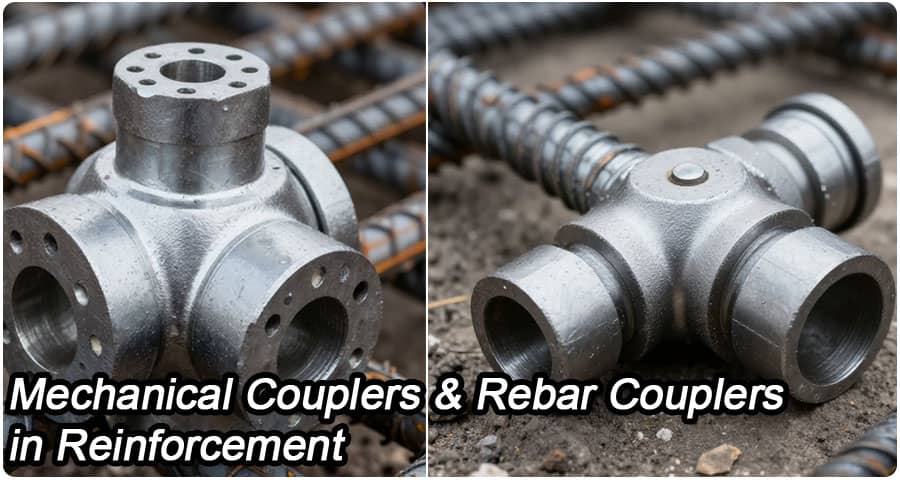
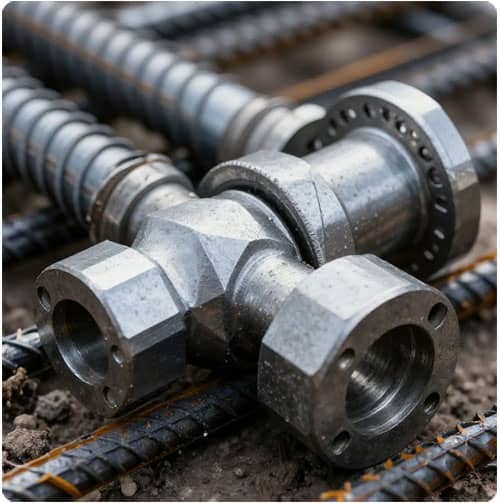
Mechanical couplers, also known as rebar couplers, reinforcement couplers, or reinforcing bar couplers, are specialized connectors used to join two reinforcing steel bars in reinforced concrete structures. They provide a mechanical connection between reinforcing bars, allowing forces to transfer from one bar to another without relying solely on the bond between steel and concrete.
In modern construction, mechanical couplers play an important role in improving reinforcement continuity, reducing steel congestion, simplifying reinforcement installation, and supporting efficient construction practices. They are widely used in high-rise buildings, bridges, industrial facilities, infrastructure projects, retaining walls, foundations, columns, shear walls, and other reinforced concrete structures.
Traditional reinforcement splicing often involves overlapping two reinforcing bars over a specified length. This technique, commonly known as a lap splice, requires additional reinforcement steel and sufficient space to accommodate the overlapping bars. When reinforcement becomes congested, particularly around beam-column joints, transfer structures, and heavily reinforced foundations, lap splicing can create practical challenges.
Mechanical rebar couplers offer an alternative by connecting reinforcing bars directly through a specially designed coupling system. Depending on the coupler type, installation may involve threading, upsetting, swaging, gripping, or other mechanical connection methods.
We can achieve better reinforcement detailing and more organized construction through the appropriate selection and installation of mechanical couplers. However, the connection must be designed, tested, and installed according to the applicable structural design requirements and project specifications.
What Are Mechanical Couplers in Reinforcement?
Mechanical couplers are engineered devices that connect two reinforcing steel bars and transfer tensile forces, compressive forces, or both across the connection. They are manufactured in different shapes, sizes, and configurations to suit specific reinforcement diameters, steel grades, installation methods, and structural requirements.
A typical mechanical coupler consists of a metal sleeve or connecting component designed to engage the ends of two reinforcing bars. Depending on the system, the connection may use internal threads, locking bolts, tapered threads, or mechanical gripping mechanisms.
Mechanical couplers are generally manufactured from high-strength steel or other specified metallic materials. Their dimensions, material properties, thread geometry, and connection performance depend on the manufacturer's design and the applicable standards.
We select the appropriate coupler based on several important factors:
- Reinforcing bar diameter: The coupler must match the specified reinforcement size.
- Steel grade: The connection must be suitable for the reinforcement's specified mechanical properties.
- Load requirements: The coupler must provide the required tensile and compressive capacity.
- Structural application: Columns, beams, walls, foundations, and seismic structures may require different connection performance.
- Installation conditions: Available space, bar alignment, accessibility, and construction sequence influence coupler selection.
- Applicable standards: The connection must satisfy the relevant building codes, testing requirements, and project specifications.
By considering these factors during reinforcement detailing, we can select a mechanical connection system that meets structural performance requirements while supporting efficient construction.
Types of Mechanical Rebar Couplers
Mechanical couplers are available in several types, each designed for particular reinforcement conditions and installation requirements.
1. Threaded Rebar Couplers
Threaded rebar couplers connect reinforcing bars through matching internal and external threads. The bar ends are prepared with the required thread profile, allowing them to engage with the coupler and form a mechanical connection.
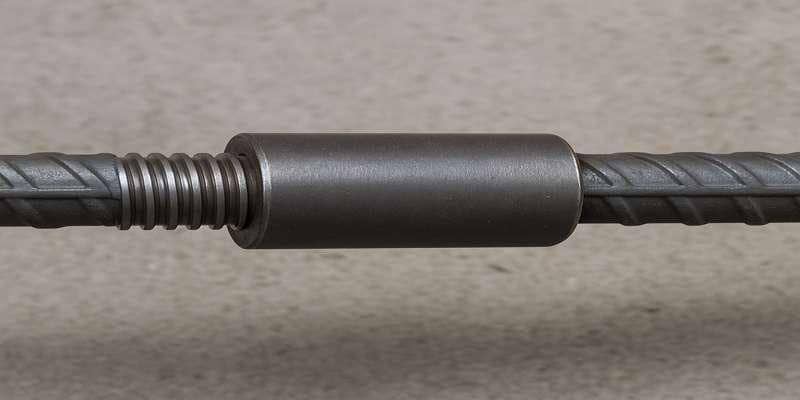
Threaded couplers are widely used in reinforced concrete columns, beams, walls, foundations, and precast concrete components.
Depending on the system, the threads may be cut directly into the reinforcing bar or formed after the bar end has been enlarged through an upsetting process.
The principal advantages of threaded couplers include repeatable installation, compact connection dimensions, and the potential to develop the required reinforcement strength when the complete system is properly designed and tested.
Threaded connections require careful control of thread dimensions, engagement length, cleanliness, and tightening procedures. Incorrect threading or incomplete engagement can compromise connection performance.
2. Parallel Thread Couplers
Parallel thread couplers use straight, parallel threads to connect reinforcing bars. These systems generally require a compatible threading process and a coupler with matching internal threads.
Some parallel-thread systems use enlarged or upset bar ends to preserve the required cross-sectional capacity after thread preparation.
These couplers are suitable for projects where consistent connection dimensions, controlled installation, and reliable reinforcement continuity are important.
We should verify the manufacturer's requirements for thread engagement, installation tolerances, inspection, and acceptance testing before using parallel-thread couplers on site.
3. Tapered Thread Couplers
Tapered thread rebar couplers use threads that gradually change in diameter along their length. The tapered configuration allows the matching threaded bar ends to engage securely within the coupler.
These systems are commonly used where the reinforcement and coupling system have been specifically designed for tapered-thread connections.
Installation requires correct thread preparation, alignment, and tightening in accordance with the manufacturer's instructions. We should not interchange tapered-thread components with parallel-thread components unless the system is explicitly designed and approved for that purpose.
4. Upset Thread Couplers
Upset thread couplers use reinforcing bars whose ends have been enlarged through a controlled upsetting process before threads are formed.
The upsetting process increases the diameter of the bar end, helping compensate for the material removed during thread cutting. When properly engineered, this approach can provide a connection capable of developing the required strength of the reinforcing bar.
These couplers are particularly useful in projects where high connection performance and reinforcement continuity are essential.
The upsetting equipment, bar-end dimensions, thread geometry, and inspection procedures must comply with the approved system requirements.
5. Swaged Rebar Couplers
Swaged rebar couplers connect reinforcing bars through a metal sleeve that is mechanically compressed around the bar ends using specialized equipment.
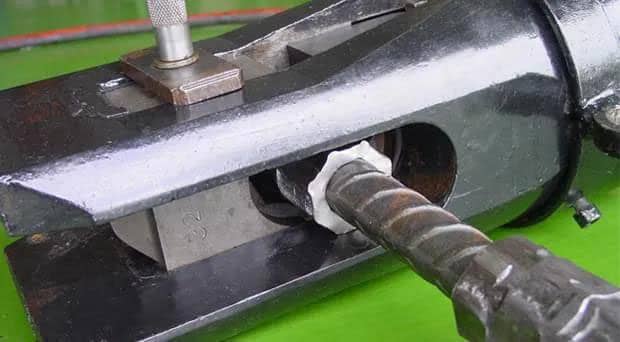
During installation, the sleeve is positioned over the prepared reinforcement ends and compressed according to the approved procedure. The resulting mechanical engagement transfers forces between the reinforcing bars.
Swaged couplers may be useful in applications where threaded bar preparation is undesirable or where the approved coupling system offers practical installation advantages.
The required equipment, compression sequence, sleeve dimensions, and inspection criteria depend on the specific product. We must use qualified installation personnel and follow the manufacturer's documented procedures.
6. Bolted Rebar Couplers
Bolted mechanical couplers use locking bolts or similar mechanical components to grip the reinforcing bars within a connecting sleeve.
Some systems use shear-head bolts that are tightened until the bolt heads reach a specified installation condition. Other designs use different locking or gripping arrangements.
Bolted couplers can be useful when connecting existing reinforcement, working in restricted spaces, or joining bars where conventional thread preparation is impractical.
However, installation torque, bolt condition, bar insertion depth, alignment, and the specified tightening sequence must be controlled. We should also confirm that the selected system is approved for the required structural application.
7. Grout-Filled Rebar Couplers
Grout-filled couplers are specialized sleeves designed to connect reinforcement through an approved cementitious grout or other specified filling material.
They are frequently associated with precast concrete construction, where reinforcement connections must be completed between prefabricated structural components.
The coupler may accommodate a reinforcing bar inserted into a sleeve, with the specified grout providing the required connection mechanism.
Successful installation depends on the correct grout type, sleeve geometry, embedment length, filling procedure, curing conditions, and inspection requirements. The complete system must be qualified for its intended structural application.
Advantages of Mechanical Couplers in Reinforced Concrete
Mechanical reinforcement couplers offer several advantages when compared with conventional reinforcement splicing, although the actual benefits depend on the project and connection system.
Reduced Reinforcement Congestion
One of the principal benefits of mechanical couplers is the reduction of overlapping reinforcement at connection locations.
In a conventional lap splice, two bars occupy the same region over a specified length. When several bars are spliced near one another, the additional steel can create congestion that complicates concrete placement and compaction.
Mechanical couplers can connect bars more directly, helping create a more organized reinforcement arrangement. This can be particularly valuable in heavily reinforced columns, transfer beams, shear walls, pile caps, and foundations.
Potential Reduction in Steel Consumption
Lap splices require additional reinforcing steel because the bars overlap over a specified length.
Mechanical couplers may reduce this additional steel, particularly when used in large-diameter reinforcement or locations where long lap lengths would otherwise be required.
However, the overall cost and material savings depend on coupler prices, installation requirements, bar diameters, splice locations, and the design provisions. Couplers do not automatically reduce total project costs in every situation.
Improved Construction Efficiency
Mechanical couplers can support more efficient reinforcement installation when the selected system is compatible with the construction sequence.
For example, reinforcement cages can be assembled in sections and connected during erection. In repetitive column construction, couplers can help establish consistent connection locations between successive reinforcement stages.
The resulting productivity benefits depend on access, equipment availability, worker training, and inspection requirements.
Better Reinforcement Continuity
A properly designed and installed mechanical coupler transfers forces between reinforcing bars and maintains reinforcement continuity across the connection.
This is particularly important in structural members subjected to substantial tensile forces, where the connection must satisfy the specified strength and deformation requirements.
The coupler must be evaluated as part of the complete reinforcement system rather than treated as an isolated accessory.
Easier Reinforcement Installation in Restricted Areas
Mechanical couplers can simplify bar connections where overlapping reinforcement would create difficult working conditions.
They are often considered for congested beam-column joints, foundation reinforcement, precast connections, and structures with complex reinforcement detailing.
Nevertheless, the selected coupler must have sufficient installation clearance and must be compatible with the actual bar positioning and construction tolerances.
Support for Precast Concrete Construction
Precast concrete construction requires reliable connections between separately manufactured structural elements.
Mechanical couplers can help connect reinforcing bars in precast columns, walls, beams, and other components. Depending on the system, the connections may be completed through threaded engagement, grout-filled sleeves, or another approved mechanical arrangement.
This can support repeatable installation and a more standardized construction process.
Applications of Rebar Couplers in Construction Projects
Mechanical couplers are used in many types of reinforced concrete construction.
High-Rise Buildings
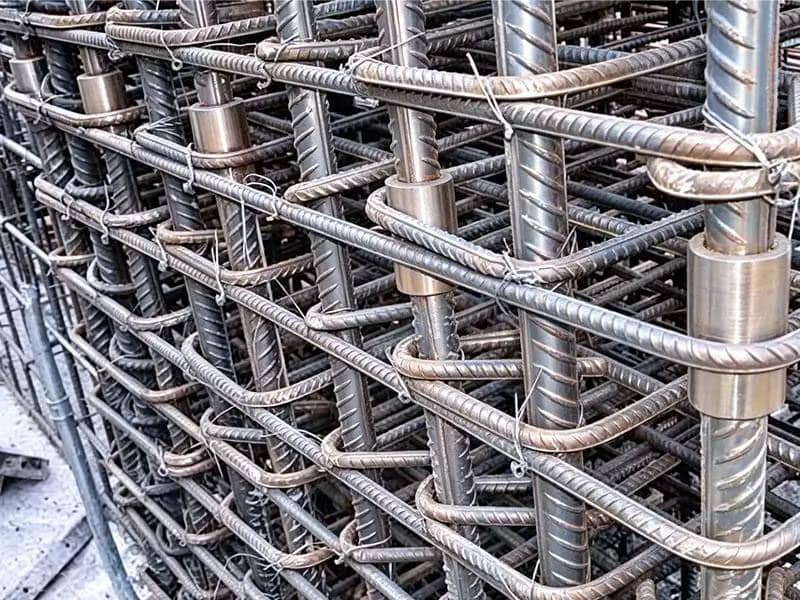
High-rise buildings require reinforcement systems capable of transferring significant structural forces through columns, shear walls, core walls, and other load-bearing elements.
Rebar couplers can simplify reinforcement continuity between successive construction lifts. They can also help reduce reinforcement congestion in heavily reinforced structural zones.
In high-rise construction, we must pay particular attention to seismic requirements, connection deformation capacity, bar alignment, and installation quality.
Bridges and Infrastructure
Bridge piers, abutments, retaining walls, and other infrastructure elements may contain large quantities of reinforcing steel.
Mechanical couplers can be used where specified by the structural design to connect reinforcement across construction stages or within complex reinforcement assemblies.
For these applications, the connection must comply with the relevant bridge design requirements and project-specific durability and performance criteria.
Foundations and Pile Caps
Large foundations and pile caps frequently contain closely spaced reinforcing bars that transfer substantial forces.
Mechanical couplers can reduce the need for overlapping bars in selected locations and may simplify reinforcement cage fabrication.
The engineer must verify the coupler's strength, placement, concrete cover, and compatibility with the foundation's reinforcement arrangement.
Retaining Walls and Shear Walls
Retaining walls and shear walls rely on reinforcement to resist bending, shear, and other structural actions.
Couplers may be used to connect vertical reinforcement between construction stages or to join reinforcement within a designed structural assembly.
Their use must be consistent with the wall's structural detailing, load conditions, and applicable ductility requirements.
Precast Concrete Structures
Mechanical couplers are frequently considered in precast construction because separately manufactured elements must be joined accurately on site.
Approved coupler systems can support connections between precast columns, wall panels, and other structural components.
Installation tolerances, grout placement where applicable, and connection verification are important to achieving the required structural performance.
Industrial Buildings
Industrial facilities often include heavily reinforced foundations, equipment supports, columns, and structural walls.
Mechanical couplers may be specified to simplify reinforcement placement and provide suitable connections in areas where conventional splicing is difficult.
The selected system must meet the applicable loading, environmental, and durability requirements.
Mechanical Couplers vs. Lap Splices
Mechanical couplers and lap splices both provide methods of connecting reinforcement, but their working principles and detailing requirements differ.
| Feature | Mechanical Couplers | Lap Splices |
| Connection method | Mechanical connection between bars | Overlapping reinforcement with force transfer through surrounding concrete |
| Additional bar length | Often reduced at the connection | Requires an overlap length determined by design |
| Reinforcement congestion | Can reduce congestion | May increase congestion |
| Installation | May require specialized tools or preparation | Requires correct bar placement and overlap |
| Quality control | Includes coupler, bar preparation, and installation checks | Includes lap length, spacing, concrete cover, and reinforcement detailing |
| Initial material cost | Includes coupler and associated installation costs | Primarily includes reinforcing steel and installation |
| Suitability | Depends on coupler approval and structural requirements | Depends on code provisions and structural detailing |
| Precast construction | Useful with compatible connection systems | May be less convenient in some precast arrangements |
We should not assume that mechanical couplers are always superior to lap splices. The appropriate method depends on the structural design, reinforcement diameter, available space, applicable code requirements, construction method, and total installed cost.
How to Select the Right Mechanical Rebar Coupler
Choosing a suitable mechanical coupler requires coordination between the structural engineer, reinforcement detailer, contractor, supplier, and quality-control team.
1. Check the Reinforcing Bar Diameter
The first step is to confirm the exact diameter of the reinforcing bars being connected.
Couplers are manufactured for specified bar sizes. A coupler that does not match the reinforcement dimensions cannot be assumed to provide the required connection performance.
We should verify bar markings, coupler identification, and the manufacturer's approved size range.
2. Verify Steel Grade and Mechanical Properties
Reinforcing steel is supplied in different grades, with specified yield strength, tensile strength, and elongation properties.
The coupler must be compatible with the actual reinforcement grade and must meet the design requirements for the connection.
Where different bar grades are connected, the system must be specifically approved for that combination.
3. Determine the Required Connection Performance
Mechanical couplers may be classified according to their strength, deformation capacity, and intended structural application.
The engineer should determine whether the connection must develop the specified tensile strength, compressive capacity, ductility, or seismic performance.
For structures designed for earthquake resistance, the applicable code may impose additional requirements on splice location, cyclic performance, and connection qualification.
4. Consider Site Conditions
Installation conditions influence the selection of couplers.
We should consider:
- Available working space around the reinforcement.
- Accessibility for tools and installation equipment.
- Whether the bars are fixed, movable, or already embedded.
- Required construction tolerances.
- The sequence of reinforcement cage assembly.
- Weather and environmental conditions where relevant.
A coupler that performs well in a workshop may be unsuitable for a restricted site location if the required installation equipment cannot be positioned correctly.
5. Review Standards and Test Documentation
Before approving a mechanical coupler, we should review the applicable standards, product approvals, technical data sheets, and test reports.
Depending on the jurisdiction and project, relevant references may include ISO 15835, which addresses mechanical splicing devices for reinforcing bars, and applicable provisions of ACI 318 or BS 8110, where relevant to the project and permitted by the governing design requirements.
For Indian projects, the applicable provisions of IS 456, IS 13920, and other relevant Indian Standards should be reviewed where applicable. The specific requirements depend on the structural system, project specification, and current adopted editions.
Product compliance should be verified against the precise standard and acceptance criteria specified by the engineer. A general reference to a standard does not automatically establish approval for every coupler type or structural application.
Mechanical Coupler Installation Procedure
Correct installation is essential to achieving the intended connection performance.
Although procedures vary between products, the following steps describe a general approach. The manufacturer's approved installation instructions and project method statement must take precedence.
Step 1: Inspect the Reinforcing Bars
We should verify the reinforcement diameter, grade, condition, and identification before installation.
Bar ends must be free from defects that could interfere with the approved connection method. Any cutting, end preparation, or other processing must follow the manufacturer's requirements.
Step 2: Prepare the Bar Ends
For threaded couplers, the bar ends may require cutting, upsetting, or thread formation.
For swaged or bolted couplers, the preparation procedure will differ according to the product design.
Bar preparation must be completed using suitable equipment and controlled procedures. Damaged threads, incorrect dimensions, or improper end preparation can reduce connection reliability.
Step 3: Check Coupler Identification
We should confirm that the coupler type, diameter, grade compatibility, and product identification match the approved drawings and material submittals.
Components from different systems should not be mixed unless their compatibility is expressly established.
Step 4: Position and Align the Bars
The reinforcement bars must be positioned within the permitted alignment tolerances.
Misalignment can create installation difficulties and may affect the connection's performance. Where the coupler is intended for offset, positional, or restricted-access conditions, the approved system must explicitly accommodate them.
Step 5: Install the Coupler
The coupler is installed according to the specified method.
Threaded systems require the prescribed engagement and tightening procedure. Bolted systems require the specified bolt-tightening sequence. Swaged systems require approved compression equipment and parameters. Grout-filled systems require the specified filling and curing procedure.
We should never substitute an improvised installation method for the manufacturer's approved process.
Step 6: Inspect the Completed Connection
After installation, the connection should be checked against the project's inspection and test plan.
Depending on the system, checks may include:
- Correct coupler identification and location.
- Required bar insertion or thread engagement.
- Tightening or installation indicators.
- Completion of swaging or other mechanical operations.
- Grout filling and curing records, where applicable.
- Visual condition and alignment.
- Documentation of nonconformities and corrective actions.
Inspection records should be retained as required by the project quality-management system.
Quality Control and Testing of Rebar Couplers
Quality control is essential for ensuring that mechanical couplers meet their specified structural performance requirements.
A connection should not be accepted solely because it appears correctly installed. Its suitability depends on the approved product, material traceability, installation quality, and required verification.
Tensile Testing
Tensile testing evaluates the connection's response to an applied pulling force.
The test may establish whether the assembled reinforcement and coupler achieve the required tensile strength and satisfy the applicable acceptance criteria.
The precise test arrangement and acceptance requirements depend on the governing standard and project specification.
Slip and Deformation Testing
Some coupler systems are subject to requirements concerning slip, deformation, or relative movement between connected bars under specified loading conditions.
These properties can be important when limiting connection movement or assessing performance under repeated loading.
Cyclic and Seismic Testing
For applications requiring seismic qualification, the connection may need to demonstrate acceptable performance under repeated tension and compression cycles.
Such testing evaluates characteristics that are not necessarily established by a single monotonic tensile test.
We should confirm that the test program matches the actual structural application and the qualification requirements in the approved design documents.
Installation Inspection
Installation inspection confirms that the coupler has been assembled according to the approved procedure.
Inspection frequency, sampling, testing, and acceptance criteria should be established in the project quality plan rather than assumed to be identical for all coupler types.
Documentation and Traceability
Material certificates, batch identification, inspection reports, test results, and installation records should be maintained as required.
Good documentation helps establish traceability and provides evidence that the reinforcement connections comply with the project's requirements.
Common Problems with Mechanical Couplers and How to Prevent Them
Mechanical couplers can provide reliable reinforcement connections when selected and installed correctly. However, certain installation and quality-control issues can compromise their performance.
Incorrect Coupler Size
Using the wrong coupler size can prevent proper engagement or gripping of the reinforcing bars.
Prevention: Check bar diameter, coupler markings, and approved product documentation before installation.
Incomplete Thread Engagement
Threaded couplers may not achieve the intended connection if the bars are not inserted or tightened according to the approved procedure.
Prevention: Follow the specified engagement requirements and use the prescribed inspection method.
Misaligned Reinforcing Bars
Poor alignment can make installation difficult and may introduce unintended stresses or violate the approved tolerances.
Prevention: Position the bars accurately and use a coupler specifically qualified for the required alignment conditions.
Improper Tightening
Insufficient or incorrect tightening may prevent a connection from achieving the required performance.
Prevention: Use the manufacturer's specified tightening procedure and suitable tools, and record checks where required.
Unapproved Component Substitution
Combining components from different coupler systems can produce an unverified connection.
Prevention: Use only approved components and confirm compatibility before assembly.
Inadequate Inspection
Failure to inspect completed couplers can allow installation defects to remain undetected.
Prevention: Establish clear inspection responsibilities, documented acceptance criteria, and corrective-action procedures.
Mechanical Coupler Cost and Factors Affecting Pricing
The cost of mechanical rebar couplers varies according to the connection system, bar diameter, material specification, supplier, quantity, and installation requirements.
Larger-diameter couplers generally require more material and may involve more demanding manufacturing or installation processes. Specialized couplers for seismic applications, restricted-access conditions, or particular structural configurations may also have different pricing.
When preparing a construction estimate, we should consider the total installed cost, not just the purchase price of each coupler.
The cost estimate may include:
- Coupler procurement.
- Reinforcement end preparation.
- Threading, upsetting, swaging, or other required operations.
- Installation tools and equipment.
- Skilled labor.
- Inspection and testing.
- Material transportation and handling.
- Any additional project-specific approval requirements.
We should also compare these costs with the corresponding cost of conventional lap splicing, including the additional reinforcing steel, installation labor, congestion-related difficulties, and construction sequencing.
A project-specific quantity takeoff and supplier quotation provide a more reliable cost comparison than a general price per coupler.
Mechanical Couplers in BIM and Reinforcement Detailing
Building Information Modeling (BIM) can help coordinate mechanical couplers with reinforcement layouts and other structural components.
In a BIM-based workflow, couplers may be represented as components within the reinforcement model, depending on the software and modeling requirements.
This can help identify potential clashes, review connection locations, and coordinate reinforcement cage assembly before construction.
For complex projects, we can use reinforcement models to examine the space occupied by couplers, check accessibility, and coordinate the construction sequence with the structural design.
However, BIM coordination does not replace engineering approval. The model must reflect the approved coupler system, and the final reinforcement detailing must satisfy the applicable design and installation requirements.
Environmental and Durability Considerations
Mechanical couplers used in reinforced concrete structures must be suitable for the intended exposure conditions.
In aggressive environments, such as marine structures or facilities exposed to certain chemicals, the connection materials and surrounding concrete must satisfy the specified durability requirements.
Corrosion protection, material compatibility, concrete cover, and exposure classification should be considered during design.
Where stainless steel, coated reinforcement, or other specialized materials are specified, the coupler system must be compatible with those materials and approved for the intended use.
We should also consider the effects of construction damage, moisture exposure during storage, and improper handling on the condition of couplers before installation.
Frequently Asked Questions About Mechanical Couplers
What is a mechanical coupler in reinforcement?
A mechanical coupler is a device used to connect two reinforcing steel bars so that forces can transfer between them through a designed mechanical connection.
What is the difference between a rebar coupler and a lap splice?
A rebar coupler mechanically connects two bars using an engineered connection system. A lap splice overlaps the bars over a specified length, allowing forces to transfer through the surrounding concrete and the reinforcement bond.
Are mechanical couplers stronger than lap splices?
Not necessarily in every application. A qualified mechanical coupler can meet or exceed the specified connection strength, but performance depends on the coupler design, installation, reinforcement properties, and applicable acceptance criteria. Lap splices can also perform adequately when designed and detailed correctly.
Where are mechanical couplers commonly used?
Mechanical couplers are commonly used in high-rise buildings, columns, shear walls, foundations, bridges, retaining walls, precast concrete structures, and other applications where reinforcement continuity or reduced congestion is important.
Do mechanical couplers reduce steel consumption?
They can reduce the additional reinforcement required for lap splices in suitable applications. Actual savings depend on bar diameters, splice locations, coupler costs, installation requirements, and the structural design.
Which standards apply to mechanical rebar couplers?
The applicable standards depend on the project location and specification. ISO 15835, relevant ACI provisions, and applicable Indian Standards may be relevant in different circumstances. The engineer should confirm the governing standard, current edition, product qualification, and acceptance requirements.
Can mechanical couplers be used in earthquake-resistant structures?
Yes, when the selected system meets the applicable seismic qualification and detailing requirements. The structural engineer must verify the coupler's strength, deformation capacity, cyclic performance where required, and permitted location within the structural member.
How do we inspect a mechanical coupler?
Inspection may involve verifying the product identification, bar preparation, engagement or insertion depth, installation indicators, alignment, and other manufacturer-specified requirements. Additional testing and documentation may be required by the project specification.
Are all mechanical couplers suitable for every reinforcing bar?
No. Couplers are designed for specific bar sizes, grades, connection methods, and performance requirements. Compatibility must be confirmed before installation.
Can mechanical couplers be used in precast concrete construction?
Yes. Suitable systems can connect reinforcement in precast columns, walls, and other structural elements. The design must account for installation tolerances, connection geometry, grout requirements where applicable, and the approved construction sequence.
Conclusion
Mechanical couplers, rebar couplers, and reinforcement couplers are important components in modern reinforced concrete construction. They provide engineered methods of connecting reinforcing bars while helping manage reinforcement congestion, improve installation flexibility, and support continuity between structural elements.
Different systems, including threaded, upset-threaded, swaged, bolted, and grout-filled couplers, serve different construction requirements. Selecting the right type requires careful consideration of reinforcement diameter, steel grade, structural loads, installation conditions, quality-control procedures, and applicable design standards.
We can achieve reliable reinforcement connections by coordinating the structural design, reinforcement detailing, product approval, installation process, and inspection requirements. When these elements are managed correctly, mechanical couplers can be an effective alternative to conventional lap splices in suitable applications.
Ultimately, the success of a mechanical coupler system depends on correct engineering, qualified products, proper installation, and documented quality control. These principles help us deliver reinforced concrete structures that meet their specified strength, durability, and construction-performance requirements.