
Top Construction Technology Trends Transforming the Construction Industry
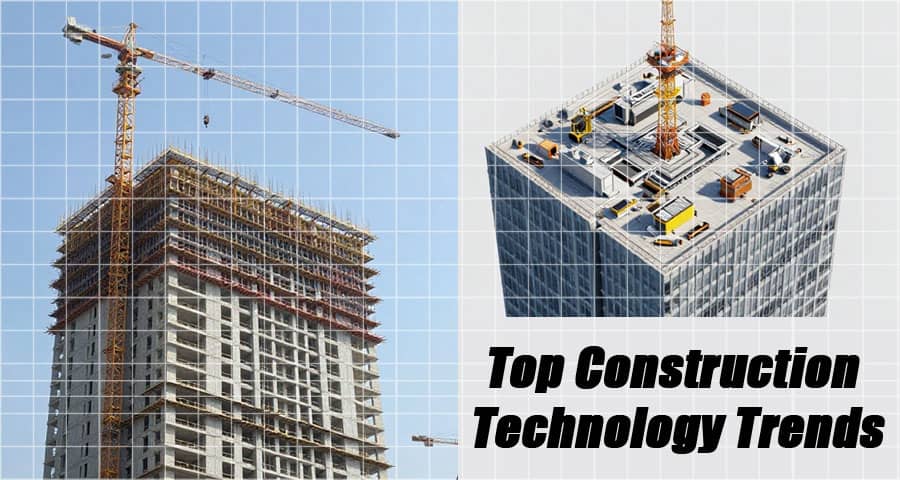
The construction industry is undergoing a major transformation driven by digital innovation, automation, artificial intelligence, sustainable building practices, and advanced engineering technologies. Traditional construction methods are increasingly being combined with intelligent software, connected equipment, digital modeling, and data-driven project management to improve productivity, reduce costs, enhance safety, and deliver higher-quality buildings and infrastructure.
As construction projects become more complex, contractors, architects, civil engineers, structural designers, quantity surveyors, and project managers are adopting new technologies to address challenges such as labor shortages, material price fluctuations, project delays, waste generation, and increasingly demanding sustainability requirements.
Understanding the top construction technology trends helps construction professionals make informed decisions about investments, project planning, workforce development, and long-term business growth. From Building Information Modeling (BIM) and digital twins to robotics, 3D printing, artificial intelligence, and green construction, modern technologies are reshaping how we design, estimate, construct, monitor, and maintain the built environment.
In this comprehensive guide, we explore the most important construction technology trends, explain their practical applications, and examine how they are influencing the future of the construction industry.
1. Building Information Modeling (BIM)
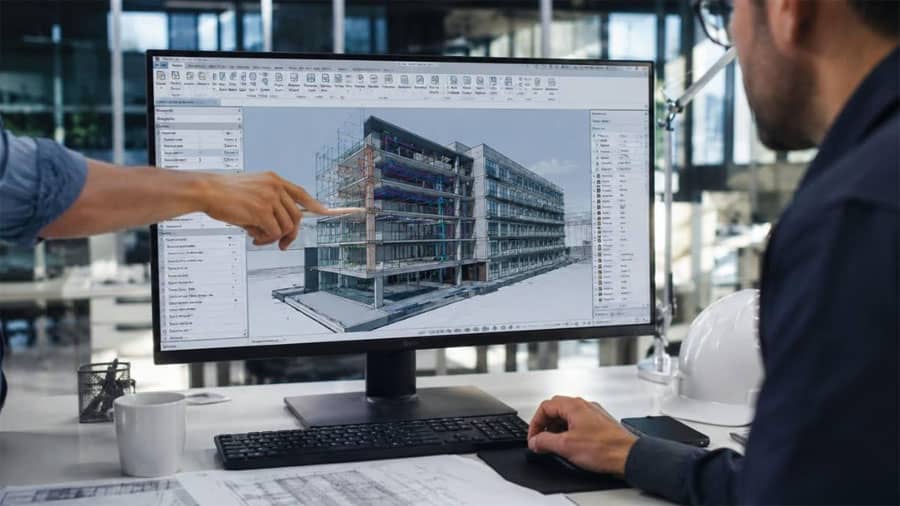
Building Information Modeling (BIM) is one of the most influential technologies in modern construction. It involves creating and managing a coordinated digital representation of a building or infrastructure project throughout its lifecycle.
Unlike conventional two-dimensional drawings, BIM models contain geometric information alongside relevant data about materials, components, quantities, structural systems, building services, and construction specifications. This information helps project teams coordinate their work before construction begins.
How BIM Improves Construction Projects
BIM enables architects, civil engineers, structural engineers, MEP consultants, contractors, and project managers to work with a shared digital model. By coordinating design information, teams can identify potential conflicts before they become expensive site problems.
For example, a BIM model can reveal a clash between an HVAC duct and a structural beam. Resolving this conflict during the design stage is generally easier and less expensive than modifying installed components on-site.
The technology also supports:
- 3D visualization: Understand building geometry and design intent before construction.
- Clash detection: Identify conflicts between architectural, structural, and MEP systems.
- Quantity takeoff: Extract material quantities from appropriately configured models.
- 4D BIM: Link model elements to construction schedules.
- 5D BIM: Connect model quantities with cost estimates and budget information.
- Facility management: Maintain useful asset information after project completion.
Applications of BIM in Construction
BIM is widely used in residential buildings, commercial complexes, hospitals, industrial facilities, bridges, airports, and infrastructure projects. It is particularly valuable for projects involving multiple disciplines, complicated building services, or extensive coordination requirements.
Construction companies can integrate BIM with scheduling, estimating, procurement, and project management systems to create a more connected workflow.
Popular BIM platforms include Autodesk Revit, Navisworks, ArchiCAD, and Tekla Structures.
Why this trend matters: BIM improves design coordination, supports more reliable quantity estimation, and helps project teams make informed decisions before committing resources to construction.
2. Artificial Intelligence and Machine Learning in Construction
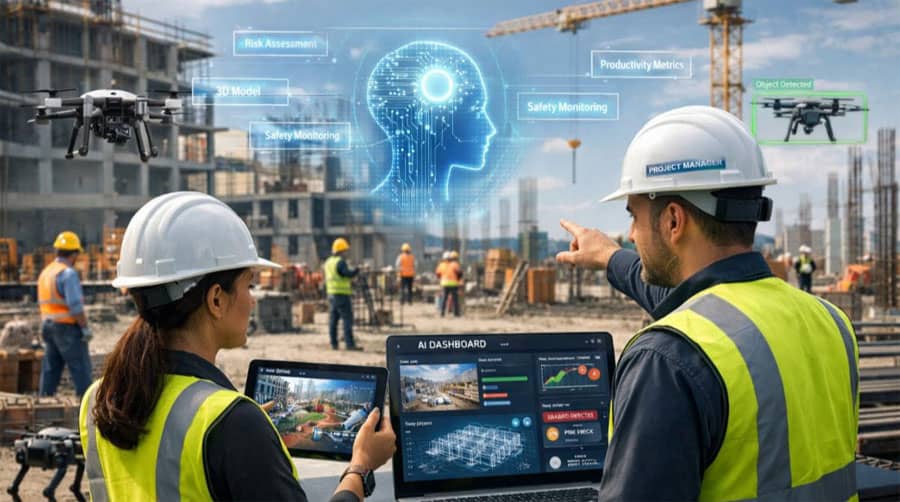
Artificial intelligence (AI) and machine learning (ML) are becoming increasingly important in construction planning, project monitoring, cost control, safety management, and quality assurance.
AI systems can analyze large amounts of project information, identify patterns, generate predictions, and support decisions that would otherwise require extensive manual analysis.
Machine learning models can be trained on historical project data, including schedules, budgets, labor productivity, weather conditions, material consumption, and change orders. When the data is reliable and relevant, these systems can help teams identify risks earlier.
Key Applications of AI in Construction
1. Project schedule prediction
AI tools can analyze project progress, resource availability, dependencies, and historical performance to identify activities that may fall behind schedule.
2. Cost estimation and budget forecasting
AI-assisted estimating systems can process quantities, historical rates, supplier information, and project parameters to support cost planning. Estimates still require professional validation, particularly when market prices and site conditions change.
3. Automated design assistance
AI can evaluate multiple design alternatives against constraints such as structural requirements, spatial layouts, energy performance, and material consumption.
4. Construction site safety
Computer vision systems can analyze camera feeds to identify potential hazards, detect missing personal protective equipment, and flag unsafe conditions for review.
5. Quality inspection
AI-based image analysis can assist in identifying visible defects, incomplete work, surface irregularities, and deviations from expected conditions.
AI in Quantity Surveying and Construction Estimation
Quantity surveyors and estimators can use AI-assisted tools to speed up document processing, organize specifications, compare project information, and identify inconsistencies in estimates.
For instance, an estimator working on a reinforced concrete building may combine digital drawings, BIM quantities, historical productivity rates, and material prices to prepare a preliminary cost forecast more efficiently.
However, AI-generated quantities and calculations should be checked against approved drawings, measurement rules, technical specifications, and applicable construction standards.
Why this trend matters: AI can reduce repetitive administrative work, strengthen forecasting, and help construction professionals focus on complex engineering decisions and project risk management.
3. Digital Twins in Construction
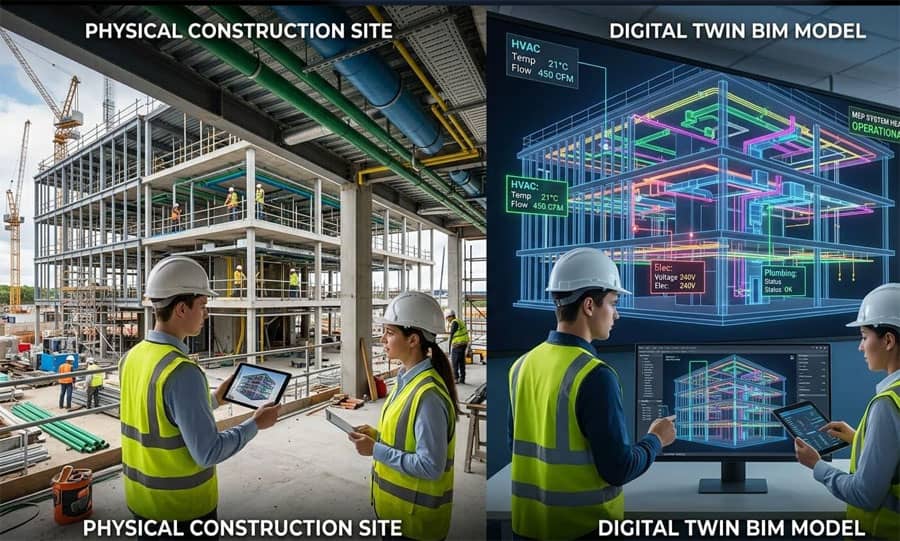
A digital twin is a digital representation of a physical building, infrastructure asset, or construction process that can be updated using information from sensors, monitoring systems, inspections, and other data sources. Depending on its design, a digital twin can help teams understand current conditions, analyze performance, and predict potential problems.
Unlike a static 3D model, a digital twin may incorporate continuously updated operational information. This makes it useful not only during construction but also throughout the operational life of a facility.
How Digital Twins Work
Digital twins combine several technologies, including BIM, the Internet of Things (IoT), cloud computing, data analytics, and sensor networks.
For example, a digital twin of a commercial building may combine its BIM model with information about indoor temperature, energy consumption, equipment performance, occupancy, and maintenance history. Facility managers can use this information to understand how the building operates and identify opportunities for improvement.
In infrastructure projects, digital twins can support the monitoring of bridges, tunnels, railways, water treatment plants, and industrial facilities.
Benefits of Digital Twins in Construction
- Real-time monitoring: Review available sensor data and site conditions.
- Predictive maintenance: Identify patterns that may indicate equipment deterioration or potential failures.
- Performance optimization: Analyze energy use and operational efficiency.
- Lifecycle management: Maintain a more complete digital record of assets.
- Risk reduction: Evaluate potential operational problems before implementing changes.
Digital twins are particularly useful for complex assets where maintenance costs, operational reliability, and long-term performance are important considerations.
However, their effectiveness depends on data quality, model accuracy, sensor coverage, and regular updates. A digital twin should not be assumed to represent real-time conditions unless the necessary connections and update processes are in place.
4. Construction Robotics and Automation
Construction robotics is changing how repetitive, physically demanding, and precision-sensitive tasks are performed on construction sites. Robots and automated equipment can support activities such as bricklaying, concrete finishing, demolition, welding, material handling, and surveying.
The primary objective is not necessarily to eliminate human involvement. Instead, automation can help construction companies improve consistency, reduce exposure to hazardous tasks, and address productivity challenges.
Types of Construction Robots
Bricklaying robots: Automated systems can position bricks and apply mortar according to programmed layouts, subject to site preparation and equipment limitations.
Demolition robots: Remote-controlled machines can perform demolition in confined, hazardous, or difficult-to-access environments.
Concrete printing and finishing robots: Specialized systems can automate selected concrete placement, finishing, or fabrication processes.
Autonomous construction equipment: Some machines can perform defined earthmoving or material-handling tasks using sensors, positioning systems, and onboard control software.
Robotic inspection systems: Robots, drones, and remotely operated devices can inspect areas that are difficult or dangerous for workers to reach.
Advantages of Construction Automation
Robotic systems can improve repeatability, support faster execution of suitable tasks, and reduce workers' exposure to certain hazards. They may also help construction companies maintain production during labor shortages.
Nevertheless, successful implementation requires trained operators, suitable site conditions, equipment maintenance, safety planning, and a clear understanding of where automation provides measurable value.
Construction robotics is likely to be most effective when integrated with digital planning, standardized workflows, and skilled human supervision.
5. 3D Printing in Construction
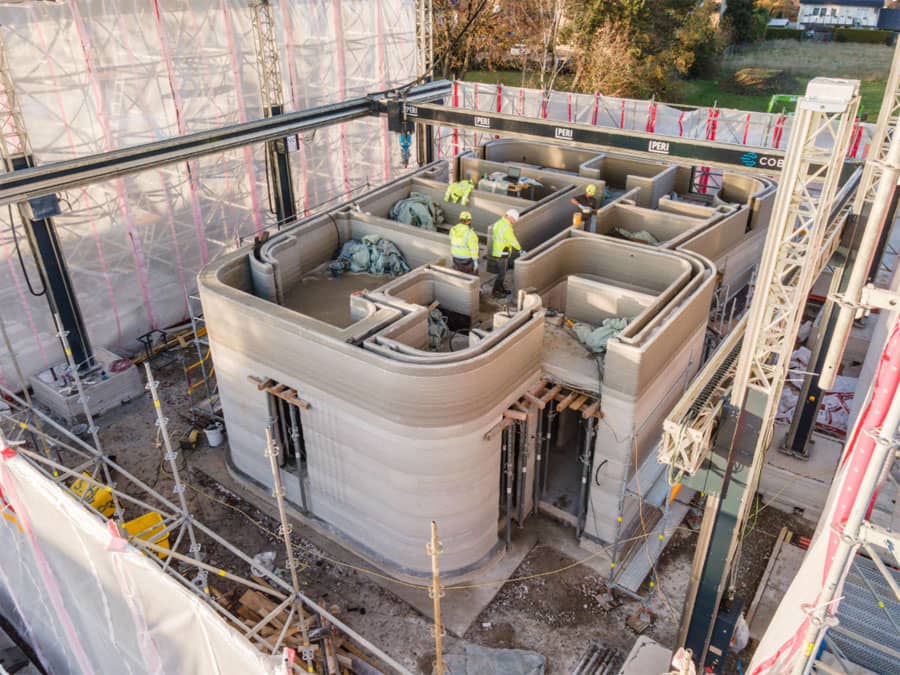
3D printing in construction, also known as additive construction, uses computer-controlled equipment to deposit material in successive layers according to a digital design.
Depending on the technology, the process may use specialized cementitious mixtures, concrete-like materials, polymers, or prefabricated components. Large-scale concrete printing has attracted attention because it can create selected wall systems and geometries without conventional formwork for every printed section.
How 3D Construction Printing Works
The process typically begins with a digital model that is converted into machine instructions. The printer then deposits material along predefined paths to create the intended geometry.
The process involves several important stages:
- Digital design: Develop the building geometry and define printable components.
- Model preparation: Convert the design into suitable printing paths and machine instructions.
- Material selection: Specify a mix that meets workability, pumpability, buildability, and performance requirements.
- Automated printing: Deposit material in controlled layers.
- Inspection and curing: Verify dimensional accuracy, material performance, and curing conditions.
- Integration: Install reinforcement where required, along with services, roofing, doors, windows, and other building elements.
Benefits and Limitations of 3D Printing
Construction printing can reduce certain formwork requirements, enable complex geometries, and automate portions of the building process. It may also reduce material waste in appropriately designed applications.
However, 3D-printed construction is not automatically faster, cheaper, or more sustainable than conventional construction. Costs depend on equipment, material formulation, transport, labor, project scale, finishing requirements, and local regulations.
Structural reinforcement, connections, fire resistance, durability, weatherproofing, and building-code compliance must be addressed through appropriate engineering and testing.
The technology is especially promising for selected housing applications, architectural components, prototypes, and projects where geometric flexibility and repeatability provide a practical advantage.
6. Internet of Things (IoT) and Smart Construction Sites
The Internet of Things (IoT) connects physical devices, sensors, machinery, and monitoring systems so that they can collect and exchange data. In construction, IoT technology helps project teams understand equipment utilization, environmental conditions, material movement, and selected aspects of site safety.
IoT devices can be installed on machinery, temporary structures, storage areas, building components, and environmental monitoring equipment.
Applications of IoT in Construction
Equipment tracking: GPS-enabled devices can help companies locate machinery, track utilization, and improve equipment allocation.
Environmental monitoring: Sensors can measure temperature, humidity, dust levels, noise, and other site conditions.
Concrete monitoring: Embedded sensors can provide information about concrete temperature and maturity to support decisions about curing and construction sequencing.
Worker safety: Wearable devices can support location monitoring, proximity alerts, and selected environmental hazard warnings.
Material management: Connected tracking systems can help teams monitor deliveries, storage conditions, and material movement.
IoT and Construction Productivity
When IoT data is integrated into a project dashboard, managers can identify idle equipment, investigate delays, and improve resource allocation. Connected sensors can also help establish a more detailed record of site conditions.
For example, temperature monitoring during concrete curing can help engineers understand how the concrete has developed under actual environmental conditions. Any decision about formwork removal or loading must still follow the applicable specifications and engineering requirements.
To gain meaningful benefits, companies should prioritize reliable connectivity, sensor calibration, cybersecurity, data ownership, and compatibility with existing systems.
7. Drones and Aerial Surveying Technology
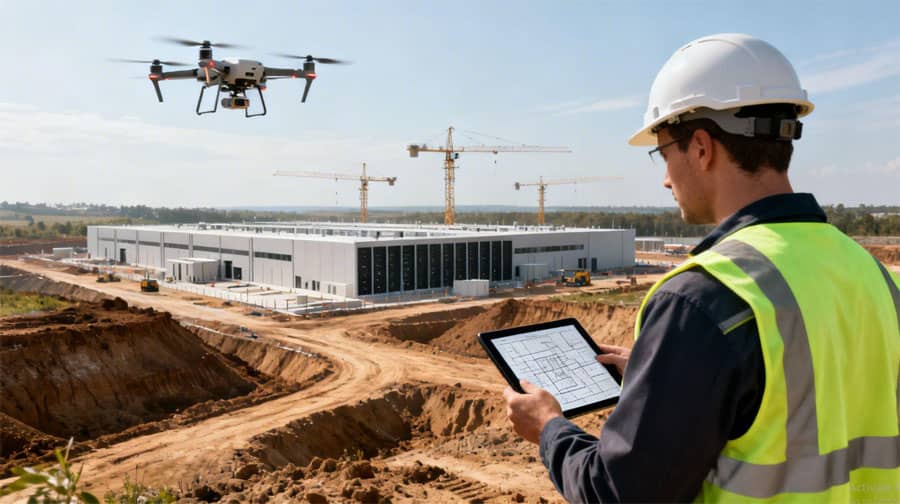
Drones, also known as unmanned aerial vehicles (UAVs), are widely used for construction surveying, aerial photography, site inspection, and progress monitoring.
When equipped with suitable cameras, positioning systems, or other sensors, drones can capture information that would be difficult or time-consuming to collect using conventional ground-based methods.
Major Uses of Drones in Construction
- Topographic surveying: Capture aerial data to support terrain mapping and site planning.
- Progress monitoring: Compare site images captured at different stages of construction.
- Stockpile measurement: Estimate the volume of soil, aggregates, and other materials using suitable survey methods.
- Roof inspections: Examine large or difficult-to-access roof areas.
- Earthwork analysis: Support cut-and-fill calculations using appropriately processed terrain models.
- Safety inspections: Inspect selected structures and site areas without requiring personnel to enter every location.
Photogrammetry and Construction Mapping
Photogrammetry converts overlapping photographs into spatial information, such as orthomosaic maps, point clouds, and three-dimensional surface models.
Construction teams can use these outputs to compare existing site conditions with design information and identify potential discrepancies.
Drone-derived measurements are not automatically survey-grade. Accuracy depends on flight planning, camera characteristics, positioning methods, ground control, processing settings, and site conditions.
Operators must also comply with applicable aviation rules, airspace restrictions, privacy requirements, and site safety procedures.
8. Augmented Reality (AR) and Virtual Reality (VR)
Augmented Reality (AR) and Virtual Reality (VR) are improving how construction professionals visualize designs, coordinate activities, and communicate project information.
VR creates an immersive digital environment, allowing users to explore a building or infrastructure model before it is constructed. AR overlays digital information onto a view of the real environment, helping users compare design intent with physical site conditions.
Applications of VR in Construction
Virtual reality allows architects, clients, and engineers to experience proposed layouts at a human scale. Users can examine room arrangements, circulation routes, equipment placement, and spatial relationships before construction begins.
VR is also useful for training workers in simulated environments, especially when practicing procedures that would be expensive or hazardous to reproduce in real life.
Applications of AR in Construction
AR can display digital drawings, installation instructions, model components, or other project information over a real-world view.
For example, an engineer may use an AR-enabled device to compare a planned service route with the actual installation area. This can support communication and inspection, although the accuracy of the overlay depends on registration, tracking, and the quality of the underlying model.
Benefits of AR and VR
- Improved design visualization and client communication.
- Better understanding of complex spatial relationships.
- Support for coordination meetings and design reviews.
- More engaging training experiences.
- Potentially earlier identification of installation discrepancies.
These technologies are most useful when they are connected to reliable project information and incorporated into established inspection and approval processes.
9. Cloud Computing and Construction Project Management Software
Cloud computing enables construction teams to access project documents, schedules, drawings, reports, and other information through internet-connected platforms. It reduces dependence on isolated files and makes it easier for distributed teams to collaborate.
In traditional workflows, project information may be stored across individual computers, email attachments, local servers, and printed documents. This can lead to outdated drawings, duplicated records, and communication gaps.
Cloud-based construction management systems help centralize project information and provide controlled access to authorized users.
Key Features of Cloud-Based Construction Software
Document management: Store, organize, share, and revise project drawings, specifications, and reports.
Real-time collaboration: Allow authorized team members to review project information from different locations.
Schedule management: Track milestones, activities, dependencies, and progress updates.
Cost control: Monitor budgets, commitments, variations, and project expenditure.
Issue tracking: Record site observations, assign responsibilities, and monitor corrective actions.
Mobile access: Allow engineers and supervisors to access approved information from compatible mobile devices.
Platforms such as Autodesk Construction Cloud and Procore provide tools for managing construction information and coordinating project activities.
Why Cloud Computing Matters
Cloud technology improves information accessibility and can reduce delays caused by fragmented communication. When combined with BIM, digital signatures, automated workflows, and mobile inspections, it can support a more connected construction process.
However, companies should establish appropriate access permissions, backup procedures, cybersecurity controls, version management, and data-retention policies. Cloud storage alone does not guarantee that project information is accurate or secure.
10. Sustainable Construction and Green Building Technology
Sustainability has become a major consideration in construction because buildings and infrastructure consume resources throughout their construction, operation, maintenance, and eventual demolition.
Green construction technology focuses on reducing environmental impacts while maintaining structural safety, occupant comfort, durability, and economic performance.
It includes energy-efficient building systems, lower-impact materials, renewable energy integration, water conservation, waste reduction, and lifecycle assessment.
Major Sustainable Construction Trends
Low-carbon concrete: Alternative binders, supplementary cementitious materials, and optimized concrete mixtures can reduce emissions in suitable applications.
Recycled construction materials: Reclaimed steel, recycled aggregates, reused building components, and other recovered materials can reduce demand for virgin resources when they meet relevant specifications.
Energy-efficient building envelopes: Better insulation, suitable glazing, airtightness, and solar shading can reduce heating and cooling demand.
Renewable energy systems: Solar photovoltaic panels and other suitable renewable technologies can help meet building energy requirements.
Water-efficient systems: Rainwater harvesting, efficient fixtures, and greywater reuse can reduce demand for potable water where regulations permit.
Construction waste management: Material planning, prefabrication, selective demolition, and recycling can reduce waste sent to landfills.
Lifecycle Assessment in Construction
Lifecycle assessment (LCA) evaluates environmental impacts across defined stages of a product or building's life. Depending on the study boundaries, this may include raw material extraction, manufacturing, transport, construction, operation, maintenance, and end-of-life treatment.
This approach helps construction professionals compare alternatives beyond their initial purchase price.
For example, a material with a lower upfront cost may require more frequent maintenance or have a higher environmental impact over its service life. Lifecycle analysis provides a structured method for evaluating these trade-offs.
The future of sustainable construction depends on combining environmental performance with engineering quality, cost control, and long-term durability.
11. Prefabrication and Modular Construction
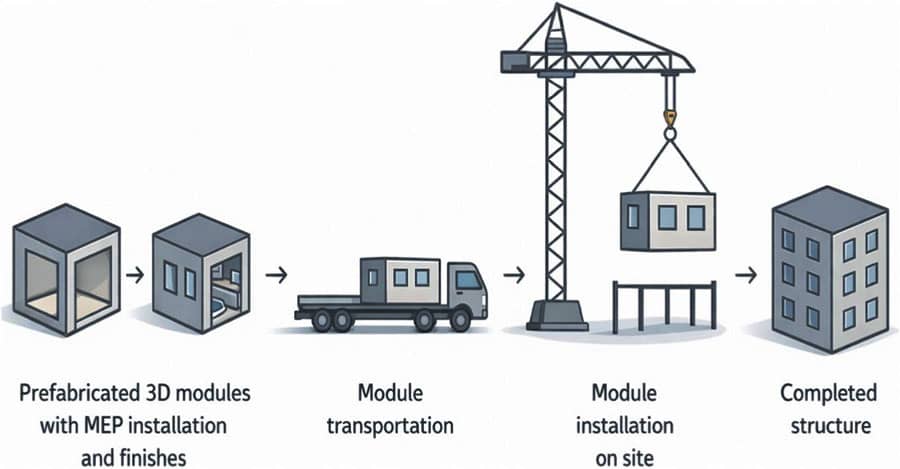
Prefabrication and modular construction involve manufacturing building components or complete modules in a controlled facility before transporting them to the construction site for installation.
Prefabricated elements may include wall panels, floor systems, reinforcement cages, bathroom pods, façade units, structural steel components, and mechanical or electrical assemblies.
Modular construction takes this concept further by using larger, coordinated building sections that can be joined together on-site.
How Prefabrication Improves Construction Efficiency
Factory-based production allows certain activities to proceed while site preparation and foundation work take place. This can reduce the amount of work that must be completed sequentially at the construction site.
Controlled manufacturing conditions may also improve repeatability and quality inspection, particularly for standardized components.
Important advantages include:
- Faster project delivery: Overlap manufacturing with suitable site activities.
- Reduced material waste: Use standardized cutting, production, and inventory processes.
- Improved quality control: Inspect components under controlled manufacturing conditions.
- Better site organization: Reduce selected on-site fabrication activities.
- Enhanced worker safety: Move appropriate tasks away from congested construction areas.
- Consistent production: Repeat standardized components across multiple projects.
Challenges of Modular Construction
Prefabrication requires careful coordination between architectural design, structural engineering, transportation, lifting operations, and installation sequencing.
Design changes made after manufacturing begins can be expensive. Transportation dimensions, crane capacity, connection detailing, fire resistance, acoustic performance, and service integration must also be considered.
BIM is especially valuable because it helps coordinate component dimensions, installation tolerances, connection details, and building services before production.
Modular construction is particularly suitable for projects with repeatable layouts, including hotels, student accommodation, healthcare facilities, worker housing, and selected residential developments.
12. Advanced Construction Materials and Smart Materials
Materials science is introducing new options for improving structural performance, durability, energy efficiency, and resource utilization.
Traditional materials such as concrete, steel, timber, and masonry remain fundamental to construction, but their composition and application continue to evolve.
High-Performance Concrete
High-performance concrete is designed to achieve specific properties, such as improved strength, durability, workability, or resistance to environmental exposure.
Its performance depends on mix design, material quality, placement, curing, and quality control. Higher compressive strength alone does not guarantee better performance for every application.
Self-Healing Concrete
Self-healing concrete refers to concrete systems designed to seal certain cracks through mechanisms such as continued hydration, mineral precipitation, or specialized biological or chemical processes.
The effectiveness of these systems depends on crack characteristics, exposure conditions, and the specific technology used. Self-healing concrete should not be treated as a universal substitute for proper structural design, crack control, or maintenance.
Engineered Timber
Products such as cross-laminated timber and glued laminated timber enable timber to be used in a wider range of structural applications.
Engineered timber can support prefabrication and reduce construction time in suitable projects. Its performance must be evaluated for fire resistance, moisture exposure, connections, vibration, durability, and local building requirements.
Recycled and Alternative Materials
Recycled steel, reclaimed timber, recycled aggregates, and selected industrial by-products can contribute to resource efficiency when their properties are verified.
Material substitution must consider structural requirements, chemical compatibility, durability, availability, and compliance with applicable standards.
Smart Materials
Smart materials respond to changes in their environment or provide information about their condition. Examples include certain shape-memory alloys, phase-change materials, and specialized sensing materials.
Potential applications include thermal regulation, selected structural monitoring systems, and adaptive building components.
These technologies can improve building performance, but adoption depends on technical validation, availability, lifecycle costs, and suitability for the intended environment.
13. Internet-Connected Wearables and Construction Safety Technology
Worker safety remains a fundamental priority in construction. Connected wearables and digital safety systems can supplement established safety procedures by providing additional information about site conditions and potential hazards.
Wearable technologies may include smart helmets, connected safety vests, location tags, environmental sensors, and devices capable of detecting selected movement patterns.
How Wearable Technology Supports Site Safety
Proximity alerts: Notify workers or equipment operators when they approach designated danger zones or moving machinery.
Environmental monitoring: Help identify exposure to certain environmental hazards when equipped with suitable sensors.
Location awareness: Support emergency response and personnel accountability in appropriately configured environments.
Fatigue-related monitoring: Certain systems may identify patterns that warrant review, although they cannot reliably diagnose fatigue or guarantee that a worker is fit for duty.
Emergency alerts: Enable workers to signal for assistance under defined conditions.
Integrating Safety Technology with Site Management
Construction companies can combine digital inspections, incident reporting, access controls, equipment monitoring, and worker training records to improve safety management.
Technology should support a comprehensive safety program rather than replace competent supervision, hazard assessments, safe work procedures, and appropriate personal protective equipment.
Organizations must also address worker privacy, informed consent where applicable, data access, and the appropriate use of monitoring information.
The most effective safety systems combine technology with a strong workplace safety culture and clear accountability.
14. Geographic Information Systems (GIS) and Advanced Surveying
Geographic Information Systems (GIS) help construction professionals collect, manage, analyze, and visualize geographically referenced information.
GIS is especially valuable for infrastructure projects where terrain, land ownership, transportation networks, utilities, environmental constraints, and existing development influence project decisions.
Applications of GIS in Construction
Site selection: Compare locations using terrain, accessibility, land-use, and environmental information.
Infrastructure planning: Analyze transportation corridors, utility networks, drainage systems, and regional development.
Land surveying: Combine suitable survey data with geographic reference systems.
Environmental assessment: Map sensitive habitats, flood-prone areas, and other environmental constraints.
Asset management: Maintain geographic records of roads, pipelines, utility networks, and public infrastructure.
GIS can also be combined with drone photogrammetry, LiDAR, BIM, and digital twins to improve spatial coordination.
LiDAR Technology in Construction
Light Detection and Ranging (LiDAR) uses laser measurements to capture three-dimensional information about surfaces and objects. Depending on the system, it can produce dense point clouds representing terrain, buildings, vegetation, and infrastructure.
LiDAR data can support topographic surveys, existing-condition documentation, structural inspections, and the creation of as-built models.
When integrated with BIM, GIS, and other design information, LiDAR-derived point clouds can help teams compare existing conditions with proposed designs.
Accuracy depends on equipment specifications, calibration, positioning, scanning geometry, surface characteristics, and data-processing methods.
15. Computer Vision and Automated Construction Quality Control
Computer vision enables software to interpret images and video to identify objects, patterns, and selected visual conditions.
In construction, computer vision can support progress tracking, defect identification, safety monitoring, and comparison between site conditions and digital project information.
How Computer Vision Works
A computer vision system processes images captured by cameras, drones, mobile devices, or other imaging equipment. Depending on the application, it may identify construction components, classify visible conditions, measure selected dimensions, or compare observed progress with a reference model.
For example, an image-analysis system may help identify whether particular installation activities appear complete. Project personnel can then verify the results against approved inspection criteria.
Applications in Quality Assurance
- Detecting visible surface defects in concrete and other materials.
- Reviewing installed components against reference images.
- Monitoring progress across repeated site visits.
- Identifying selected deviations from expected construction conditions.
- Organizing photographic records for inspections and reporting.
Computer vision can reduce manual review time, but image quality, lighting, occlusion, model limitations, and site conditions can affect results. Structural defects and safety-critical conditions require appropriate professional inspection and verification.
16. Construction Data Analytics and Predictive Project Management
Modern construction projects generate large volumes of information through estimates, schedules, site reports, procurement systems, inspections, equipment records, and financial transactions.
Construction data analytics converts this information into useful insights that support planning, monitoring, and continuous improvement.
Key Uses of Construction Analytics
Productivity analysis: Compare planned and actual labor hours, equipment utilization, and completed quantities.
Schedule performance: Monitor milestones, identify recurring delays, and investigate critical dependencies.
Cost forecasting: Compare actual expenditure and commitments against approved budgets.
Procurement optimization: Monitor delivery times, supplier performance, inventory levels, and material requirements.
Risk analysis: Identify recurring issues, evaluate possible scenarios, and prioritize management attention.
For example, a contractor may analyze historical productivity data for concrete placement across multiple projects. The results can help establish more realistic production assumptions for future estimates, provided differences in crew size, site access, equipment, concrete supply, and working conditions are considered.
Predictive analytics does not eliminate uncertainty. Its reliability depends on complete records, appropriate assumptions, consistent definitions, and regular validation against actual project performance.
17. Blockchain Technology in Construction
Blockchain is a distributed digital record system that can help maintain traceable records of transactions, approvals, and information exchanges among multiple parties.
Construction projects involve owners, contractors, subcontractors, suppliers, consultants, and regulatory authorities. Coordinating documentation and commercial transactions across these stakeholders can be challenging, especially when project records are fragmented.
Blockchain-based systems may provide additional transparency for specific workflows when properly designed and adopted by the participating organizations.
Potential Applications of Blockchain
- Supply chain traceability: Maintain records of material origin, certification, and movement.
- Contract administration: Support controlled records of contractual milestones and approvals.
- Payment processes: Facilitate certain automated payment arrangements through smart contracts.
- Document verification: Help establish whether recorded information has changed after it was entered into the system.
- Project accountability: Maintain traceable transaction histories across participating organizations.
Smart contracts are programs that execute predefined actions when specified conditions are met. For example, a system could initiate a payment workflow after an authorized party records acceptance of a defined milestone.
However, blockchain does not independently verify whether a physical construction activity has been completed correctly. The reliability of the record still depends on the information entered, verification procedures, contractual arrangements, and system governance.
Blockchain is therefore a specialized construction technology rather than a universal solution for project management.
18. Green Building Certifications and Smart Energy Management
The construction industry is increasingly using digital energy management systems to improve building performance and support sustainability objectives.
Modern buildings can incorporate connected meters, automated lighting, smart thermostats, occupancy sensors, energy monitoring platforms, and building management systems.
These technologies allow building operators to examine energy consumption patterns and adjust building operations according to actual requirements.
Smart Building Technology Applications
Intelligent lighting: Automatically adjust lighting based on occupancy, daylight availability, or predefined operating schedules.
HVAC optimization: Monitor indoor conditions and control heating, ventilation, and air conditioning systems according to building requirements.
Energy monitoring: Track electricity consumption across equipment, floors, or designated building systems.
Water management: Monitor water use and identify abnormal consumption patterns where suitable metering is available.
Renewable energy integration: Coordinate solar generation, energy storage, and building loads where the necessary systems are installed.
Role of Green Building Standards
Green building certification frameworks provide structured approaches to evaluating building performance and sustainability. Examples include LEED and IGBC certification programs.
Depending on the applicable rating system, assessments may consider energy efficiency, water conservation, material selection, indoor environmental quality, and site sustainability.
Digital monitoring can support the collection of relevant performance information, but certification requires compliance with the specific framework and its documentation requirements.
19. 4D and 5D BIM for Construction Scheduling and Cost Management
The development of BIM has created opportunities to integrate design information with construction schedules and cost data.
4D BIM links three-dimensional model elements with time-based scheduling information. 5D BIM adds cost-related information to support budgeting, estimating, and financial planning.
These methods help project teams understand the relationship between design, construction sequencing, quantities, and expenditure.
How 4D BIM Supports Project Scheduling
A 4D model can visually represent how a building or infrastructure project is expected to develop over time.
Project managers can use this visualization to review construction sequences, identify logistical conflicts, coordinate subcontractors, and communicate milestones.
For example, a construction sequence can show foundation work, structural framing, façade installation, and interior finishing as linked activities within the project schedule.
How 5D BIM Supports Cost Estimation
A 5D workflow connects model quantities with rates, resource costs, and other estimating information.
This enables project teams to investigate the financial effects of selected design changes and compare alternative construction approaches.
Potential benefits include:
- Faster preparation of model-based quantity takeoffs.
- Improved coordination between design and estimating teams.
- More transparent budget updates.
- Better visualization of cost changes.
- Improved communication between contractors and clients.
However, a model-based estimate is only as reliable as its geometry, classification, measurement rules, rate database, and scope assumptions. Model quantities must be reconciled with project specifications and the applicable method of measurement.
20. Digital Fabrication and Computer Numerical Control (CNC)
Digital fabrication uses computer-controlled machinery to manufacture components from digital design information. In construction, this includes CNC cutting, automated steel fabrication, robotic welding, panel production, and precision machining.
The technology connects engineering design with manufacturing and can reduce manual measurement and fabrication errors when workflows are correctly configured.
Applications of Digital Fabrication
Structural steel fabrication: CNC machinery can cut, drill, and process steel components according to approved fabrication data.
Reinforcement processing: Automated equipment can cut and bend reinforcement bars to specified shapes and dimensions.
Timber fabrication: CNC systems can produce accurately shaped timber components and connection details.
Façade manufacturing: Digital production can support complex panel geometries and coordinated building envelopes.
Prefabricated assemblies: Digital models can provide manufacturing information for selected building components and modules.
Digital fabrication is particularly valuable when projects require repeatable components, precise connections, or close coordination between design and manufacturing.
Successful implementation depends on accurate fabrication drawings, approved revisions, material traceability, quality inspections, and coordination between engineering and production teams.
Challenges of Adopting New Construction Technologies
Although modern construction technologies offer significant opportunities, their implementation requires careful planning. Purchasing software or equipment alone does not guarantee improved productivity.
Construction companies must consider several practical challenges before introducing new systems.
1. Initial Investment and Operating Costs
Advanced equipment, software subscriptions, sensors, cloud services, and staff training require investment.
Companies should evaluate the total cost of ownership, including maintenance, upgrades, integration, support, and eventual replacement.
A pilot project can help determine whether a technology delivers sufficient operational or financial benefits before wider adoption.
2. Skills Gaps and Workforce Training
New construction workflows often require digital modeling, data analysis, equipment operation, and information management skills.
Organizations should provide role-specific training and establish clear procedures so that employees understand how to use the technology effectively.
3. Data Integration and Compatibility
Construction companies may use multiple systems for BIM, accounting, estimating, scheduling, procurement, and site reporting.
If these systems cannot exchange information reliably, teams may still need manual data entry, duplicate records, or time-consuming reconciliation.
Interoperability and consistent data standards should therefore be considered during technology selection.
4. Cybersecurity and Information Governance
Connected construction systems may contain sensitive commercial information, project drawings, financial records, and operational data.
Companies should implement appropriate access controls, authentication, backups, software updates, and data-sharing policies.
5. Resistance to Change
Employees may be reluctant to adopt new processes when existing methods are familiar or when the benefits are unclear.
Successful implementation requires management support, practical training, clear communication, and measurable objectives.
6. Return on Investment
Construction technology should be evaluated against specific project needs rather than general claims about innovation.
Useful performance measures include reductions in rework, improved schedule reliability, estimating time saved, equipment utilization, safety performance, and material waste.
A technology that works well for one contractor or project type may not provide the same value in another environment.
How to Choose the Right Construction Technology for Your Business
The most effective construction technology strategy begins with identifying operational problems and selecting tools that address them.
Rather than adopting every new development, companies should prioritize technologies that align with their project types, workforce capabilities, budgets, and long-term objectives.
A practical evaluation process includes the following steps:
- Identify the problem: Determine whether the main challenge involves estimating accuracy, project delays, design coordination, safety, or material waste.
- Establish a baseline: Measure current performance before introducing a new system.
- Evaluate available solutions: Compare functionality, compatibility, implementation costs, and support.
- Run a pilot project: Test the technology on a suitable project or workflow.
- Train employees: Ensure that the people responsible for using the system understand its capabilities and limitations.
- Measure results: Compare actual performance with the baseline.
- Expand gradually: Scale successful solutions while continuing to monitor costs and outcomes.
For example, a contractor experiencing frequent coordination problems may benefit from BIM and cloud-based document management before investing in robotics or advanced artificial intelligence.
Similarly, a company that regularly undertakes earthworks may prioritize drone surveying, GIS, and digital quantity measurement.
The best investment is the technology that solves a clearly defined problem and produces measurable value.
The Future of Construction Technology
The future of construction will increasingly depend on the integration of digital design, automated production, connected equipment, sustainable materials, and data-driven project management.
BIM models will continue to support coordination between design and construction. Artificial intelligence will help professionals analyze project information, while digital twins and IoT systems will provide better visibility into selected physical conditions. Robotics and prefabrication will automate suitable tasks, and advanced surveying technologies will improve the collection of spatial information.
We can also expect greater emphasis on interoperability, lifecycle information management, energy efficiency, and measurable project performance.
However, technology will remain most valuable when combined with sound engineering principles, experienced professionals, reliable data, and effective project governance.
Construction is a complex physical process. Software can support decisions, sensors can collect information, and automated equipment can perform specific tasks, but successful project delivery still requires competent planning, quality assurance, safety management, and technical oversight.
Organizations that adopt technology strategically will be better positioned to improve their workflows, manage uncertainty, and respond to changing industry requirements.
Conclusion: Embracing the Top Construction Technology Trends
The top construction technology trends are reshaping how we plan, design, estimate, build, inspect, and maintain buildings and infrastructure.
Technologies such as BIM, artificial intelligence, digital twins, robotics, 3D printing, IoT, drones, AR and VR, cloud computing, sustainable materials, and modular construction offer practical ways to improve specific aspects of construction delivery.
Their benefits depend on appropriate implementation, skilled personnel, reliable information, and alignment with project objectives. No single technology can solve every construction challenge, but a coordinated digital strategy can help organizations improve productivity, reduce avoidable rework, strengthen quality control, and make more informed decisions.
As the industry evolves, construction professionals should focus on continuous learning, practical experimentation, and measurable improvements. By selecting the right technologies for the right applications, we can build more efficiently, manage resources responsibly, and create durable infrastructure for future generations.
The construction industry's digital transformation is not simply about adopting advanced tools. It is about using technology to make construction safer, smarter, more efficient, and more sustainable.